Artwork
The Crucifixion
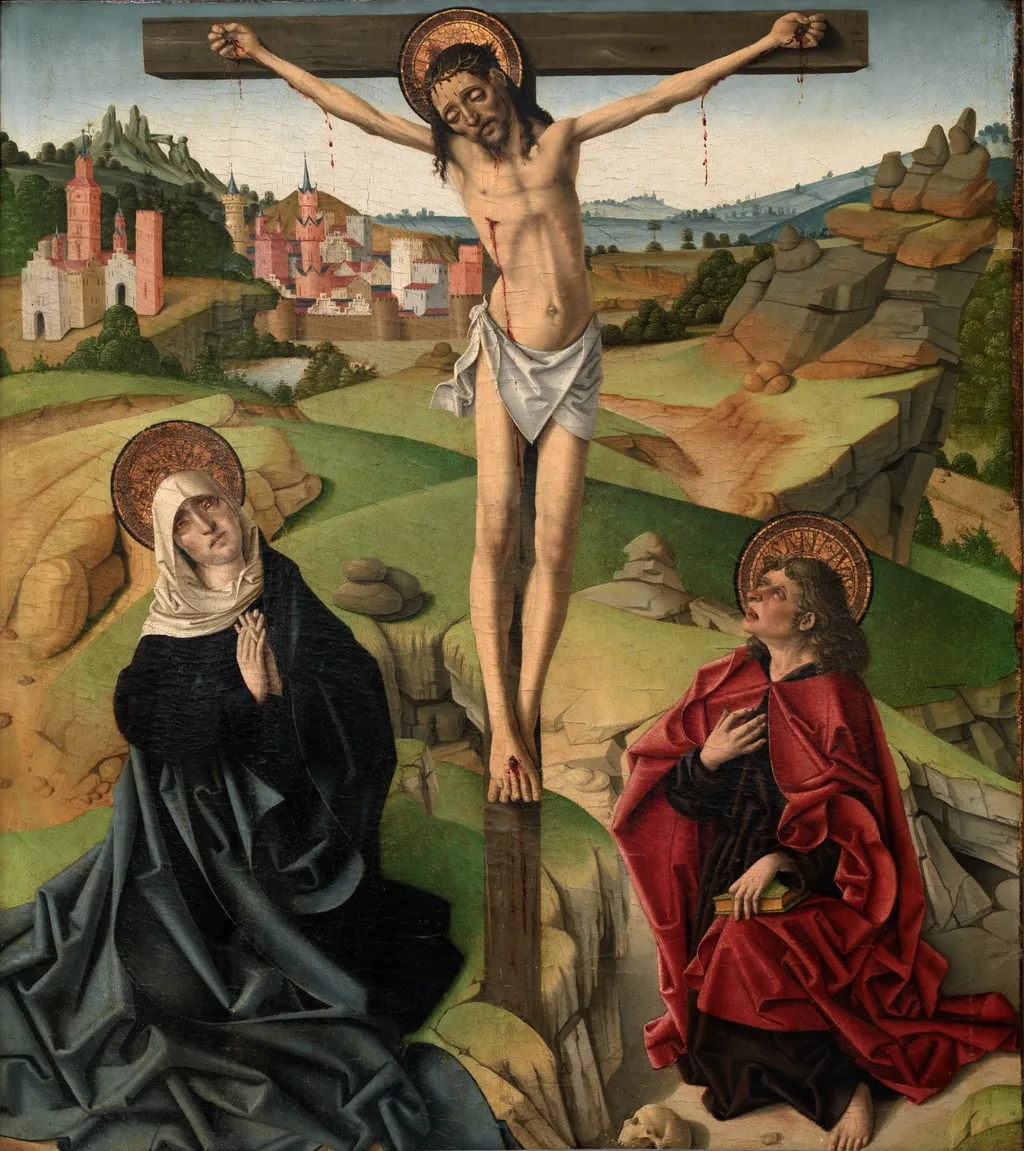
The Crucifixion is an unspecified painting by the Early Renaissance artist Master of Avila. It dates from 1496 and is held in the collection of the Museo del Prado.
About this work
Overview
Created in 1496, this panel portrays the crucifixion of Jesus Christ, positioned centrally on a rugged hill. Flanking the cross are two kneeling figures—one clothed in dark blue with a head covering, the other in vivid red, his hand resting on a book. A modest settlement rises behind them, set on a hilltop above a river and cultivated fields.
Subject & Meaning
The central figure represents the biblical narrative of Christ’s death, while the accompanying mourners are traditionally identified as John the Evangelist and the Virgin Mary. Their gestures—folded hands and the contemplative pose with a text—emphasize devotion and the theological significance of the Passion, inviting viewers to contemplate sacrifice and redemption.
Technique & Style
Executed in the early Renaissance, the work reflects a Flemish influence evident in its detailed landscape and careful modeling of flesh. The artist employs a restrained palette, contrasting the starkness of the cross with the rich reds and blues of the figures, and renders the surrounding terrain with a naturalistic attention to light and texture.
History & Provenance
Attributed to the anonymous Master of Ávila, an active painter in mid‑15th‑century Castile, the piece entered the collection of Madrid’s Museo del Prado, where it remains on display. The artist’s identity is unknown, though stylistic links tie him to the workshop of Fernando Gallego.
Context
The painting integrates a sacred event with a recognizable rural setting, a characteristic approach of the Master of Ávila who often merged devotional subjects with everyday scenery. This synthesis reflects contemporary devotional practices that sought to bring biblical stories into the familiar visual world of the viewer.
Own this work as a print
Artist & collection
Artist
The Master of Ávila is the name given to an anonymous painter who was active in Ávila and its surroundings in the middle of the 15th century.