Artwork
Female Musicians
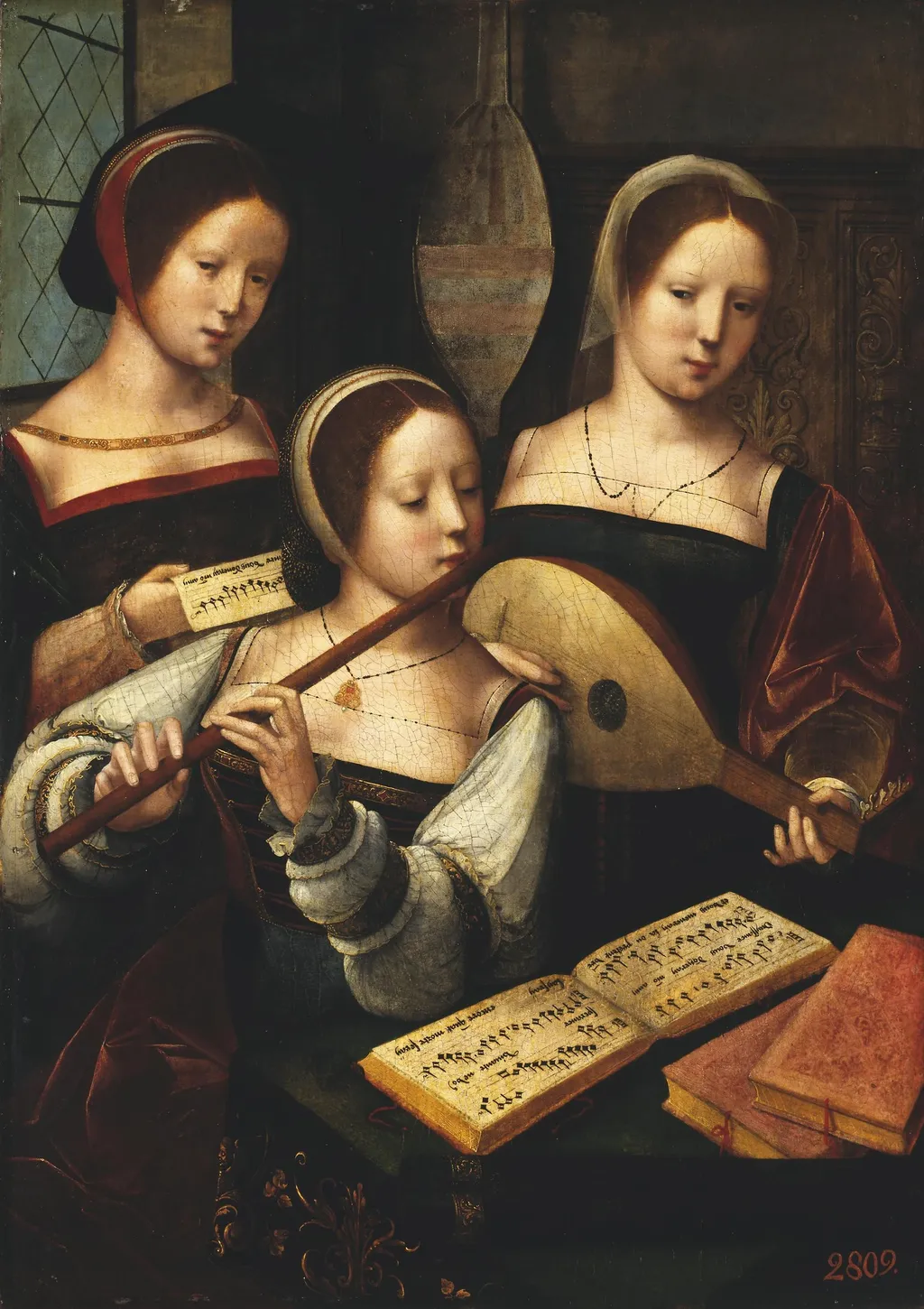
Female Musicians is an oil painting by the Mannerist artist Master of the Female Half-Lengths. It dates from 1530 and is held in the collection of the Hermitage Museum.
About this work
Overview
The work depicts three women in contemporary Renaissance dress engaged in a musical performance against a dark, neutral background.
Female Musicians, attributed to the Master of the Female Half-Lengths, is an oil painting executed circa 1530. The work depicts three women in contemporary Renaissance dress engaged in a musical performance against a dark, neutral background. The composition arranges the figures in a tight half-length format, focusing attention on their gestures and instruments. The figure on the left holds a sheet of music and appears to be singing, while the central figure plays a transverse flute. To the right, a third woman plays a lute, with a second music sheet resting on the table before her. This piece exemplifies the output of the anonymous Antwerp-based workshop active during the 1530s, known for producing standardized, mass-produced images of elegant female figures. The artist typically employed a formulaic approach, repeating poses and facial types across numerous panels to meet the demands of a growing market for domestic devotional and decorative art. Female Musicians reflects the period's interest in secular themes and the allegorical representation of the liberal arts, specifically music, rendered with the precise, smooth finish characteristic of Flemish Renaissance panel painting.
Subject & Meaning
The work highlights the cultural role of music among women in the early sixteenth century, portraying both vocal and instrumental practices. By placing a sheet of music in the hands of the singer and on the table before the lute player, the painting underscores the scholarly and artistic dimensions of female musicianship, suggesting a refined, private enjoyment of the arts.
Technique & Style
Rendered in oil on panel, the artist employs a restrained palette of dark fabrics accented with red, allowing the figures to emerge from a shadowy background. Fine brushwork defines the delicate folds of clothing and the intricate details of the instruments, while subtle chiaroscuro models the faces, lending a quiet realism characteristic of the Master of the Female Half‑Lengths.
History & Provenance
Attributed to the anonymous Master of the Female Half‑Lengths, the painting dates to circa 1530 and reflects the artist’s focus on half‑length female portraits. It entered the collection of the State Hermitage Museum, where it remains on display, providing insight into Northern Renaissance genre scenes and the period’s interest in domestic music.
Artist & collection
Artist
Master of the Female Half-Lengths
The Master of the Female Half-Lengths is a notname coined by the German art historian Max J.