Artwork
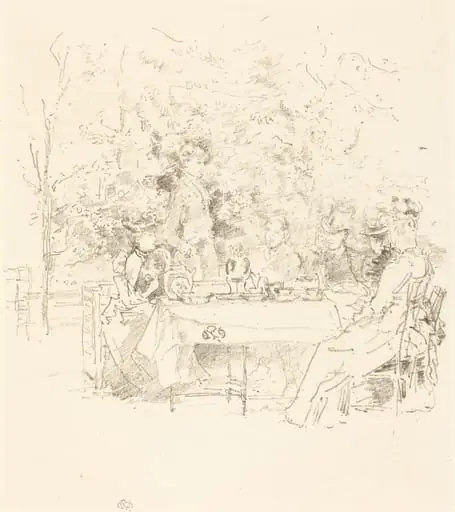
Five O'Clock Tea
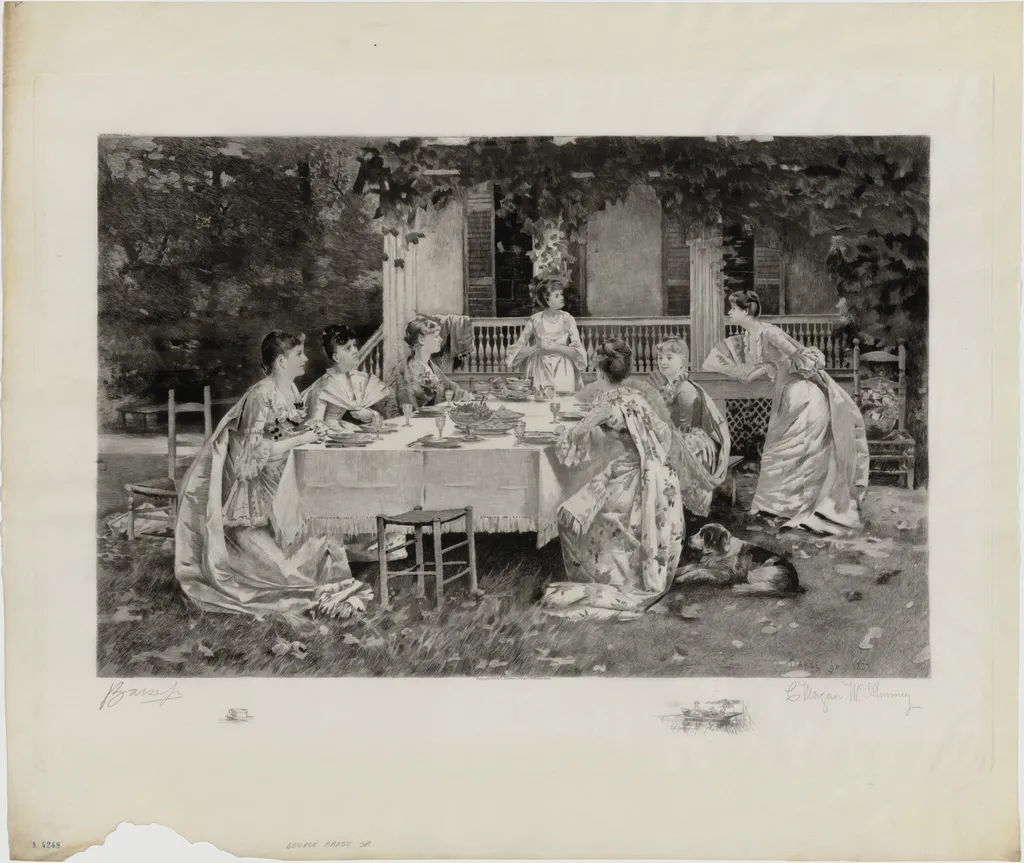
Five O'Clock Tea is an ink print by the Impressionist artist Morgan C. McIlhenney. It dates from 1887 and is held in the collection of the National Gallery of Art.
About this work
Overview
The composition conveys stillness and routine, emphasizing the calm rhythm of upper-middle-class leisure in the late 19th century.
Five O'Clock Tea is a black-and-white etching produced by Morgan C. McIlhenney in 1887. The print captures a quiet domestic moment: a group of women gathered outdoors for afternoon tea. The scene is framed by a wooden porch, scattered trees, and a distant building, all rendered with fine linear detail. The composition conveys stillness and routine, emphasizing the calm rhythm of upper-middle-class leisure in the late 19th century.
Subject & Meaning
The image depicts women in elaborate Victorian attire—flowing dresses, lace collars, and wide-brimmed hats—engaged in the ritual of tea. One pours from a teapot, another rests her arm on the table, and a dog sleeps at their feet. The setting suggests a private, genteel moment, free from overt narrative. The absence of male figures and the focus on quiet interaction reflect contemporary ideals of feminine domesticity and social refinement.
Technique & Style
McIlhenney employed etching to achieve subtle tonal gradations and fine line work. The use of cross-hatching and delicate stippling models light and shadow, giving depth to the figures and landscape. The texture of fabric, grass, and wood is suggested through controlled ink lines rather than solid masses. The composition is tightly framed, drawing attention to the intimate interactions among the figures while maintaining a sense of spatial depth.
History & Provenance
Created in 1887, the etching emerged during a period when American artists were increasingly turning to printmaking as a medium for intimate, observational art. McIlhenney, active in the Northeast, was part of a generation exploring domestic scenes with technical precision. The work likely circulated among collectors of fine prints, though its early ownership records remain undocumented. It has since been preserved in institutional collections focused on American graphic arts.
Context
The scene reflects the cultural practice of afternoon tea among affluent American women in the late 1800s, a ritual imported from Britain and adapted as a symbol of social grace. Such gatherings were often depicted in literature and visual art as markers of class and gender roles. The setting—a shaded porch surrounded by nature—echoes contemporary ideals of domestic harmony and moral purity associated with the home.
Legacy
Five O'Clock Tea stands as a quiet example of American etching’s capacity to capture everyday life with nuance. While McIlhenney is not widely known today, this work contributes to a broader understanding of how 19th-century printmakers documented social customs outside grand historical themes. It remains a reference point for studies of gender, leisure, and the domestic sphere in American visual culture.
Artist & collection

 Infantry in Arms
 Untitled (Two Girls at a Window)
 The Boat Trip: The Lunch before Going Aboard at Asnières
 The Garden
 Flower Painting
 Hüssener, Auguste: Andruckbogen mit drei Gemäldereproduktionen
 La Terrasse de la Villa Brancas
 Frédéric Mistral: Mémoires et Recits by Frédéric Mistral: woman outside with a basket of flowers (insert after p. 192)
 Les présents du berger
 The Bathers