Artwork
Costume of a Persian Harem Lady
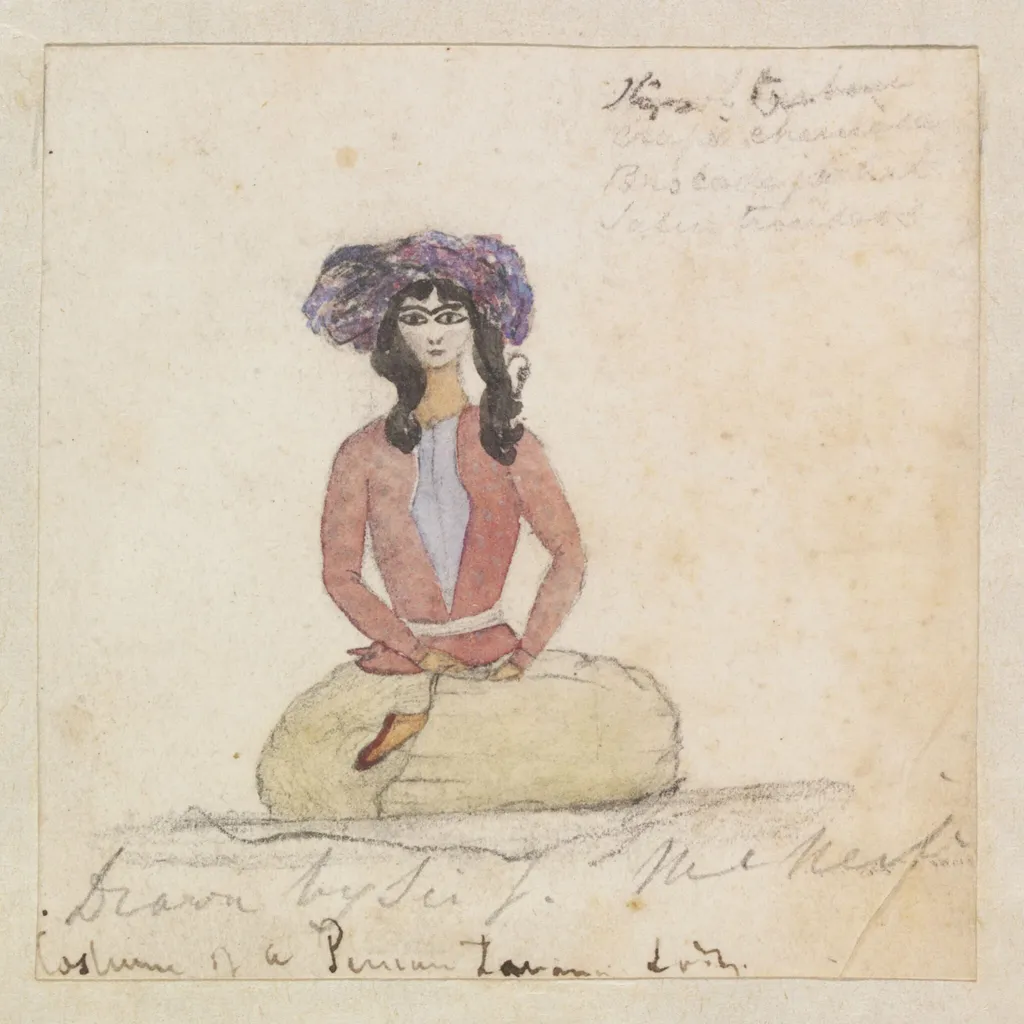
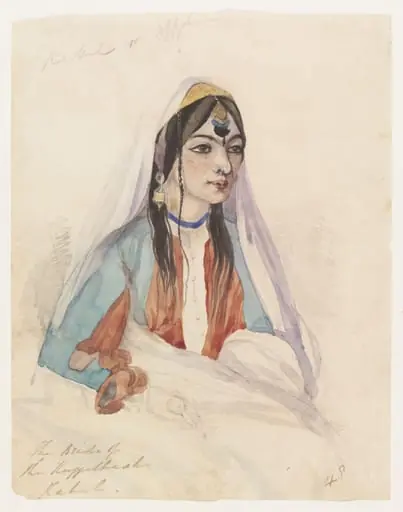
Costume of a Persian Harem Lady is a watercolor work on paper by the Orientalist artist John McNeill. It dates from 1833 and is held in the collection of the Victoria and Albert Museum.
About this work
Overview
This watercolour, dated 1833, is the work of Sir John McNeill, a British diplomat and amateur artist.
This watercolour, dated 1833, is the work of Sir John McNeill, a British diplomat and amateur artist. It depicts a Persian woman in domestic attire, rendered with restrained brushwork and muted tones. The piece was acquired by a public collection in 1971 from the artist’s great-nephew, Henry D'Olier Vigne, following a documented lineage within the McNeill family. Its modest scale and intimate subject reflect the personal nature of McNeill’s travel sketches.
Subject & Meaning
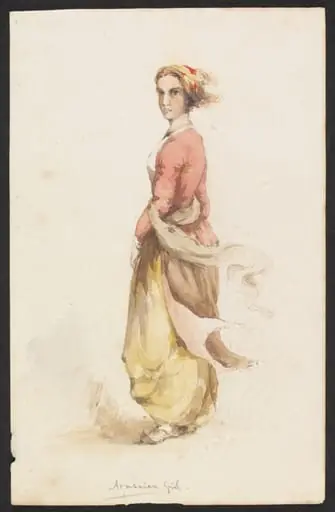
The figure is portrayed as a woman of the Persian harem, seated cross-legged on the floor, her posture suggesting quiet contemplation. Her loose dark hair, red jacket, purple headpiece, and wrapped waistcloth indicate regional dress, though the depiction is filtered through a Western observer’s lens. The downward gaze and stillness convey an atmosphere of solitude rather than exoticism, aligning with Romantic-era tendencies to emphasize inner mood over narrative.
Technique & Style
Executed in watercolour, the work employs soft washes and fine linear detail to define form and texture. The palette is subdued—dominated by red, purple, and beige—with no harsh contrasts. The background is left largely unmodeled, allowing the figure to emerge through delicate outlines and subtle tonal shifts. The style reflects Romantic sensibilities: intimate, lyrical, and focused on emotional resonance rather than precise ethnographic accuracy.
History & Provenance
Created during McNeill’s time in Persia as a British envoy, the drawing likely served as a personal record of his observations. It remained in the artist’s family for nearly 140 years before being sold in 1971 to a public institution for £200. The provenance is well-documented through descent from McNeill to his great-nephew, Henry D'Olier Vigne, ensuring its authenticity and continuity within the family archive.
Context
McNeill’s watercolours emerged during a period of heightened European interest in the Near East, fueled by diplomatic missions and travel literature. While his work shares thematic ground with Orientalist art, it avoids theatricality, instead offering quiet, observational sketches. These pieces were not intended for public exhibition but as private documents, reflecting the artist’s engagement with cultures he encountered during service abroad.
Legacy
Though not widely exhibited, McNeill’s watercolours contribute to a lesser-known strand of 19th-century British art that prioritizes personal observation over imperial spectacle. This drawing, like others in his oeuvre, offers a restrained counterpoint to more sensationalized Orientalist imagery. Its preservation in public collections ensures its role as a quiet testament to cross-cultural encounter through the lens of a diplomat-artist.
Artist & collection
Artist
John McNeill put these rich watercolors on paper in 1833. “Persian” and “Costume of a Persian Harem Lady” show finely brushed robes, jewelry, and palace interiors straight from British visitors’ travel sketches. He…