Artwork
Saint Christopher
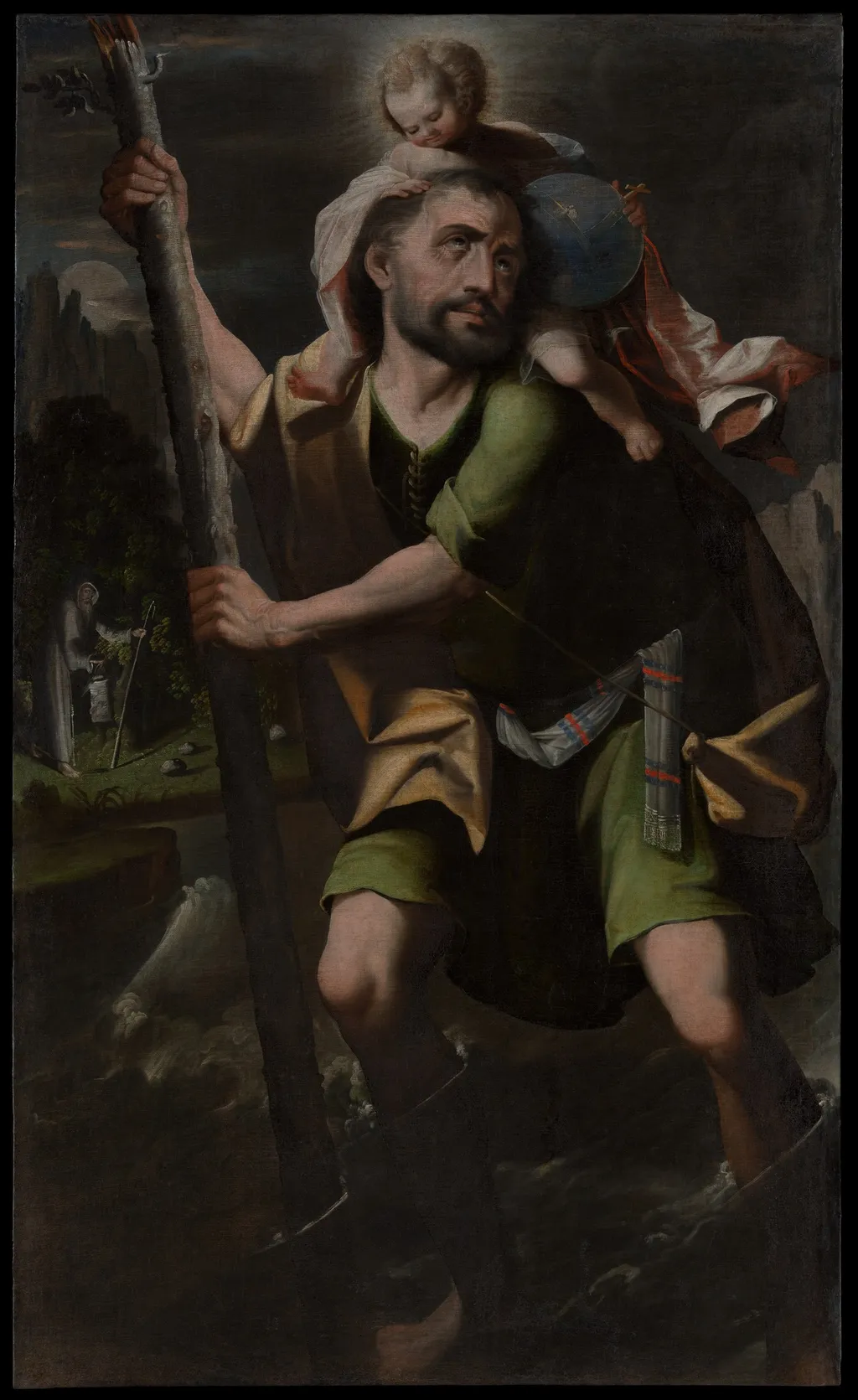
Saint Christopher is an oil painting by Melchor Pérez de Holguín. It dates from 1710 and is held in the collection of the Metropolitan Museum of Art.
About this work
Overview
Created in 1710, this oil painting portrays Saint Christopher bearing the Christ Child across water. The work belongs to the collection of The Metropolitan Museum of Art and exemplifies the Baroque religious imagery typical of early 18th‑century South America.
Subject & Meaning
Saint Christopher is shown as a bearded figure in a green tunic and brown cloak, supporting a child in a white robe. The infant rests his right hand on the saint’s head and holds a blue orb topped with a golden cross, symbols of Christ’s authority and the world’s salvation.
Technique & Style
The artist employs chiaroscuro to model the figures, creating strong contrasts of light and shadow that give a three‑dimensional presence. A dark, cloud‑filled sky and distant sun or moon illuminate the landscape of trees, rocks, and water, enhancing the devotional atmosphere.
History & Provenance
Melchor Pérez de Holguín, active in Potosí from 1689 until his death in 1732, painted the work. As a leading member of the Potosí School of Baroque art, he produced numerous religious commissions that reflect regional visual traditions. The painting entered the Metropolitan Museum’s collection in the 20th century.
Context
The composition follows the conventional iconography of Saint Christopher, a patron saint of travelers, commonly depicted carrying the Christ Child across a river. This motif resonated in colonial Spanish America, where pilgrimage and protection were central themes in ecclesiastical art.
Own this work as a print
Artist & collection

Artist
Melchor Pérez de Holguín (c. 1660-1732) was a painter and architect, known for the creation of Baroque artworks in Potosí. He was a central figure in the Potosi School tradition. He was active from 1689 to his death in 1732.
