Artwork
Maria mit Kind in der Glorie, den hll. Hieronymus und Jakobus mit Stifter (?)
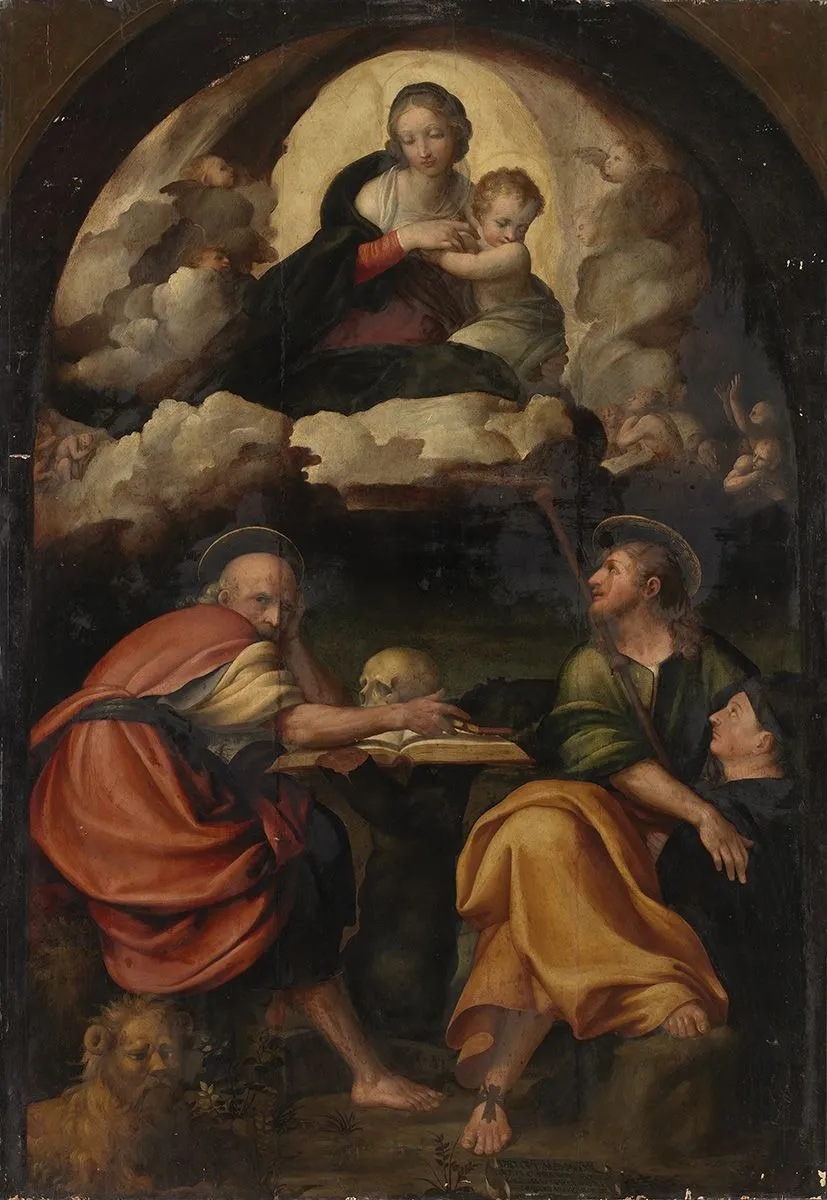
Maria mit Kind in der Glorie, den hll. Hieronymus und Jakobus mit Stifter (?) is an unspecified painting by the Mannerist artist Michelangelo Anselmi. It dates from 1523 and is held in the collection of the Bavarian State Painting Collections.
About this work
Overview
Created in 1523, this oil painting by the Italian Renaissance artist Michelangelo Anselmi presents a celestial tableau of four figures set against a luminous, cloud‑filled sky. The composition is housed in Munich’s Alte Pinakothek, where it remains a representative example of early‑16th‑century devotional art.
Subject & Meaning
A skull rests on Jerome’s text, invoking mortality, while a lion peeks from the lower left, a traditional attribute of Jerome.
At the upper center, a woman in a dark mantle cradles an infant, identified as the Virgin Mary with the Christ Child. Below, two male saints are seated: Saint Jerome, distinguished by a red robe and an open book, and Saint James, rendered in green and gold, both engaged in contemplation. A skull rests on Jerome’s text, invoking mortality, while a lion peeks from the lower left, a traditional attribute of Jerome.
Technique & Style
Anselmi employs a soft chiaroscuro to model the figures, allowing the diffused light of the heavenly atmosphere to define form and volume. The delicate handling of drapery and the subtle gradations of color reflect the influence of Lombard painting, while the overall composition balances serene reverence with a hint of narrative tension.
History & Provenance
The work entered the collection of the Alte Pinakothek in the 19th century, though its earlier ownership remains uncertain. Its title, referencing Mary, the saints, and a donor, suggests it may have been commissioned for a private chapel or guild altar, a common practice for devotional panels of the period.
Context
Anselmi, active in Parma and Cremona, worked within the artistic currents that followed Correggio and Parmigianino, integrating both naturalistic detail and idealized grace. The inclusion of Jerome and James aligns the painting with the Counter‑Reformation emphasis on saintly intercession and the contemplation of death as a moral reminder.
Artist & collection