Artwork
Predella with the Resurrection of Christ
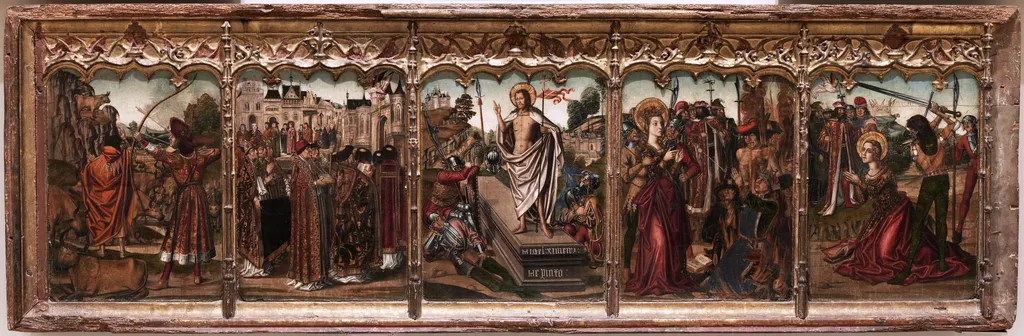
Predella with the Resurrection of Christ is an unspecified painting by the Early Renaissance artist Miguel Ximénez. It dates from 1475 and is held in the collection of the Museo del Prado.
About this work
Overview
The five small scenes are arranged horizontally, each illustrating a distinct episode that culminates in Christ’s rising from the dead.
Created circa 1475 by Miguel Ximénez, a Spanish Gothic painter active in Zaragoza, the Predella with the Resurrection of Christ is a multi‑panel work now in the Museo del Prado. The five small scenes are arranged horizontally, each illustrating a distinct episode that culminates in Christ’s rising from the dead. The composition reflects the transitional period between late medieval conventions and the early Renaissance in Iberia.
Subject & Meaning
The central panel portrays the Resurrection, with Christ emerging from the tomb surrounded by attendants, while the surrounding scenes include a hunter with bow and arrow, a gathering before a building, a woman in a red dress, and a group of armored figures bearing swords. Together they suggest a narrative of earthly activity juxtaposed with the divine triumph over death, a common devotional theme in 15th‑century Spanish art.
Technique & Style
Ximénez employs the intricate detailing typical of Gothic painting, using bright pigments and gold leaf to accentuate clothing, armor and architectural elements. The figures are rendered with a linear precision that anticipates the more naturalistic approach of the early Renaissance, while the overall composition retains the hierarchical arrangement and ornamental richness of medieval panels.
History & Provenance
Miguel Ximénez served as court painter to Ferdinand II of Aragon from 1484, and worked closely with his son Juan. The predella was likely produced for a local chapel or altarpiece in Zaragoza before entering the royal collection. It was acquired by the Museo del Prado in the 20th century, where it remains part of the museum’s Spanish Gothic holdings.
Legacy
The work illustrates the stylistic currents that shaped later Aragonese painters such as Bartolomé Bermejo and Martín Bernat, who adopted Ximénez’s blend of detailed surface treatment and emerging spatial awareness. The presence of contemporary armor and weaponry also reflects the courtly milieu of late‑15th‑century Spain, linking the sacred narrative to the patron’s worldly concerns.
Artist & collection
Artist
Miguel Ximénez (Pareja -Guadalajara-, 15th century) was a Spanish Gothic painter.
