Artwork
the Saints Peter, Benedict, Julian (?), Stephan (?), and a holy bishop (Nicholas of Bari?)
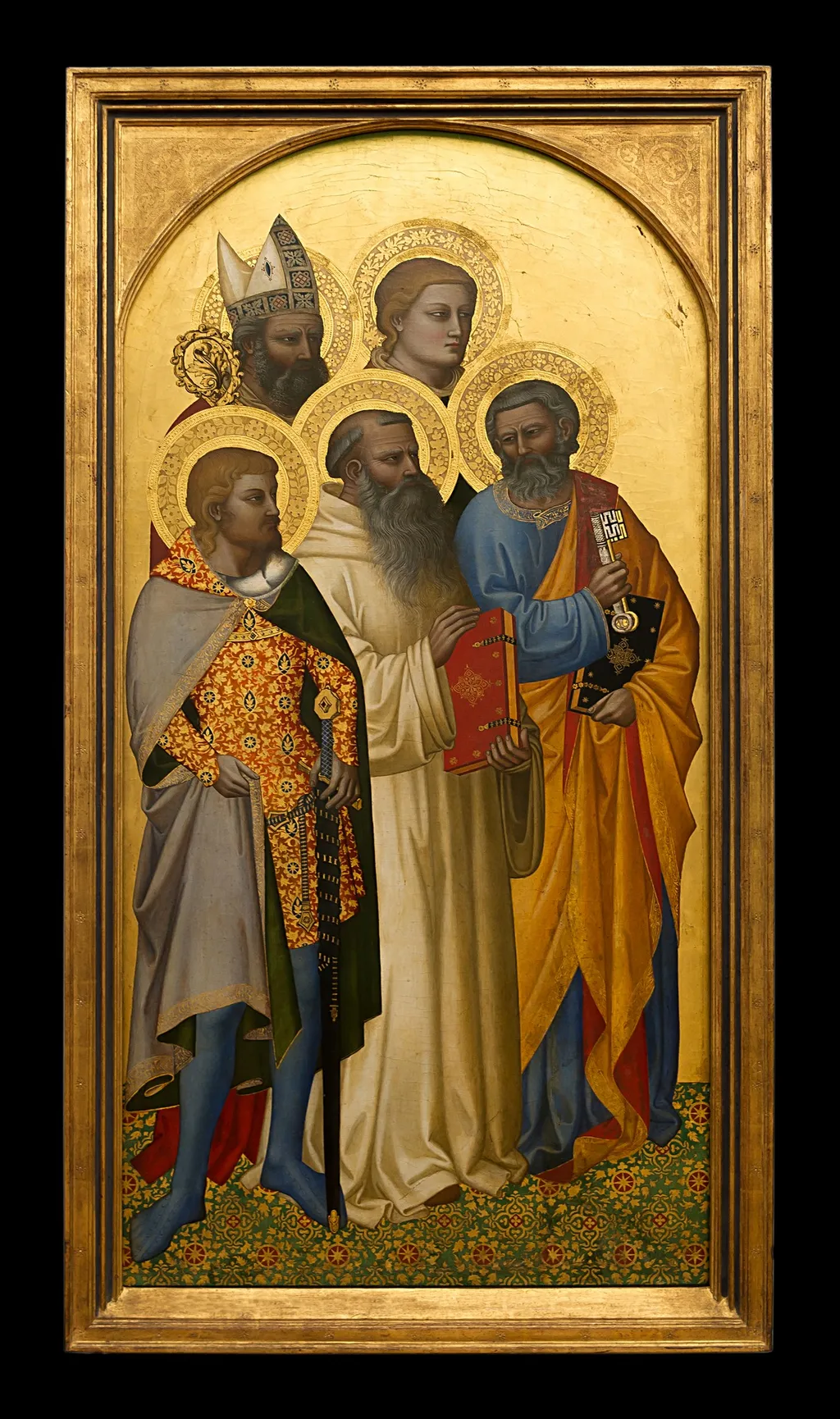
the Saints Peter, Benedict, Julian (?), Stephan (?), and a holy bishop (Nicholas of Bari?) is an oil painting by the Byzantine icon painting artist Nardo di Cione. It dates from 1364 and is held in the collection of the Bavarian State Painting Collections.
About this work
Overview
Created in 1364 by the Florentine painter Nardo di Cione, this wooden panel portrays a group of five bearded saints, each crowned with a golden halo. The work is part of the collection of the Alte Pinakothek in Munich and exemplifies the devotional imagery typical of mid‑fourteenth‑century Italy.
Subject & Meaning
The central figures are traditionally identified as Saint Peter and Saint Stephen, while the flanking figures are thought to represent Saint Benedict, a possibly misidentified Saint Julian, and a holy bishop identified by some scholars as Nicholas of Bari. Their solemn expressions and symbolic attributes—books, staffs, and richly colored vestments—underscore their roles as intercessors and exemplars of Christian virtue.
Technique & Style
Executed in tempera on a wooden panel, the painting employs a luminous gold ground that isolates the figures and enhances their jeweled colors. Nardo renders the folds of the robes with meticulous attention, using bright greens, reds, blues, and oranges to convey material richness. The flat background and lack of spatial depth reflect the International Gothic aesthetic prevalent in the period.
History & Provenance
The panel was likely commissioned for a private chapel or confraternity in Florence, though its original setting remains undocumented. It entered the Alte Pinakothek’s holdings in the 19th century, becoming part of the museum’s extensive collection of early Italian panel paintings.
Context
Nardo di Cione worked alongside his brothers, the more famous painter and architect Orcagna, during a time when Florentine art was transitioning from Byzantine rigidity toward greater naturalism. This work illustrates the collaborative workshop environment and the devotional focus of the city’s religious patrons in the decades following the Black Death.
Artist & collection


![Saint John the Evangelist [right panel], by Nardo di Cione](https://artifactworldgallery.com/img/nardo-di-cione--saint-john-the-evangelist-right-panel--fdd92c8ff7afceaf-w320.webp) Saint John the Evangelist [right panel]
Saint John the Evangelist [right panel]![Saint Peter [left panel], by Nardo di Cione](https://artifactworldgallery.com/img/nardo-di-cione--saint-peter-left-panel--df6a39da35a16159-w320.webp) Saint Peter [left panel]
Saint Peter [left panel]![Madonna and Child, with the Man of Sorrows [middle panel], by Nardo di Cione](https://artifactworldgallery.com/img/nardo-di-cione--madonna-and-child-with-the-man-of-sorrows-middle-panel--5ab4de48523071e4-w320.webp) Madonna and Child, with the Man of Sorrows [middle panel]
Madonna and Child, with the Man of Sorrows [middle panel]![Madonna and Child, with Saints Peter and John the Evangelist, and Man of Sorrows [entire triptych], by Nardo di Cione](https://artifactworldgallery.com/img/nardo-di-cione--madonna-and-child-with-saints-peter-and-john-the-evangelist--a57f261be4c5dd48-w320.webp) Madonna and Child, with Saints Peter and John the Evangelist, and Man of Sorrows [entire triptych]
Madonna and Child, with Saints Peter and John the Evangelist, and Man of Sorrows [entire triptych]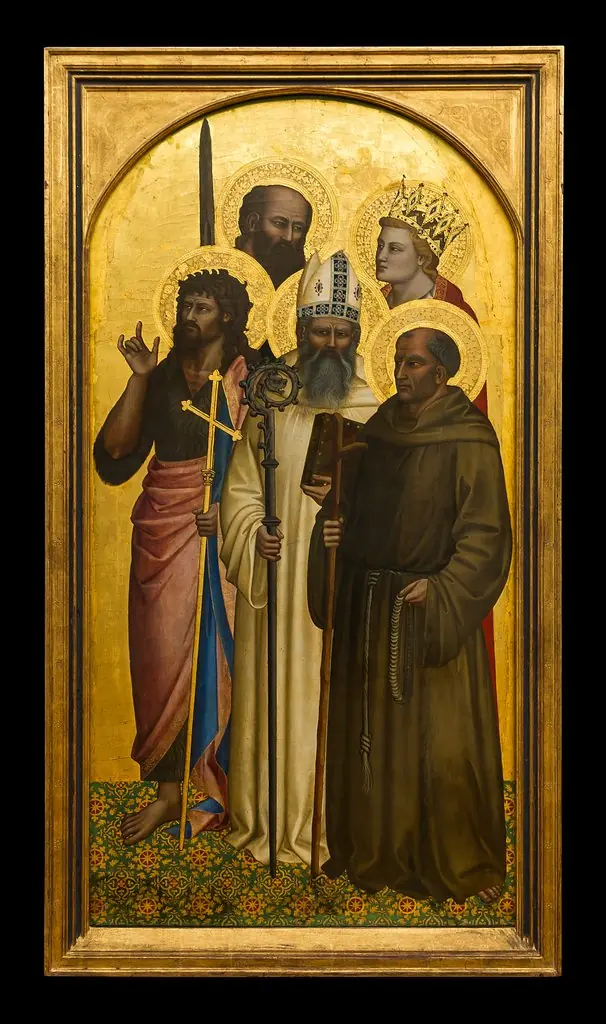 the Saints John the Baptist, Egidius, Gerard of Villamagna, Paul and Catherine (or Miniato)