Artwork
Untitled
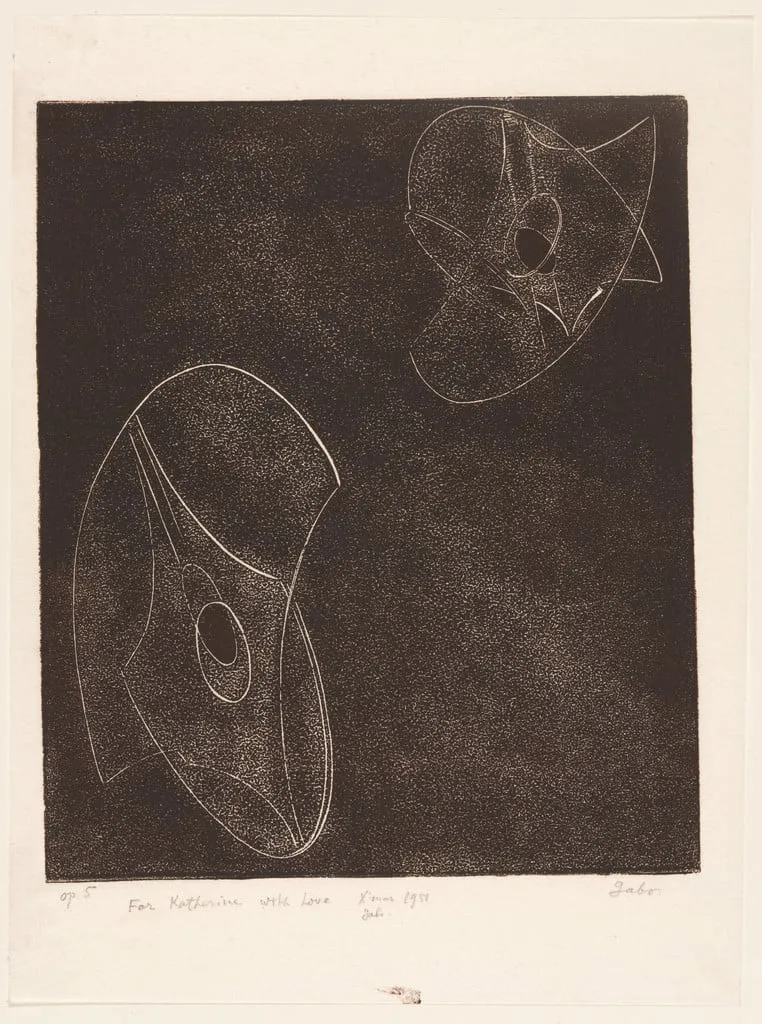
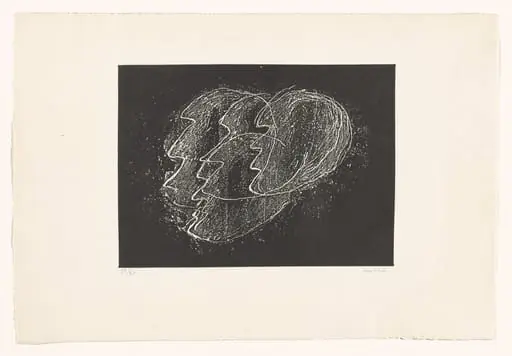
Untitled is an ink print by Naum Gabo. It dates from 1951 and is held in the collection of the Museum of Modern Art.
About this work
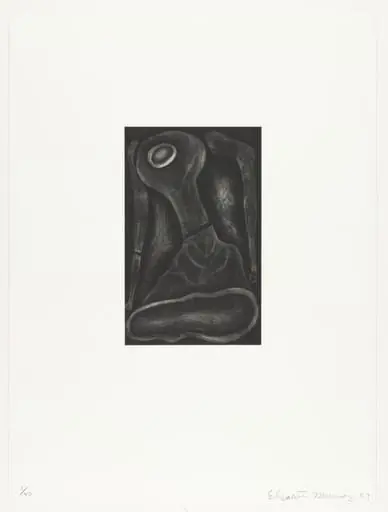
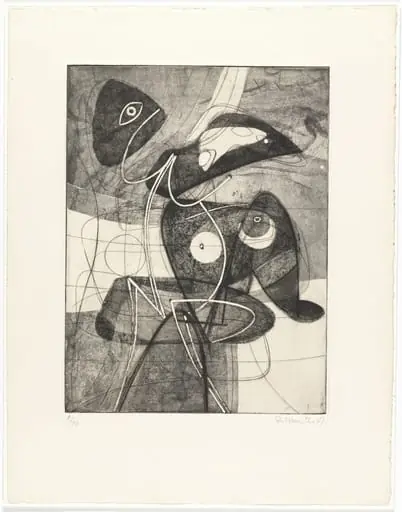
One looks like a stretched oval with a small circle inside, the other like a lopsided oval with jagged lines.
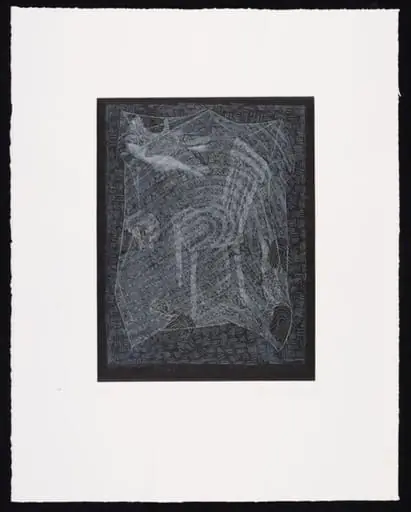
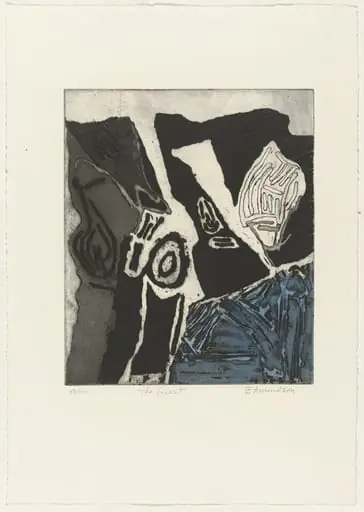
This print shows two simple shapes floating against a dark background. One looks like a stretched oval with a small circle inside, the other like a lopsided oval with jagged lines. Both shapes are outlined in thin white lines, and the background has tiny dots scattered across it.
The artist signed it "Gabo" and wrote "For Katherine with love" in the corner. The year 1951 is also tucked in there—this wasn’t made long ago.
If you like this kind of clean, geometric look, check out engraving.
Overview
Created in 1951, this color wood engraving by Naum Gabo is a restrained yet precise work within his broader printmaking practice. Executed with technical clarity, it reflects his enduring interest in spatial relationships and abstract form. Though modest in scale and composition, the piece carries the conceptual rigor characteristic of his Constructivist roots, translating three-dimensional concerns into two-dimensional media.
Subject & Meaning
The composition features two abstract shapes— one a stretched oval enclosing a small circle, the other a distorted form with irregular edges—both suspended in a dark field. Thin white outlines define their contours, suggesting separation and autonomy. The inclusion of a dotted background introduces subtle texture, evoking depth without illusion. The inscription to Katherine suggests a personal gesture, yet the forms remain deliberately non-referential, aligned with Gabo’s rejection of representational content.
Technique & Style
Gabo employed wood engraving, a labor-intensive method allowing fine linear detail, and printed it in multiple colors to achieve tonal contrast. The precision of the white outlines and the even distribution of micro-dots in the background demonstrate meticulous craftsmanship. His style here avoids ornamentation, favoring clarity and balance. The geometric simplicity reflects his lifelong commitment to form as an expression of structure and space, not emotion or narrative.
History & Provenance
The work was produced in 1951 and inscribed with a personal dedication and date, indicating its creation during Gabo’s later years in the United States. It entered the collection of The Museum of Modern Art, where it remains as part of a broader holding of his prints and sculptures. Its preservation underscores its significance within the context of mid-century abstract printmaking and Constructivist legacy.
Context
In the postwar period, Gabo continued to explore abstraction through non-traditional media, even as the art world shifted toward expressionism and pop. This print aligns with his earlier Constructivist principles—emphasizing space, material, and geometry—while adapting to the intimacy of printmaking. It stands apart from the dominant trends of its time, maintaining a quiet dialogue with scientific and architectural ideals.
Legacy
Though less widely known than his sculptures, Gabo’s prints like this one reveal the consistency of his vision across media. The work exemplifies how abstract form could be rendered with technical discipline and emotional restraint. It contributes to the understanding of printmaking as a legitimate vehicle for Constructivist ideas, influencing later generations interested in minimalism and geometric abstraction.
Artist & collection
Artist
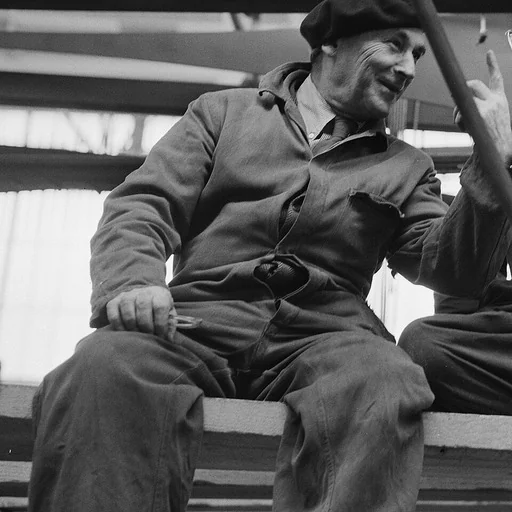
Naum Gabo (born Naum Neemia Pevsner; Russian: Наум Борисович Певзнер; Hebrew: נחום נחמיה פבזנר; 5 August 1890 – 23 August 1977) was a Russian and American constructivist sculptor and theorist.