Artwork
Claudia Quinta
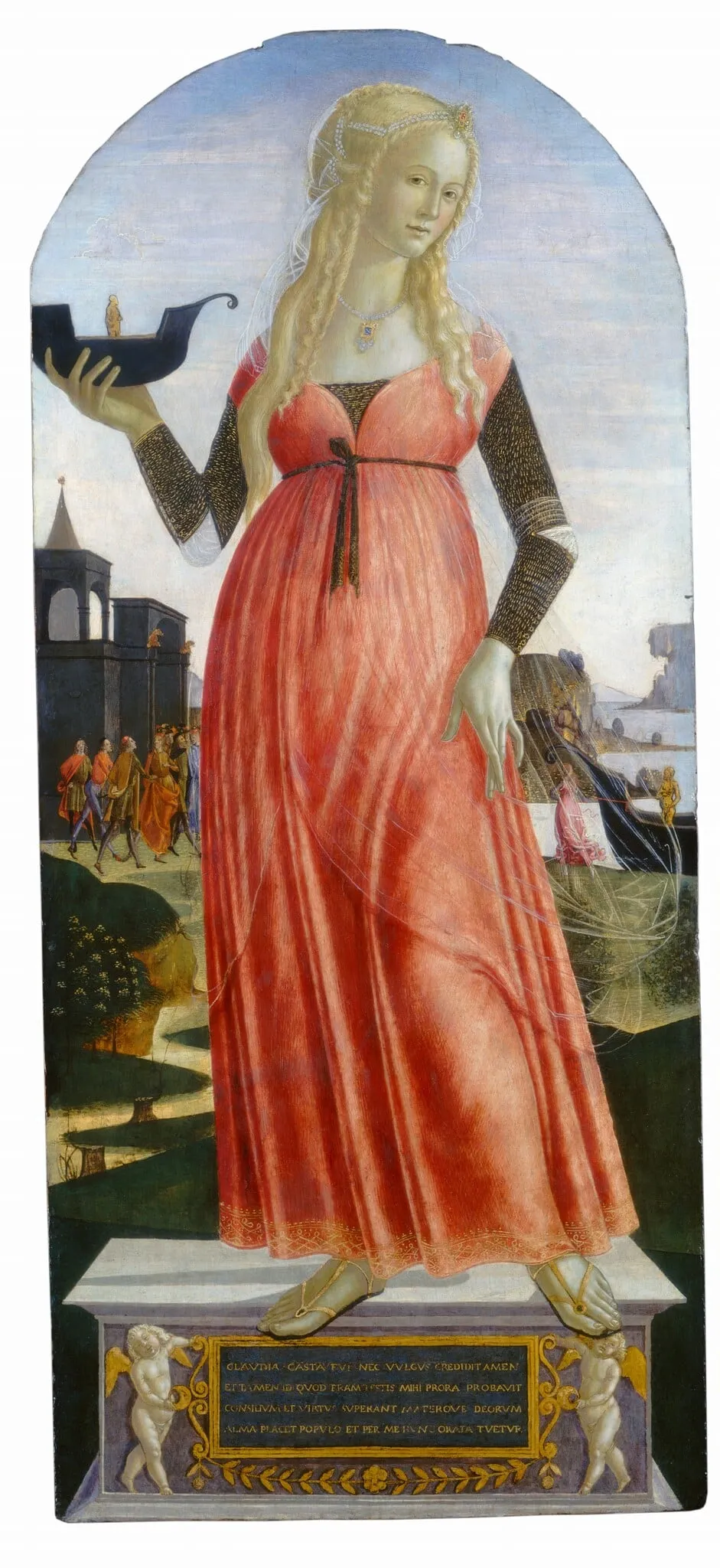
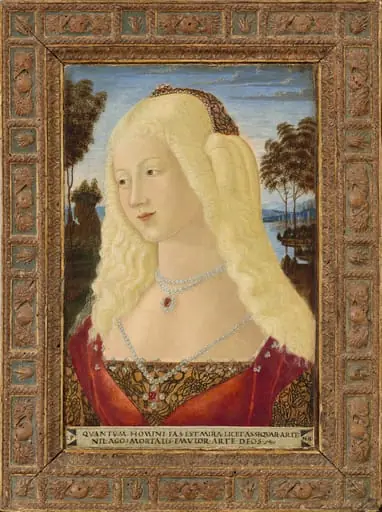
Claudia Quinta is a tempera painting by the Early Renaissance artist Neroccio de' Landi. It dates from 1492 and is held in the collection of the National Gallery of Art.
About this work
Overview
Claudia Quinta is a tempera painting on poplar panel executed by the Italian artist Neroccio de' Landi around 1492. The work presents a solitary female figure in a vivid red garment, set against a muted landscape that includes a distant urban skyline and a vessel on water. A Latin inscription runs along a decorative ledge at the bottom of the composition.
Subject & Meaning
The central figure is identified as Claudia Quinta, a legendary Roman woman celebrated for her fidelity and virtue. She is depicted standing upright, clutching a small cup that may allude to themes of purity or a ritual offering. The inclusion of the Latin motto beneath her feet reinforces the moral narrative associated with her story.
Technique & Style
Rendered in egg‑tempera, the painting achieves a smooth, matte surface characteristic of the medium, with pigments bound in a yolk medium applied in thin, layered strokes. The contrast between the bright scarlet dress and the darker, sleeveless overlay creates a visual tension, while the background is treated with a flat, atmospheric wash that recedes into distance.
History & Provenance
Created at the close of the 15th century, the work reflects Neroccio de' Landi’s activity in Siena, where he was active as a painter and sculptor. Although specific ownership records are sparse, the panel has been documented in several catalogues of Sienese art and is now held in a public collection that focuses on Renaissance works.
Context
The painting belongs to a period when artists frequently illustrated moral exempla drawn from classical antiquity, aligning with humanist interests of the time. The choice of tempera on wood aligns with regional practices in Tuscany before the widespread adoption of oil painting, and the composition’s clear narrative focus mirrors contemporary devotional and didactic artworks.
Artist & collection


![The Archangel Gabriel [middle left panel], by Cosmè Tura](https://artifactworldgallery.com/img/cosme-tura--the-archangel-gabriel-middle-left-panel--c900f72d54477be2-w320.webp)