Artwork
View of the City of New York and Governors Island Taken from Brooklyn Heights on the Morning after the Conflagration
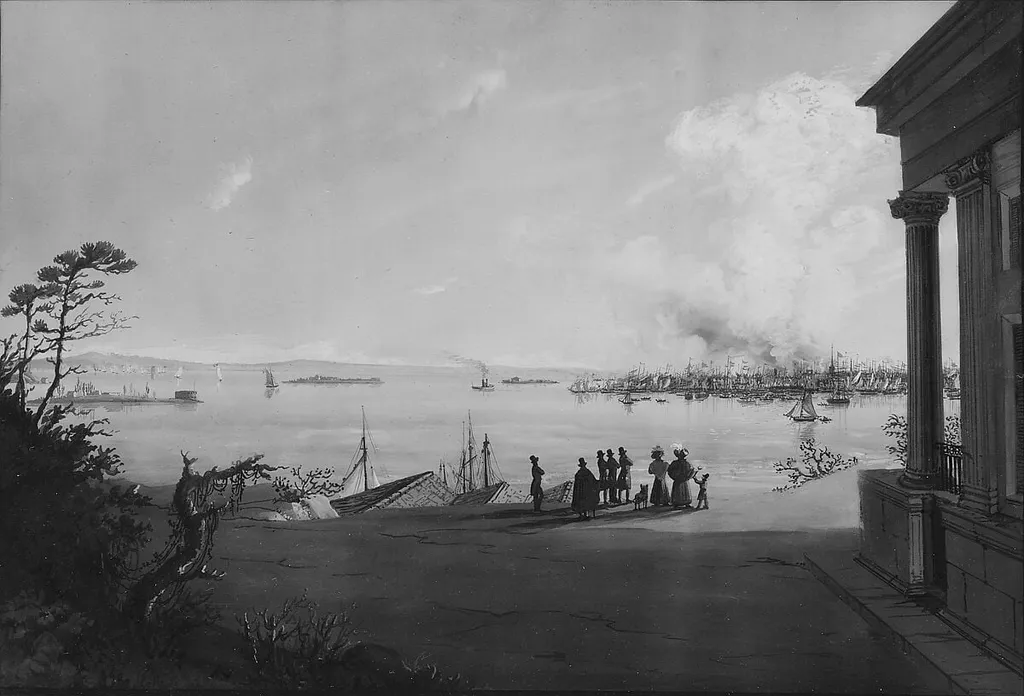
View of the City of New York and Governors Island Taken from Brooklyn Heights on the Morning after the Conflagration is a watercolor work on paper by the Romanticist artist Nicolino Calyo. It dates from 1841 and is held in the collection of the Metropolitan Museum of Art.
About this work
You see a smoky skyline of early New York from across the river—tiny boats, church steeples, and a pale sky.
Calyo painted this the morning after a huge fire in 1835. The city looks quiet, but the disaster is still fresh. He used thin watercolor washes to show the haze, making the scene feel soft and a little sad.
If you like this, look up other landscapes from the same time.
Overview
This work, rendered in watercolor and gouache on paper, captures a panoramic vista of New York City and Governors Island as seen from Brooklyn Heights.
Nicolino Calyo, an Italian-American artist, created View of the City of New York and Governors Island Taken from Brooklyn Heights on the Morning after the Conflagration in 1841. This work, rendered in watercolor and gouache on paper, captures a panoramic vista of New York City and Governors Island as seen from Brooklyn Heights. The painting specifically illustrates the urban landscape on the day following a significant fire, reflecting a moment of quiet aftermath. Calyo, born in the Kingdom of Naples in 1799, was known for his depictions of New York scenes.
Subject & Meaning
Calyo's painting presents a serene yet poignant view of New York City's skyline and Governors Island, observed from across the East River. Despite the apparent calm, the title indicates the scene unfolds on the morning after a devastating conflagration, likely the Great Fire of 1835. The smoky haze that lingers over the city suggests the recent disaster, imbuing the otherwise tranquil landscape with a sense of recent trauma and quiet reflection on the city's resilience.
Technique & Style
Calyo utilized watercolor and gouache on paper to achieve the atmospheric qualities of the scene. The artist employed thin watercolor washes to depict the pervasive haze hanging over the city, lending a soft and somewhat melancholic tone to the landscape. This technique effectively conveys the lingering smoke from the fire, while details such as distant church steeples and small boats on the water emerge from the pale sky, contributing to the painting's contemplative mood.
Context
Nicolino Calyo's personal history shaped his artistic perspective. Born in the Kingdom of Naples in 1799, he left his homeland after a failed political uprising in 1821, subsequently traveling through Europe before establishing himself in the United States following the First Carlist War. His experiences as an émigré likely influenced his keen observation of urban environments. This particular work, created in 1841, depicts an event from 1835, showcasing his interest in documenting significant moments in New York City's history.
Artist & collection

Artist
Nicolino Calyo (1799 – 9 December 1884) was an Italian-American painter best known for his paintings of the Great Fire of New York and other scenes in New York City.