Artwork
San Biagio, Venice
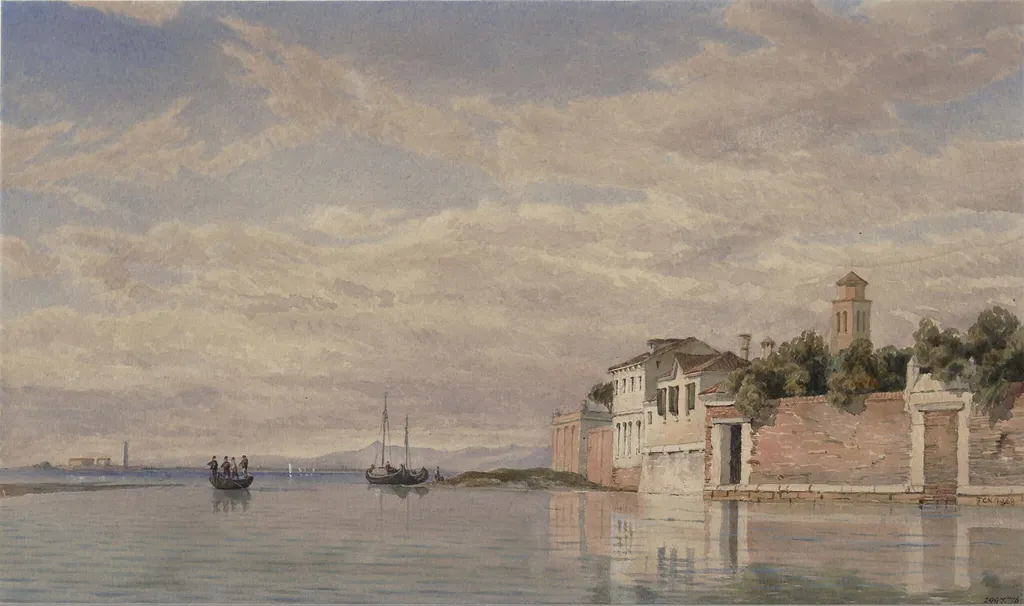
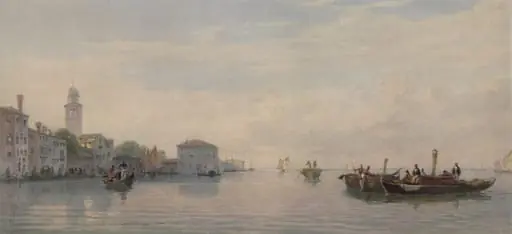
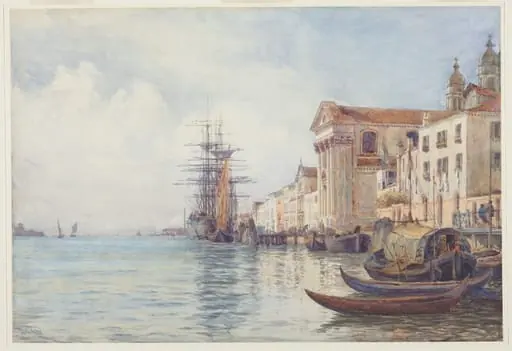
San Biagio, Venice is a watercolor work on paper by the British Romanticist artist Frederick C. Nightingale. It dates from 1868 and is held in the collection of the Victoria and Albert Museum. Frederick C.
About this work
Overview
Its quiet atmosphere and restrained palette reflect a focus on atmosphere over narrative, characteristic of 19th-century topographical watercolours.
Frederick C. Nightingale created this watercolour in 1868, signing and dating it clearly. The work depicts a tranquil Venetian canal, rendered with delicate washes and minimal detail. Its quiet atmosphere and restrained palette reflect a focus on atmosphere over narrative, characteristic of 19th-century topographical watercolours. The piece captures a moment of stillness, emphasizing light and reflection rather than architectural precision.
Subject & Meaning
The scene centers on a narrow waterway flanked by weathered stone buildings, one featuring a slender tower. A small rowboat with three figures glides silently along the canal, suggesting everyday life rather than tourist spectacle. Trees rise behind the structures, softening the urban edge. The absence of human activity beyond the boat reinforces a sense of solitude, inviting contemplation of place and time.
Technique & Style
Nightingale employed loose, transparent washes to suggest form and atmosphere. The sky and water are rendered with subtle gradations, allowing reflections to emerge naturally. Edges are blurred, and details are implied rather than defined, creating a sense of air and moisture. The muted tones—soft greys, pale ochres, and faint blues—enhance the hazy, overcast mood, prioritizing light effects over chromatic intensity.
History & Provenance
The work is documented as signed and dated 1868, placing it within Nightingale’s active period as a watercolourist. While its full provenance is not detailed, its subject and technique align with British artists who traveled to Venice during the mid-19th century, often producing works for private collectors interested in picturesque views. It may have been part of a broader tradition of topographical watercolours circulated in England.
Context
In the 1860s, Venetian scenes were popular among British artists and patrons drawn to the city’s fading grandeur and atmospheric light. Watercolour was favored for its immediacy and portability, suited to sketching on location. Nightingale’s approach reflects a shift from detailed topography toward impressionistic mood, anticipating later developments in landscape painting while remaining grounded in observational tradition.
Legacy
Though not widely exhibited today, the work exemplifies a quiet strand of 19th-century British watercolour practice—focused on serenity, light, and place. Its preservation offers insight into how artists engaged with Venice beyond the monumental, capturing intimate, unassuming moments. It contributes to a broader understanding of how travel and medium shaped visual responses to European cities during the Victorian era.
Own this work as a print
Artist & collection
Artist
Frederick C. Nightingale didn’t travel like other artists—he spent years sketching the same Venice alley from his pension window. His watercolor of San Biagio Church (1868) hides its spires behind laundry lines and a…