Artwork
Southwest Corner, Public Square, Cleveland
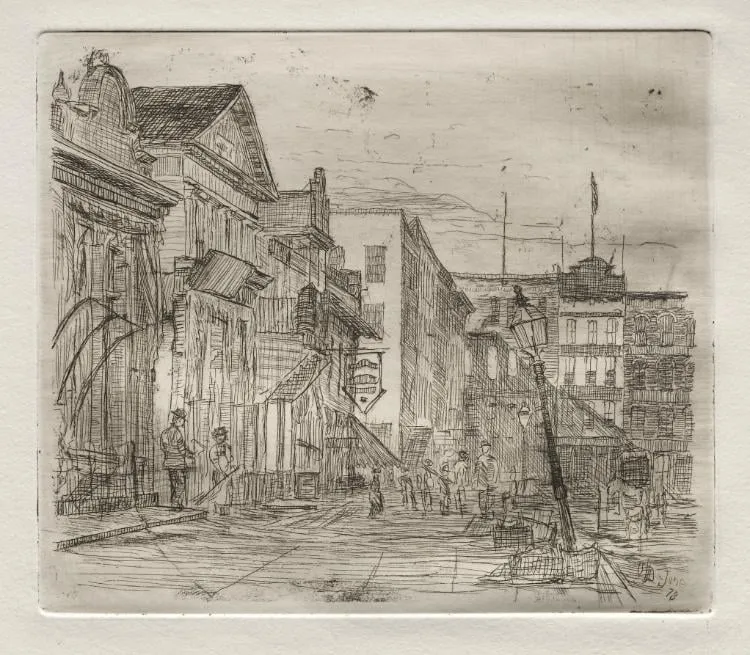
Southwest Corner, Public Square, Cleveland is a print by the Impressionist artist Otto Henry Bacher. It dates from 1878 and is held in the collection of the Cleveland Museum of Art. Otto H.
About this work
Overview
Bacher, a Cleveland-born artist active in the late 19th century, created this etching in 1878 as a detailed record of his hometown’s urban landscape.
Otto H. Bacher, a Cleveland-born artist active in the late 19th century, created this etching in 1878 as a detailed record of his hometown’s urban landscape. Though known for illustrations and oil paintings, this work belongs to his printmaking output. It captures a specific moment in the city’s development, focusing on the southwest corner of Public Square. The piece is part of The Cleveland Museum of Art’s permanent collection, reflecting local historical interest in Bacher’s work.
Subject & Meaning
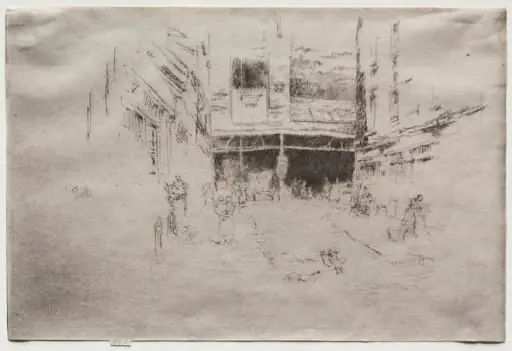
The scene portrays a quiet yet active urban intersection, with pedestrians moving along the sidewalk and street, and buildings of varying architectural styles framing the space. The presence of a streetlamp and clustered figures suggests daily life in a growing American city. Bacher’s choice of this ordinary corner—neither grand nor dramatic—emphasizes the value of everyday environments, aligning with Realist principles that found dignity in the mundane.
Technique & Style
Executed as an etching, the work uses fine lines and controlled tonal gradations to suggest texture and depth. Light falls unevenly across the facades and pavement, enhancing spatial recession and atmospheric mood. Bacher’s precision in rendering architectural details and human figures reflects his training in draftsmanship. The composition avoids theatricality, favoring observational clarity over idealization, a hallmark of Realist aesthetics in printmaking.
History & Provenance
Created in 1878, the print emerged during a period of rapid urban expansion in Cleveland. Bacher, who later studied in Europe, returned to his native city to document its transformation. The work remained in regional hands before entering The Cleveland Museum of Art’s collection, where it has been preserved as a document of local history. Its survival reflects early institutional interest in civic-themed art by native artists.
Context
In the late 1870s, American cities like Cleveland were reshaped by industrialization and population growth. Public Square served as a commercial and social hub, and artists like Bacher turned their attention to these evolving urban centers. While European Realism influenced American practitioners, Bacher’s focus on his own environment reflects a growing domestic interest in depicting local life with accuracy rather than romanticism.
Legacy
Bacher’s etching contributes to a broader 19th-century movement that valued urban observation as a legitimate artistic subject. Though not widely exhibited beyond regional circles, the work remains a significant record of Cleveland’s architectural and social fabric during its formative years. It continues to inform historical studies of American city life and the role of printmaking in documenting everyday environments.
Artist & collection
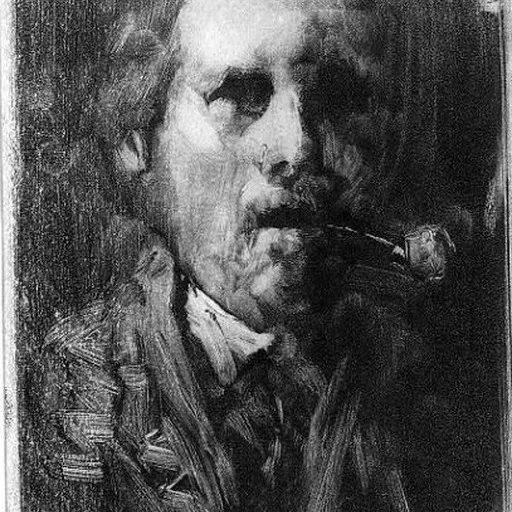
Artist
Otto Henry Bacher (May 31, 1856, Cleveland - August 16, 1909, Bronxville, New York) was an American artist; primarily known for his etchings and illustrations. He also painted oils in a variety of genres.