Artwork
Standing Female Nude
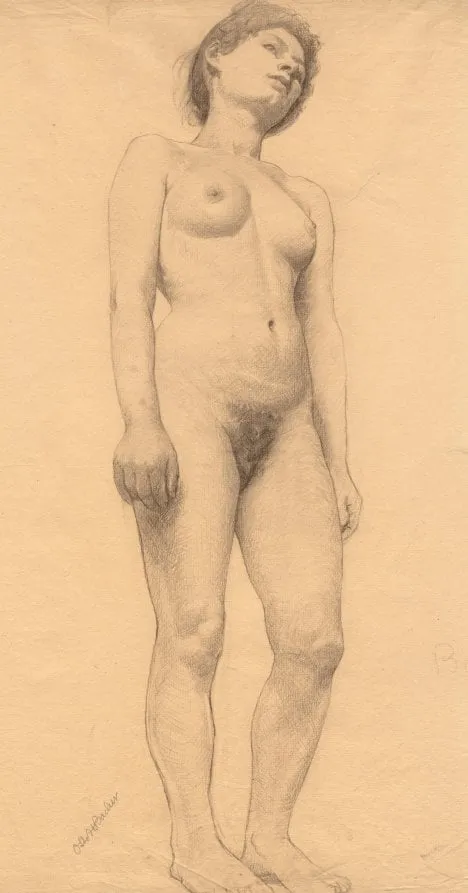
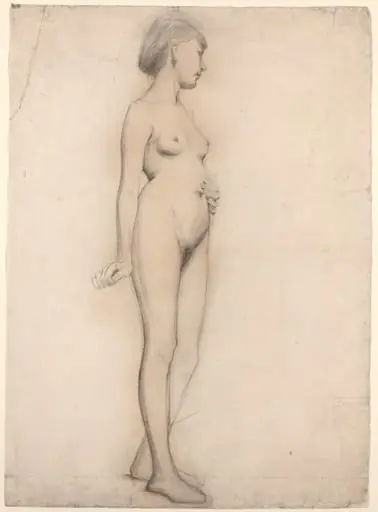
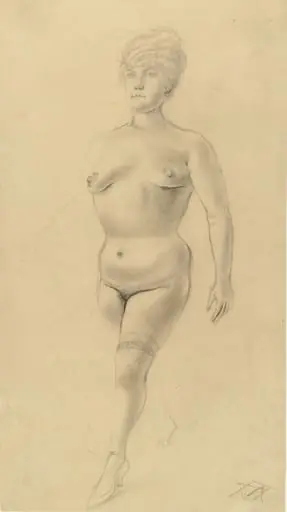
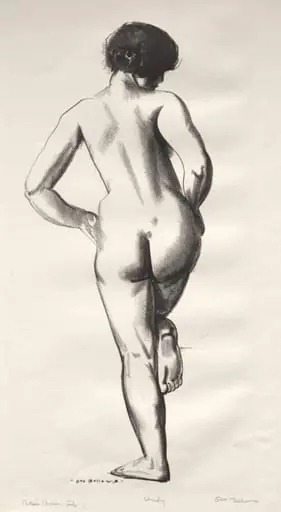
Standing Female Nude is a drawing by the Impressionist artist Otto Henry Bacher. It dates from 1878 and is held in the collection of the Cleveland Museum of Art.
About this work
Overview
The work reflects Bacher’s engagement with European training and his commitment to observational drawing, distinguishing him among American artists of the time.
This pencil drawing by Otto Bacher depicts a standing female nude, rendered with restrained precision. Created during his studies at the Royal Academy in Munich in the late 1870s, it stands as one of the earliest known American academic nudes from this period. The work reflects Bacher’s engagement with European training and his commitment to observational drawing, distinguishing him among American artists of the time.
Subject & Meaning
The figure is shown from behind, her posture natural and untheatrical, with no facial features visible. This omission directs attention to the form’s volume and balance, emphasizing anatomical truth over idealization. The absence of narrative or symbolic context suggests a focus on the body as a subject of study, aligning with academic traditions that valued direct observation over allegory.
Technique & Style
Bacher employed soft, confident pencil lines to define the figure’s contours and subtle shifts in weight. The drawing avoids heavy shading, relying instead on line quality and spatial arrangement to convey volume. Its clarity and economy reflect the rigorous draftsmanship taught in Munich, while its unembellished approach distinguishes it from more ornate academic nudes of the era.
History & Provenance
Created during Bacher’s time in Munich, the drawing is among the few surviving American academic nudes from the 1870s. It remained in private hands until acquired by The Cleveland Museum of Art, where it now serves as a rare example of early American engagement with European life drawing practices. Its preservation underscores its significance in the history of American art education.
Context
In the late 1870s, American artists increasingly traveled to Europe to study at academies like Munich’s, where life drawing was central. While nudes were common in European studios, few American artists produced them with such restraint. Bacher’s work parallels contemporary scientific studies of motion, like Muybridge’s, suggesting a shared interest in the body as a measurable, observable entity.
Legacy
Bacher’s drawing represents a quiet but important step in the development of American realism. It demonstrates how American artists absorbed European techniques while cultivating a more direct, less stylized approach to the human form. As one of the earliest such works by an American, it helped pave the way for later generations to treat the nude with greater psychological and formal honesty.
Artist & collection
Artist
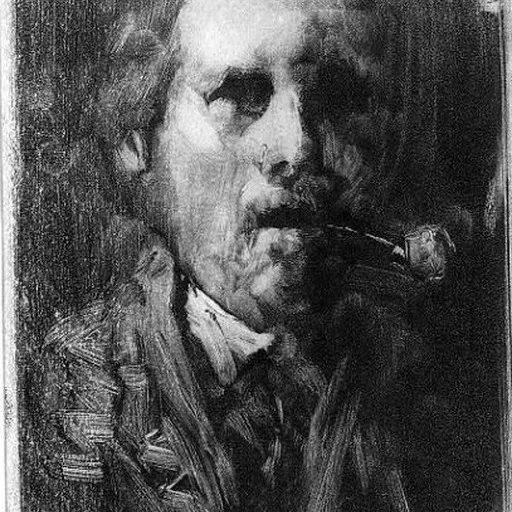
Otto Henry Bacher (May 31, 1856, Cleveland - August 16, 1909, Bronxville, New York) was an American artist; primarily known for his etchings and illustrations. He also painted oils in a variety of genres.