Artwork
Sign on the horizon
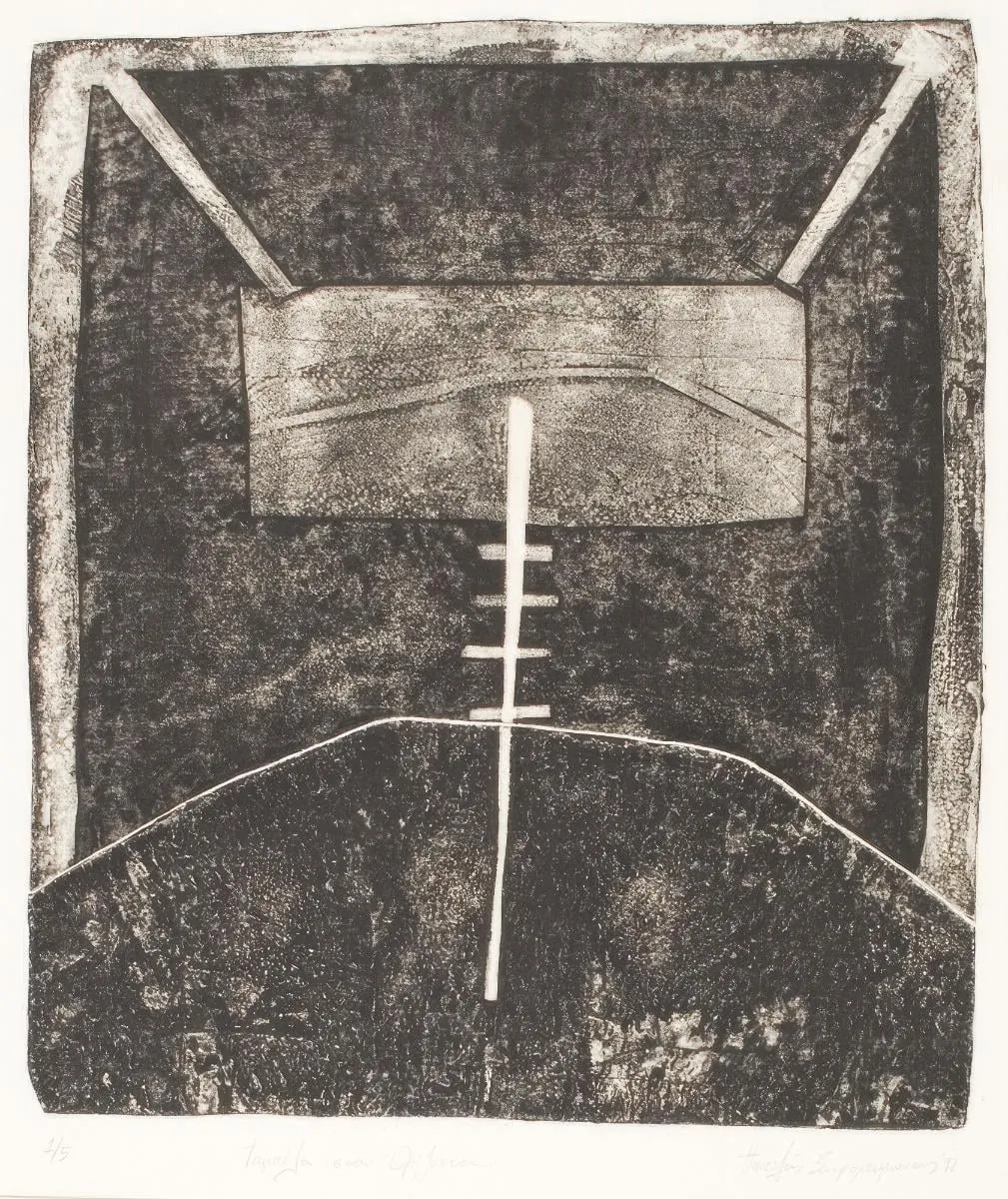
Sign on the horizon is a print by Pantelis dry winter. It dates from 1992 and is held in the collection of the Athens School of Fine Arts.
About this work
Overview
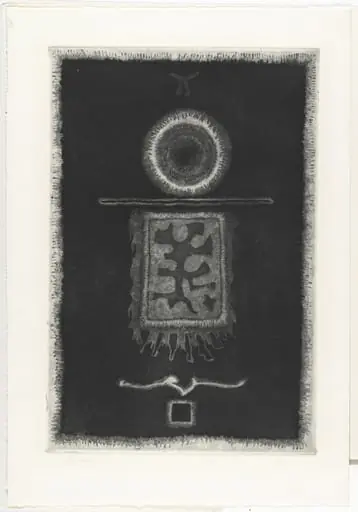
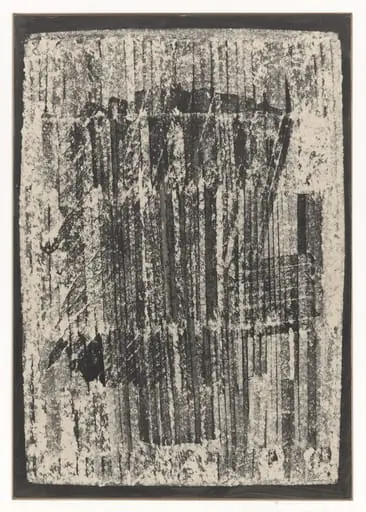
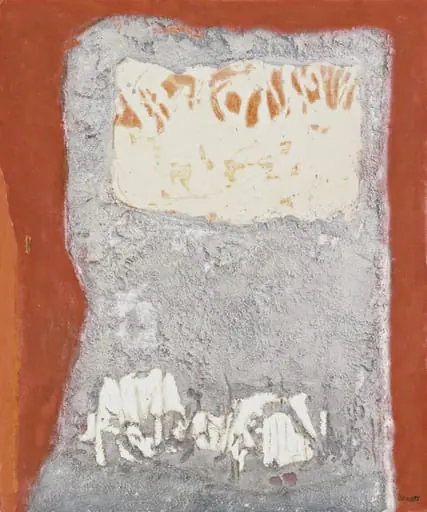
Created in 1992 by Pantelis Dry Winter, this print is part of the Museum of Ethnography’s collection. It presents a minimalist composition centered on a stark white rectangular sign, set against a textured, deep brown field. The work avoids narrative detail, focusing instead on form, contrast, and spatial ambiguity. Its quiet presence invites contemplation rather than immediate interpretation.
Subject & Meaning
The central white sign, geometric and isolated, resists clear identification—its text or purpose is absent. Positioned near a faint curved line that suggests a horizon, it evokes themes of direction, absence, or markers in barren landscapes. The lack of context transforms the sign into a universal symbol, open to readings of navigation, loss, or human intervention in nature.
Technique & Style
The artist employed a printmaking method that emphasized tactile surface, with the background showing coarse, organic texture achieved through layered ink or relief. The sign’s clean, sharp edges contrast with the surrounding grain, creating visual tension. Color is restrained—earthy browns and white—enhancing the work’s austerity and formal balance.
History & Provenance
The work entered the Museum of Ethnography’s holdings shortly after its creation. No public record of prior ownership or exhibition history exists beyond its inclusion in the museum’s permanent collection. Its acquisition aligns with the institution’s interest in contemporary works that engage with cultural symbols and spatial abstraction.
Context
Emerging from a period when Greek artists were re-examining identity through minimal forms, Dry Winter’s work reflects a broader regional trend toward abstraction rooted in landscape and memory. The piece avoids political or folk references, instead favoring elemental imagery that resonates with universal experiences of place and displacement.
Legacy
Though not widely reproduced, the work is cited in academic discussions on post-1980s Greek printmaking for its restrained aesthetic. It contributes to a quiet lineage of artists who use simplicity to explore absence and ambiguity. Its presence in a museum of ethnography underscores its role as a cultural artifact shaped by perception rather than documentation.
Artist & collection
Artist
Pantelis Dry Winter made prints that turn quiet moments into sharp, unexpected shapes.