Artwork
The Entombment
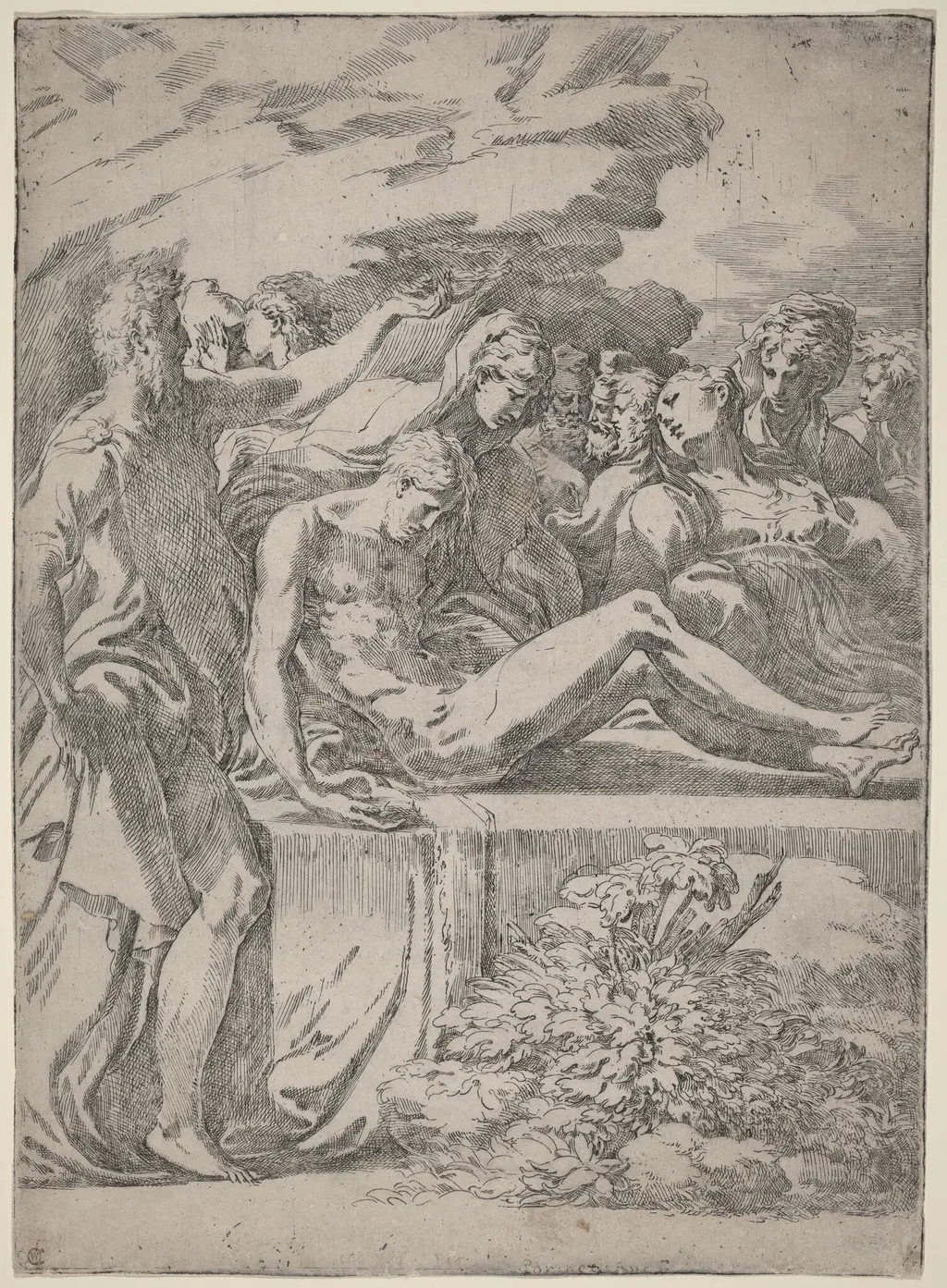
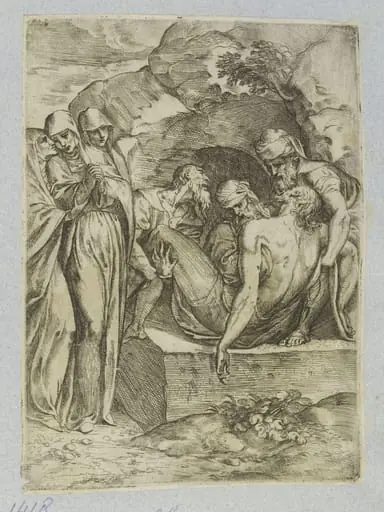
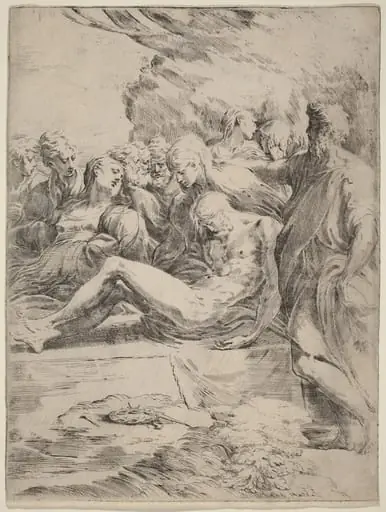
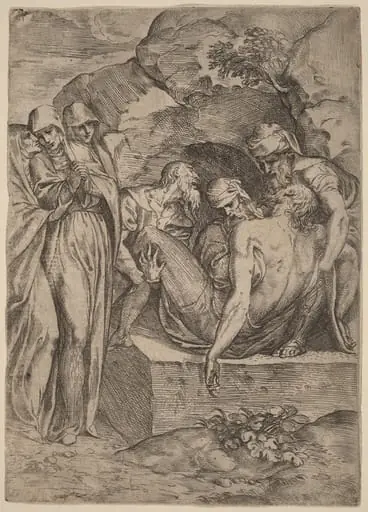
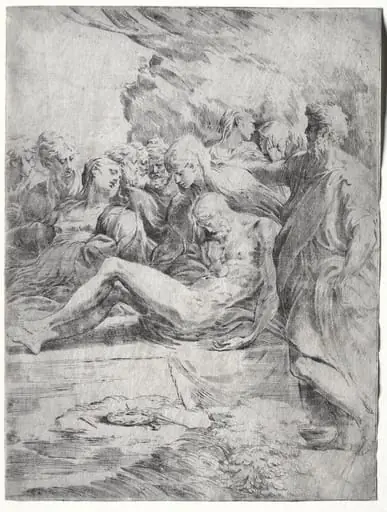
The Entombment is an ink print by the Renaissance artist Parmigianino. It dates from 1530 and is held in the collection of the National Gallery of Art.
About this work
Overview
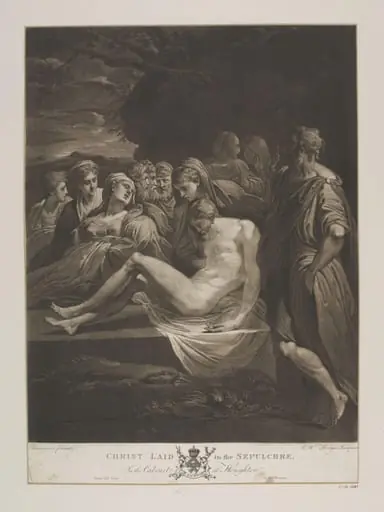
Created around 1530, *The Entombment* is a print by Parmigianino executed in etching and drypoint on laid paper. It captures a moment from the burial of Christ, rendered with the delicate line work and tonal subtlety typical of his graphic work. Unlike his paintings, this piece reveals his mastery of printmaking, where fine incisions and varied pressure produce rich textures and emotional nuance.
Subject & Meaning
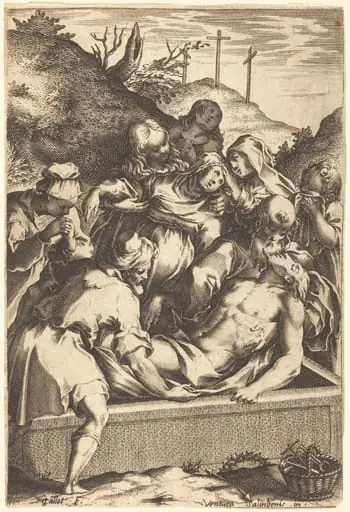
The scene portrays Christ’s body being lowered into a tomb by a group of mourners, including Joseph of Arimathea and Mary Magdalene.
The scene portrays Christ’s body being lowered into a tomb by a group of mourners, including Joseph of Arimathea and Mary Magdalene. The composition emphasizes quiet solemnity rather than dramatic anguish. Figures are arranged in a compact, inward-turning group, focusing attention on the stillness of the dead Christ and the weight of the moment, reflecting a contemplative interpretation of the event.
Technique & Style
Parmigianino employed etching to outline forms and drypoint to deepen shadows and add tactile texture. The fine, meandering lines capture the drapery’s folds and the softness of skin, while the drypoint’s burr creates velvety blacks that enhance emotional depth. His elongated figures and refined contours align with Mannerist ideals, prioritizing elegance and expressive distortion over naturalism.
History & Provenance
The print was made during Parmigianino’s time in Rome, where he was influenced by classical sculpture and the works of Raphael. Few impressions survive from the original plate, and those that do are held in major museum collections. Its rarity and technical sophistication suggest it was produced in limited numbers, likely for collectors and connoisseurs rather than mass distribution.
Context
In the 1520s and 1530s, Italian artists increasingly turned to printmaking as a means of disseminating their designs. Parmigianino’s prints, including this one, circulated widely among artists and patrons, helping to spread his distinctive Mannerist style. His work stood apart from the more robust engravings of his contemporaries, favoring lyrical precision over monumental force.
Legacy
Parmigianino’s *The Entombment* influenced later printmakers through its integration of painterly sensitivity into graphic form. Its delicate handling of line and emotion became a model for artists exploring the expressive potential of etching. Though less known than his paintings, the print remains a key example of how Mannerist aesthetics translated effectively into the medium of print.
Artist & collection

Artist
Girolamo Francesco Maria Mazzola (11 January 1503 – 24 August 1540), also known as Francesco Mazzola or, more commonly, as Parmigianino (UK: , US: , Italian: ; "the little one from Parma"), was an Italian Mannerist…