Artwork
Two Drawings of Ships (verso)
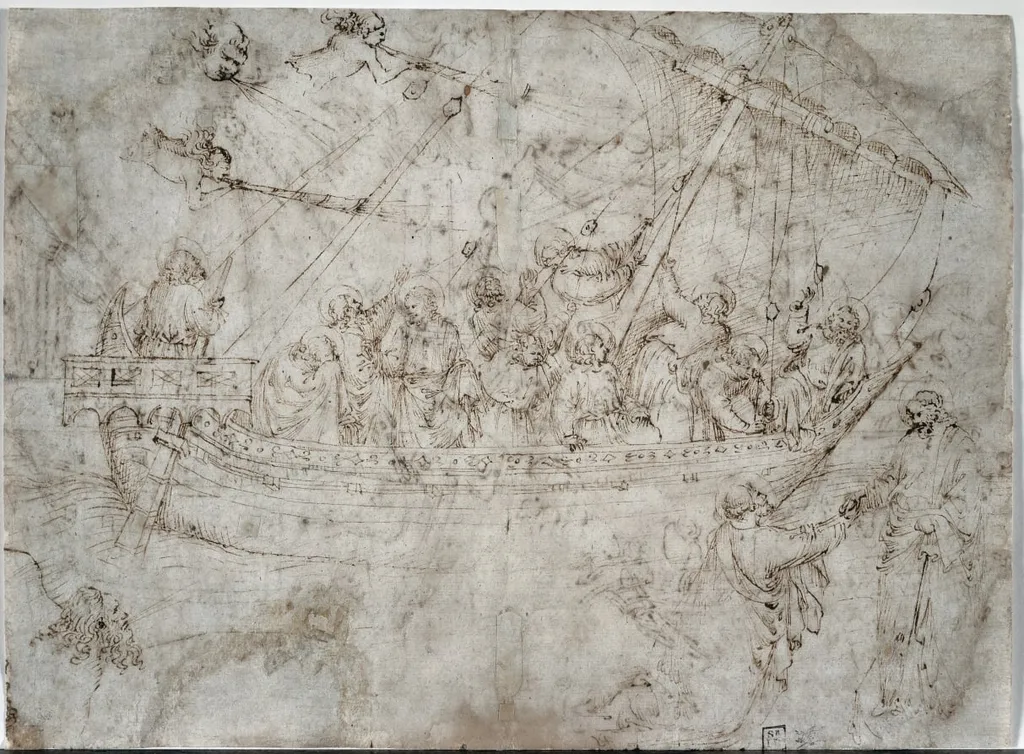
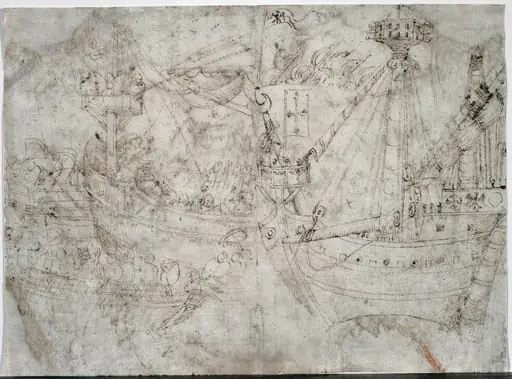
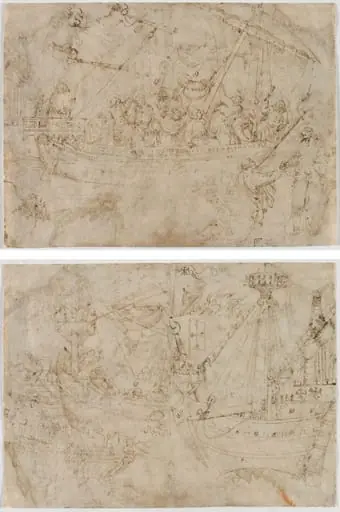
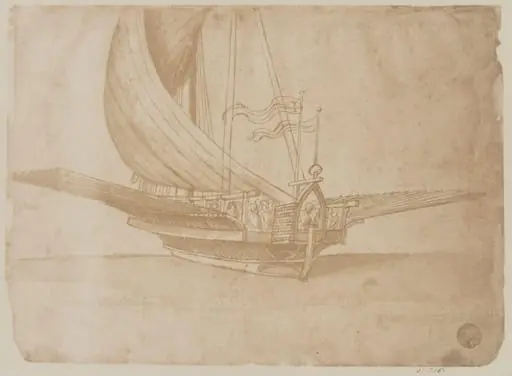
Two Drawings of Ships (verso) is a drawing by the Renaissance artist Parri Spinelli. It dates from 1414 and is held in the collection of the Cleveland Museum of Art. The sheet contains two modest sketches of vessels, one leaning to the left and the other drawn in a more level pose.
About this work
The sheet was once thought to be by Giotto himself, which tells you how closely Spinelli studied his teacher’s work.
You see two quick sketches of ships on one sheet of paper—one ship tilts left, the other rides straight.
These aren’t original designs; Parri Spinelli copied them from a mosaic Giotto made for Old St. Peter’s in Rome. The sheet was once thought to be by Giotto himself, which tells you how closely Spinelli studied his teacher’s work.
To see how early artists built on each other’s ideas, look up artist: Parri Spinelli (Italian, 1387–c. 1453).
Overview
The sheet contains two modest sketches of vessels, one leaning to the left and the other drawn in a more level pose. Executed in pen on paper, the drawings are modest in scale and serve as studies rather than finished compositions. They represent a rare surviving example of a medieval artist’s practice sheet, preserving the visual language of maritime forms used in larger decorative programs.
Subject & Meaning
Both images depict generic ships, likely intended to illustrate the types of vessels that would have appeared in a narrative scene. The tilted ship suggests movement or a turning maneuver, while the upright vessel conveys stability. As studies, they functioned as visual references for larger works, helping the artist translate complex maritime details into a broader compositional context.
Technique & Style
The drawings are rendered with swift, confident strokes of a fine pen, emphasizing outline over shading. The line work reflects the linear clarity characteristic of early Italian drawing, with an emphasis on proportion and the basic geometry of hulls. The simplicity of the sketches indicates they were preparatory, capturing the essential shape without decorative embellishment.
History & Provenance
Long regarded as an original work by Giotto, the sheet is now identified as a copy made by Parri Spinelli, a Florentine painter active in the early 15th century. Spinelli reproduced the designs from a mosaic that Giotto created for the portico of Old St. Peter’s in Rome. The drawing entered the Cleveland Museum of Art’s collection as its earliest dated paper work, illustrating the shifting attributions that accompany medieval artworks.
Context
The original mosaic, part of Giotto’s decorative program for the entrance of Old St. Peter’s, combined narrative scenes with architectural framing. Spinelli’s copies demonstrate how later artists studied and transmitted the visual solutions of their predecessors, especially in the depiction of complex subjects such as ships. This practice of copying served both pedagogical and practical purposes within workshop traditions of the period.
Artist & collection

Artist
Parri Spinelli (c. 1387 – 1453) was an Italian (Tuscan) painter of the early renaissance who was born in the Province of Arezzo. His father and teacher was Spinello Aretino (1350–1410), who was active throughout…

![Hercules Leaning on His Club [recto], by Parri Spinelli](https://artifactworldgallery.com/img/parri-spinelli--hercules-leaning-on-his-club-recto--1ed658247dda4bac-w320.webp)
![Gothic Vault [verso], by Parri Spinelli](https://artifactworldgallery.com/img/parri-spinelli--gothic-vault-verso--460e34f7da8824d7-w320.webp)