Artwork
The Legend of St. Kenelm, King of Mercia
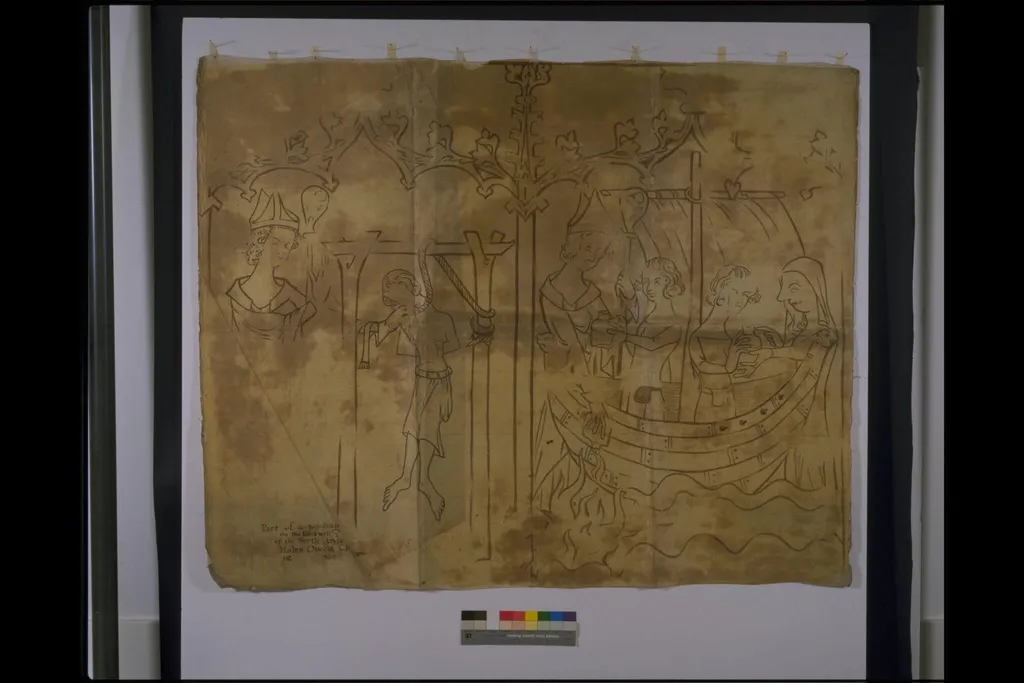
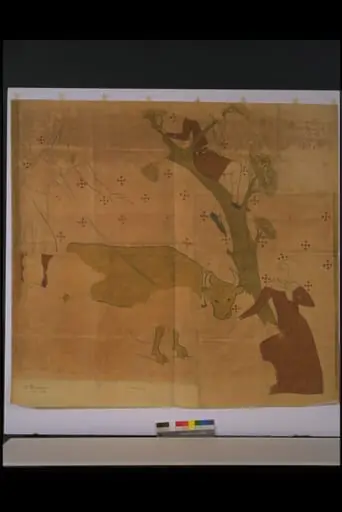
The Legend of St. Kenelm, King of Mercia is a watercolor work on paper by the Romanticist artist Unknown. It dates from 1839 and is held in the collection of the Victoria and Albert Museum. Created in 1839, this watercolour by H.
About this work
Overview
The work reflects a 19th-century interest in documenting ecclesiastical art before it vanished, serving as both record and tribute to a forgotten fresco cycle.
Created in 1839, this watercolour by H.P. Colburn (monogrammed 'HPC') is a faithful reproduction of lost 13th-century wall paintings from Hales Owen Church in Shropshire. Composed of two joined sheets, it preserves visual details of a medieval narrative that no longer exists in its original form. The work reflects a 19th-century interest in documenting ecclesiastical art before it vanished, serving as both record and tribute to a forgotten fresco cycle.
Subject & Meaning
The three panels depict episodes from the legend of St. Kenelm, a young Mercian king martyred in the 9th century. The left panel shows his coronation and piety; the center, his crucifixion by conspirators; the right, the miraculous discovery of his body by a dove guiding monks to a grave beside a shipwreck. The ship and flames symbolize divine intervention, reinforcing the sanctity of his death and the legitimacy of his veneration.
Technique & Style
Executed in delicate watercolour, the work employs fine linework and muted tones to emulate the faded appearance of the original medieval frescoes. Figures are rendered with simplified forms and minimal shading, prioritizing narrative clarity over naturalism. The composition is flat and sequential, echoing medieval manuscript illumination rather than Renaissance perspective, aligning with the artist’s intent to replicate rather than reinterpret.
History & Provenance
The original 13th-century wall paintings at Hales Owen Church deteriorated over time and were lost by the 19th century. H.P. Colburn, an antiquarian artist, created this watercolour as part of a broader effort to preserve endangered religious imagery. The work entered the Victoria and Albert Museum’s collection, where it remains as one of the few surviving visual records of the lost cycle, valued for its documentary precision.
Context
In the early 1800s, a revival of interest in medieval art and ecclesiastical history prompted scholars and artists to document deteriorating church decorations. Colburn’s watercolour aligns with this movement, reflecting the Gothic Revival’s reverence for pre-Reformation England. Such works were often commissioned by institutions seeking to archive cultural heritage before industrialization and neglect erased it.
Legacy
Though not widely exhibited, this watercolour endures as a key reference for historians studying medieval hagiography and the transmission of religious imagery. Its survival offers insight into how 19th-century antiquarians approached preservation—not through restoration, but through careful transcription. It stands as a quiet testament to the fragility of visual memory and the efforts made to sustain it.
Artist & collection

 Domestic Scene
 Giacomo and Cardinal Marco, investing Andrea, Abbot of San Zeno, with his Benefice
 The Nymph of Fontainebleau
 Portrait of a Woman
 Madonna and Child with Saints in the Enclosed Garden
 Venus and Minerva
 Family Group of Four on Sofa
 Wall painting from Room H of the Villa of P. Fannius Synistor at Boscoreale
 Two Drawings of Ships (verso)
 Navicella (recto)
 Navicella (recto); Two Drawings of Ships (verso)
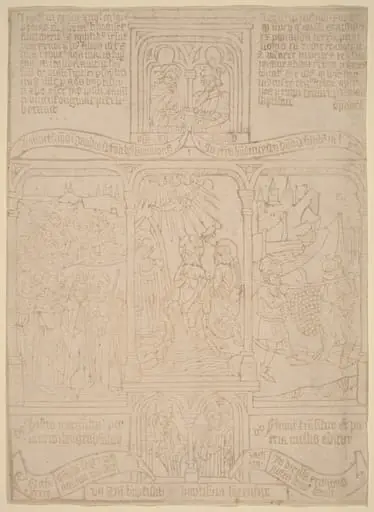 The Baptism of Christ; Pharoah Passing through the Red Sea; Joshua and Caleb
 Untitled
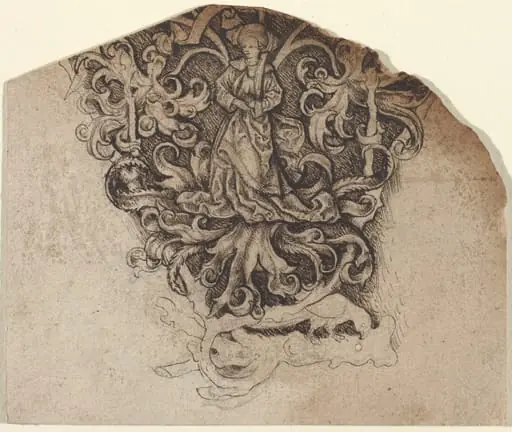 Gothic Ornament with a Lady and a Parrot
 Untitled
 Alma Mater: Fragment
 Martirul Eustatiu
 The Head of Saint George and Architectural Plans (verso)
 Original cartoon for the decoration of panels in the Grill Room of the Victoria and Albert Museum; "January."
 The Legend of St. Kenelm, King of Mercia