Artwork
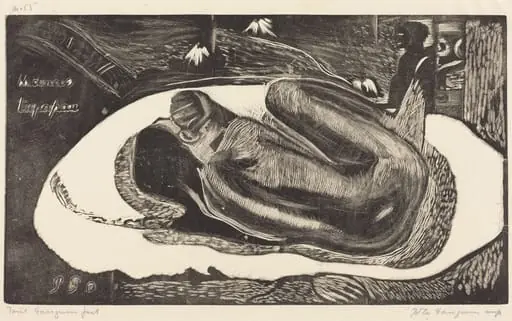
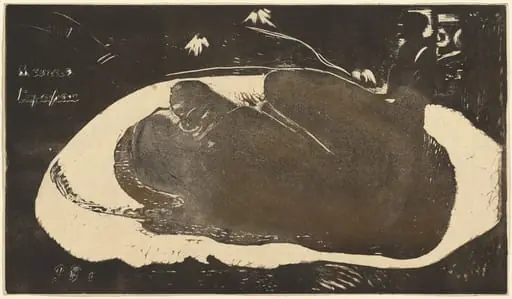
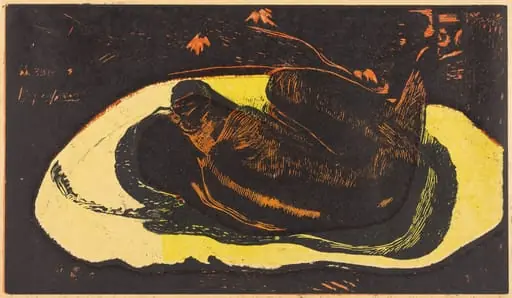
Noa Noa: Manao Yupapau ( Watched by the Spirts of the Dead)
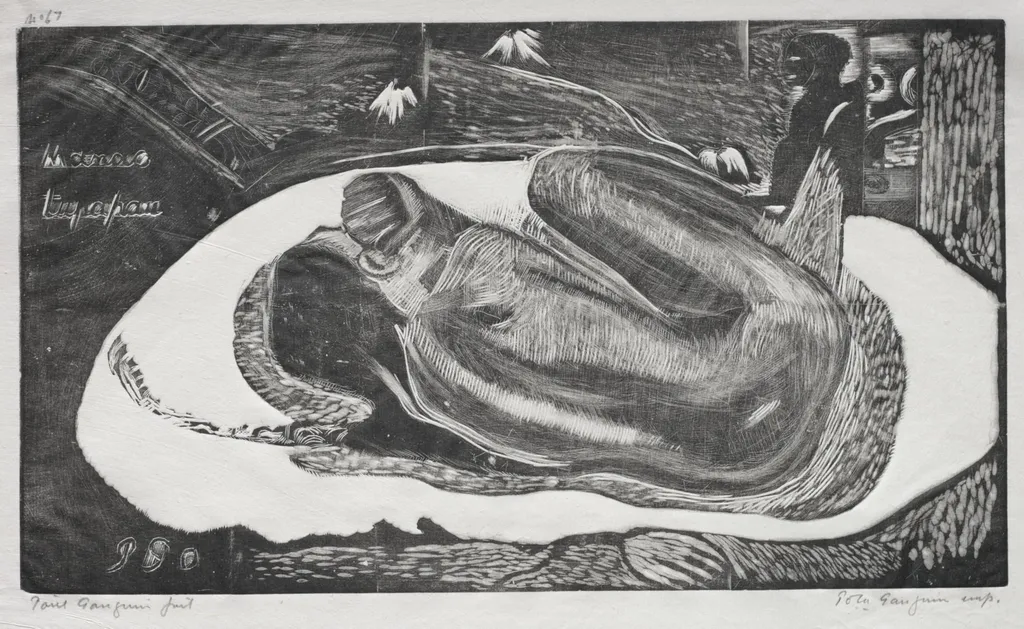
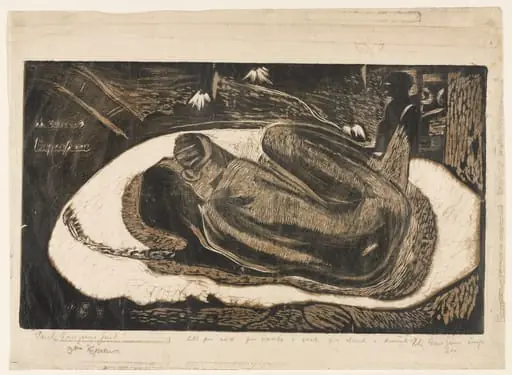
Noa Noa: Manao Yupapau ( Watched by the Spirts of the Dead) is a print by the Impressionist artist Paul Gauguin. It dates from 1894 and is held in the collection of the Cleveland Museum of Art.
About this work
Overview
Created in 1894 during Paul Gauguin’s time in Tahiti, this print is part of his *Noa Noa* series, which visualized his experiences and imagined spiritual narratives of the islands. Executed as a woodcut with hand-coloring, it merges printmaking with painterly expression, reflecting his departure from European artistic conventions and his search for alternative cultural and aesthetic truths.
Subject & Meaning
The image centers on a reclining nude woman, her form rendered with simplified contours, seemingly unaware of a dark, amorphous shape behind her—interpreted as a spirit or ancestral presence. The title, meaning 'She Thinks of the Dead,' suggests a quiet communion between the living and the unseen, drawing from Tahitian beliefs about the permeability between worlds, rather than European notions of the supernatural.
Technique & Style
Gauguin employed a woodcut technique, carving bold, incised lines that define the figure and background with a rough, tactile quality.
Gauguin employed a woodcut technique, carving bold, incised lines that define the figure and background with a rough, tactile quality. Flat planes of color, applied by hand, contrast with the textured, sketch-like edges of the paper, which suggest foliage or movement. The composition avoids perspective and modeling, favoring symbolic form over naturalism, aligning with Synthetist principles of emotional and spiritual synthesis.
History & Provenance
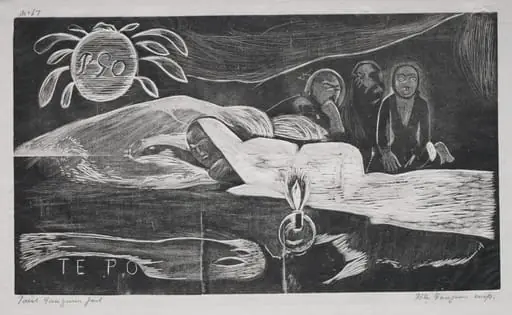
Made during Gauguin’s second stay in Tahiti, the print was produced for his illustrated book *Noa Noa*, intended to accompany his written accounts of island life. Though the book was never fully realized as planned, individual prints like this one circulated among his circle and later entered museum collections, serving as tangible fragments of his broader project to reconstruct identity through non-Western imagery.
Context
Gauguin’s relocation to Tahiti was driven by a desire to escape European modernity and engage with what he perceived as an uncorrupted, spiritual culture. This print reflects his selective interpretation of Polynesian mythology and his tendency to project his own psychological and artistic needs onto the landscape and people, blending observation with invention in pursuit of a deeper symbolic reality.
Legacy
The print contributed to the broader reception of Gauguin as a pioneer of primitivism and symbolic art. Its raw, expressive technique influenced later Expressionist and modernist printmakers who valued emotional immediacy over technical polish. While his cultural representations remain contested, the work endures as a key example of how artists in the late 19th century redefined visual language through cross-cultural engagement.
Artist & collection
Artist
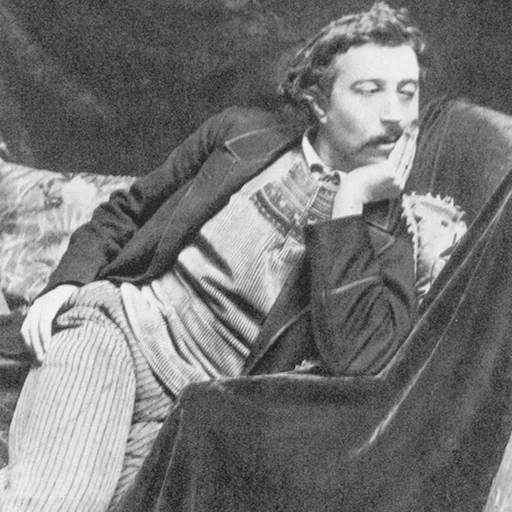
Eugène Henri Paul Gauguin (; French: ; 7 June 1848 – 8 May 1903) was a French painter, sculptor, printmaker, ceramist, and writer, whose work has been primarily associated with the Post-Impressionist and Symbolist movements.