Artwork
Untitled
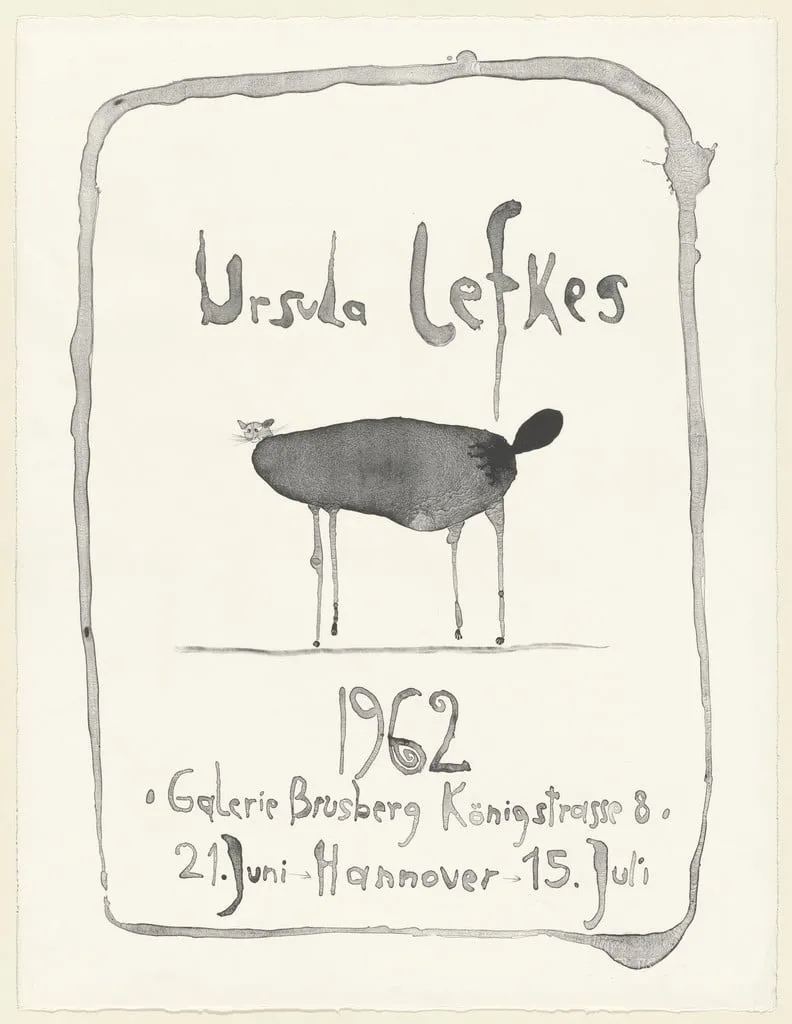
Untitled is an ink print by Paul Wunderlich. It dates from 1962 and is held in the collection of the Museum of Modern Art.
About this work
Below the sheep, the year "1962" and an address in Hannover are scribbled in messy ink.
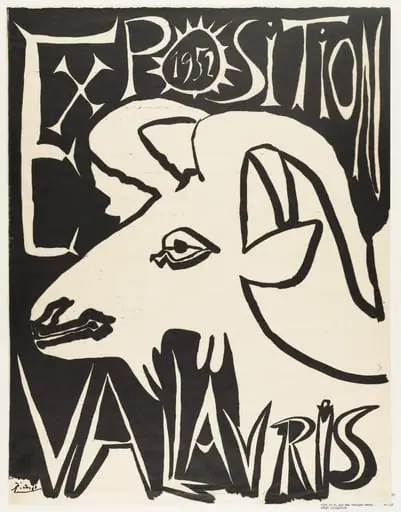
This poster shows a simple black sheep standing on four thin legs. Above it, the name "Ursula Lefkes" is written in uneven, hand-drawn letters. Below the sheep, the year "1962" and an address in Hannover are scribbled in messy ink.
The sheep looks almost like a shadow, with no real details—just solid black. The edges of the poster are jagged, like someone tore the paper.
Look up lithography next to see how artists print images like this.
Overview
This 1962 lithograph by Paul Wunderlich is a minimalist poster print, notable for its raw, unpolished appearance. It features a solid black silhouette of a sheep, accompanied by handwritten text including a name, year, and Hannover address. The edges are deliberately torn, suggesting an informal, almost ephemeral quality. Unlike commercial posters, it resists conventional design, prioritizing immediacy over refinement.
Subject & Meaning
The lone black sheep, rendered without detail, evokes isolation or anonymity. The inclusion of 'Ursula Lefkes'—possibly a person’s name—and a specific address grounds the image in a personal or local context, though no explicit narrative is provided. The absence of explanation invites interpretation: is this a memorial, a note, or a private gesture disguised as public art?
Technique & Style
Executed in lithography, the image relies on the medium’s capacity for tonal contrast and hand-drawn marks. The sheep is a flat, inked silhouette, contrasting with the irregular, ink-blotted handwriting that surrounds it. The torn borders and uneven script reject mechanical precision, embracing a handcrafted, almost spontaneous aesthetic that blurs the line between art and artifact.
History & Provenance
Created in 1962, the work entered the collection of The Museum of Modern Art, where it is preserved as part of its graphic design and print holdings. Its origins as a poster suggest a possible connection to a local event, exhibition, or personal initiative in Hannover. No record of public display or commission exists, reinforcing its sense of private or experimental intent.
Context
In early 1960s Germany, artists like Wunderlich were exploring figuration beyond traditional realism, often incorporating text and found aesthetics. This work aligns with broader postwar tendencies to challenge formal boundaries in printmaking, favoring personal expression over institutional norms. Its unpolished form reflects a broader cultural shift toward authenticity in artistic production.
Legacy
Though not widely reproduced, this piece contributes to understanding Wunderlich’s engagement with print as a direct, intimate medium. Its inclusion in MoMA’s collection signals its value as an example of artist-driven, non-commercial graphic work from the period. It remains a quiet testament to the power of simplicity and imperfection in postwar European art.
Artist & collection

Artist
Paul Wunderlich was a German painter, sculptor and graphic artist. He designed Surrealist paintings and erotic sculptures. He often created paintings which referred to mythological legends.