Artwork
Untitled
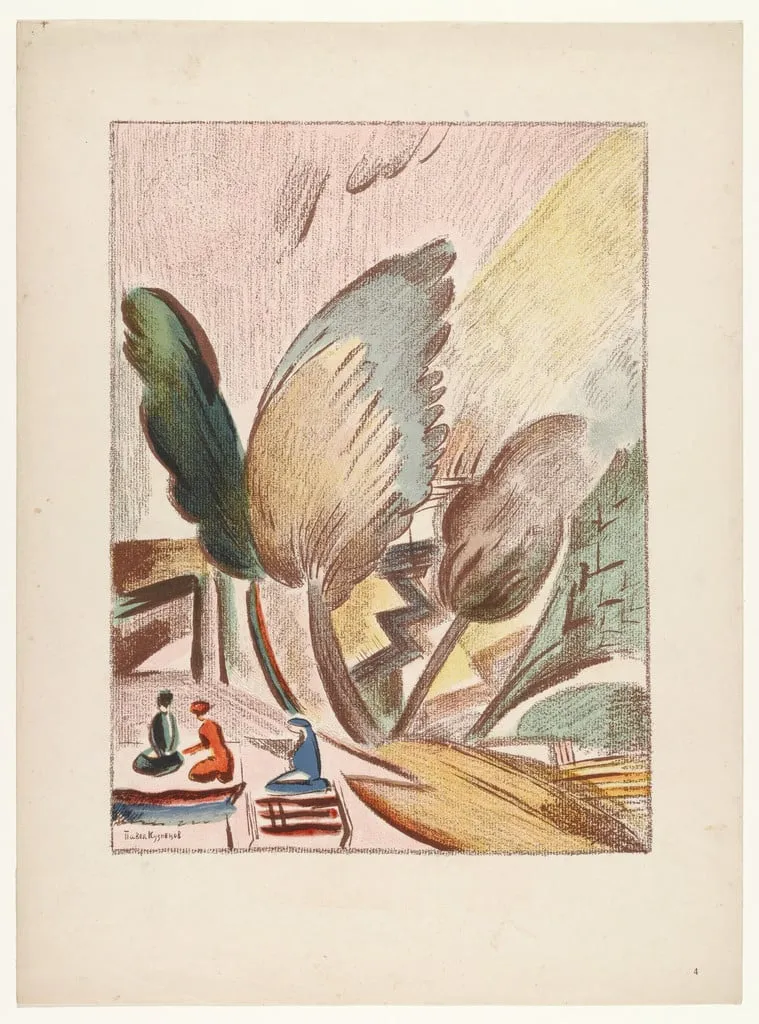
Untitled is an ink print by Pavel Kuznetsov. It dates from 1923 and is held in the collection of the Museum of Modern Art.
About this work
Overview
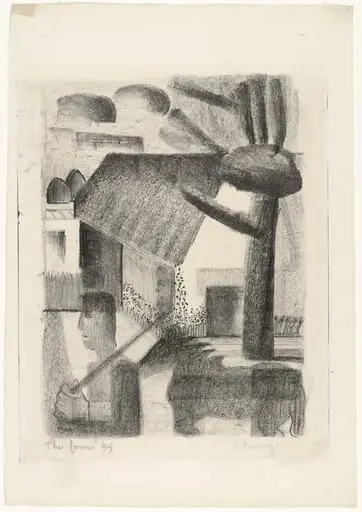
Created in 1923, this lithograph by Pavel Kuznetsov is part of The Museum of Modern Art’s print collection. It is an offset-printed work that exemplifies early 20th-century Russian avant-garde sensibilities. The image presents a quiet interior scene disrupted by surreal external elements, blending domestic stillness with fantastical imagery through flat, unmodulated color and simplified forms.
Subject & Meaning
The birds, devoid of detail yet commanding presence, may symbolize inner emotion, spiritual presence, or the unconscious breaking through routine.
A solitary figure sits by a window, clad in a red coat and dark trousers, facing an impossible sight: two enormous blue-green birds perched on the ledge outside. Their scale and stillness defy natural logic, suggesting a dreamlike intrusion into everyday life. The birds, devoid of detail yet commanding presence, may symbolize inner emotion, spiritual presence, or the unconscious breaking through routine.
Technique & Style
The image was produced using lithographic printing, a method allowing sharp, flat color fields. Kuznetsov employs bold, unshaded hues and clean outlines, rejecting naturalistic modeling. The composition reduces architecture and foliage to geometric shapes, enhancing the otherworldly tone. The lack of perspective and shadow reinforces a symbolic, rather than observational, approach to space and form.
History & Provenance
Made in 1923, during Kuznetsov’s active years in the Russian avant-garde, the work reflects the experimental spirit of post-revolutionary art circles. It entered The Museum of Modern Art’s collection through established acquisition channels in the mid-20th century, likely as part of broader efforts to document non-Western modernist practices. Its preservation underscores its significance within early Soviet graphic art.
Context
Kuznetsov worked amid a surge of artistic experimentation in 1920s Russia, where traditional representation gave way to abstraction and symbolism. This print aligns with contemporaneous movements that fused folk motifs, spiritual themes, and surreal imagery. While not overtly political, its dreamlike quality resonated with artists seeking new modes of expression beyond realism or propaganda.
Legacy
The work contributes to the recognition of Russian printmakers who expanded the boundaries of lithography beyond commercial use. Its dreamlike juxtapositions influenced later generations interested in the psychological dimensions of visual form. Though not widely reproduced, it remains a quiet but distinct example of how surrealism emerged independently in early Soviet art.
Artist & collection