Artwork
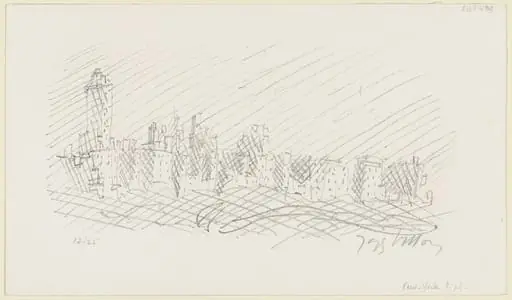
New York from Brooklyn
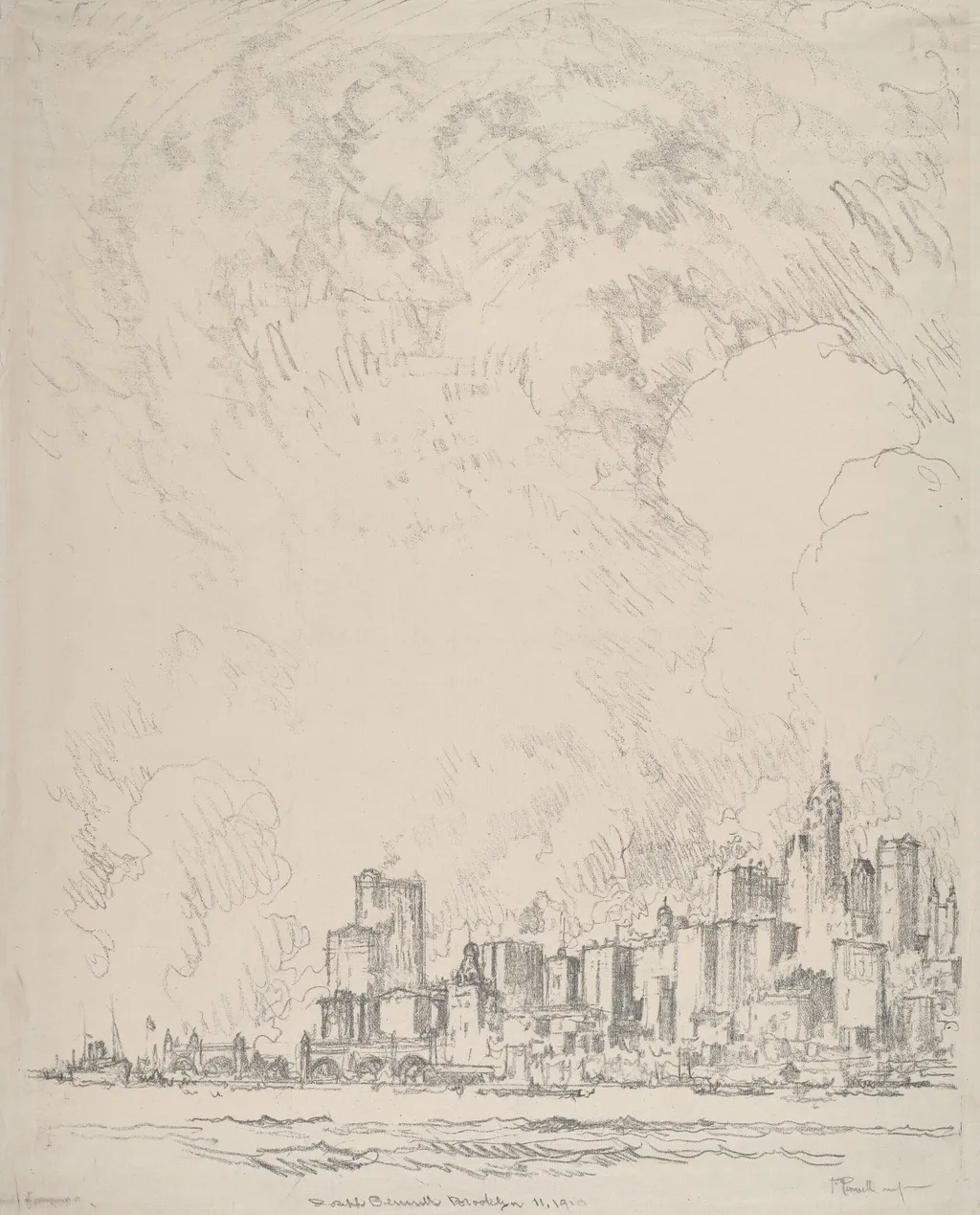
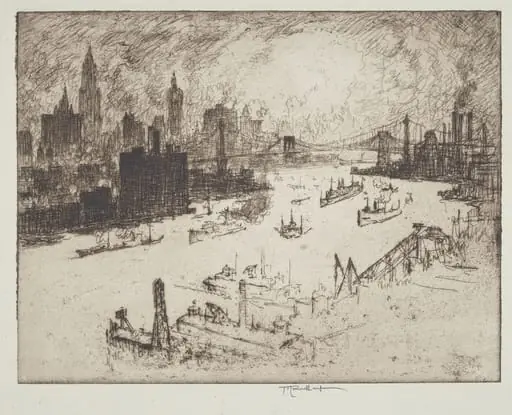
New York from Brooklyn is an ink print by Joseph Pennell. It dates from 1910 and is held in the collection of the National Gallery of Art.
About this work
Tall buildings with spires and domes line the horizon, while a bridge stretches across the middle.
This sketch shows a city skyline across a body of water. Tall buildings with spires and domes line the horizon, while a bridge stretches across the middle. The lines are loose and quick, like a hurried drawing.
The artist signed it in the corner—*"Pennell"*—and dated it 1910. The whole thing looks like it was made fast, almost like a quick note of what they saw.
Want to see more by this artist? Check out Pennell, Joseph.
Overview
Created in 1910, Joseph Pennell’s lithograph *New York from Brooklyn* captures the Manhattan skyline as viewed from across the East River. Executed with swift, expressive lines, the print reflects the artist’s interest in modern urban landscapes. Its loose, almost spontaneous draftsmanship suggests a direct observation made on the spot, emphasizing movement and scale over精细 detail. Pennell signed and dated the work in the lower corner, affirming its immediacy as a personal record of the city’s evolving form.
Subject & Meaning
The composition centers on the dense cluster of Manhattan’s early skyscrapers, punctuated by spires and domes, with the Brooklyn Bridge arcing prominently through the foreground. Rather than idealizing the city, Pennell presents it as a dynamic, assembled structure—industrial, layered, and alive. The bridge functions as both a literal connector and a visual metaphor for the relationship between boroughs, grounding the viewer’s perspective in a specific, tangible location.
Technique & Style
Pennell employed lithography to achieve a fluid, sketch-like quality, using rapid, gestural lines that mimic the energy of a field drawing. The medium allowed him to translate the immediacy of observation into print, favoring tonal contrasts and loose contours over precise rendering. His approach reflects a modernist sensibility, prioritizing the impression of form and motion over detailed realism, aligning with the aesthetic principles of Whistler and the broader shift toward expressive draftsmanship in early 20th-century printmaking.
History & Provenance
Pennell produced this lithograph during a period when he was actively documenting urban environments across Europe and America. Though he spent much of his career abroad, he returned regularly to the United States to record its architectural transformations. *New York from Brooklyn* is part of a broader series of city views he created between 1900 and 1920, many of which were published in periodicals or exhibited in institutions focused on modern life and industrial progress.
Context
In 1910, Manhattan was undergoing rapid vertical expansion, with new steel-frame buildings redefining the skyline. Pennell’s work responds to this transformation, capturing the city not as a static monument but as an evolving organism. His focus on bridges, cranes, and dense clusters of towers reflects contemporary interest in infrastructure and urban density, aligning with broader cultural conversations about modernity, mobility, and the American metropolis.
Legacy
Pennell’s lithographs, including this one, helped establish urban views as a legitimate subject for fine art printmaking in America. His direct, unembellished style influenced later artists documenting city life, particularly those interested in the intersection of architecture and everyday experience. While not widely celebrated in his time, his body of work is now recognized for its honest, observant portrayal of early modern urbanism.
Artist & collection
Artist
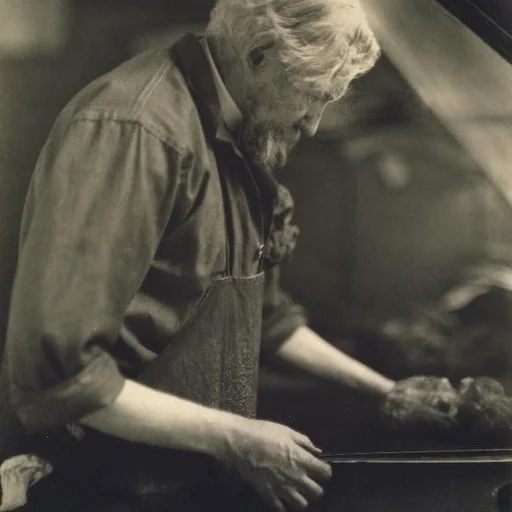
Joseph Pennell (July 4, 1857 – April 23, 1926) was an American draftsman, etcher, lithographer, and illustrator for books and magazines.