Artwork
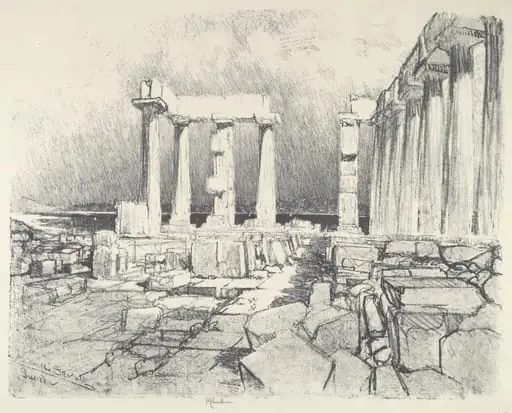
The Facade of the Parthenon, Sunset
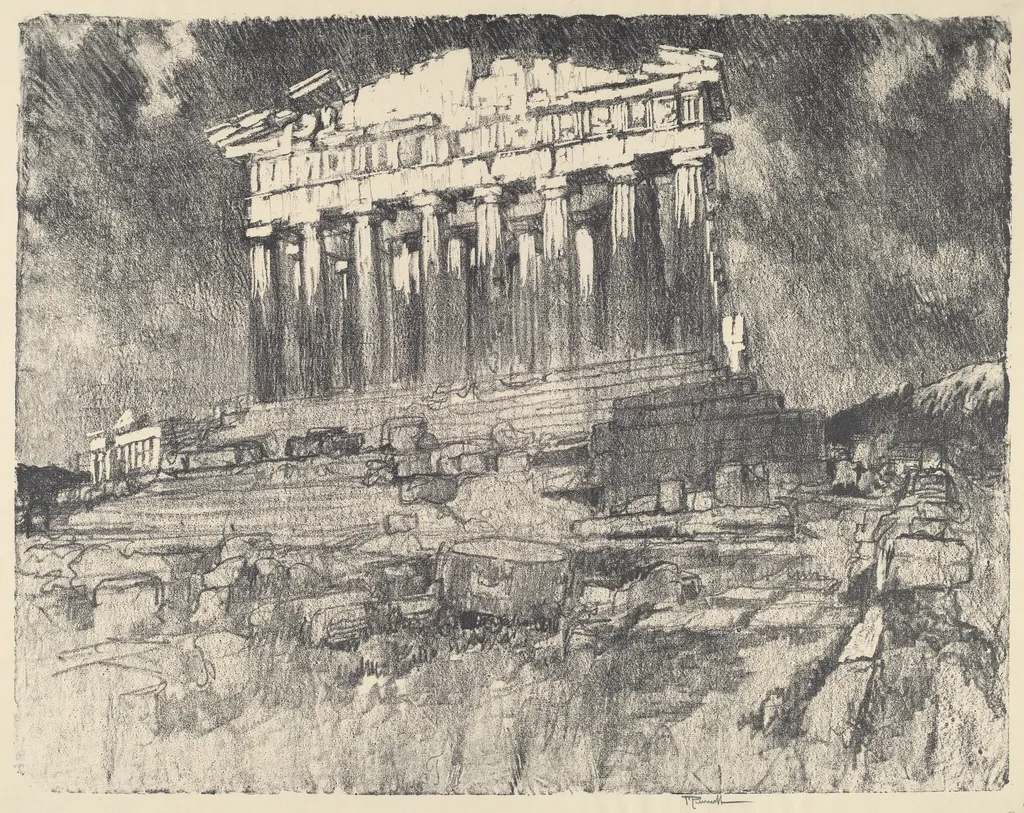
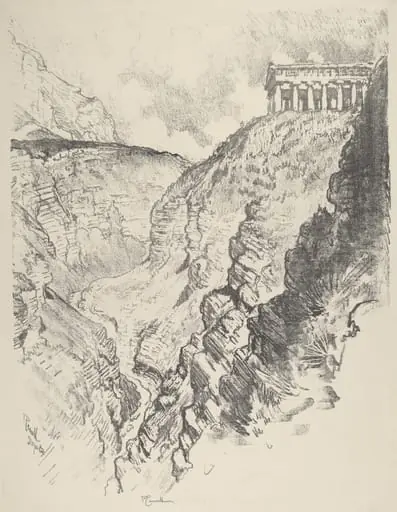
The Facade of the Parthenon, Sunset is an ink print by Joseph Pennell. It dates from 1913 and is held in the collection of the National Gallery of Art.
About this work
Overview
Created during a period when Pennell was deeply engaged with European architecture, the work reflects his fascination with ruins as vessels of time.
Joseph Pennell’s 1913 lithograph captures the Parthenon at twilight, emphasizing its decayed grandeur. Created during a period when Pennell was deeply engaged with European architecture, the work reflects his fascination with ruins as vessels of time. Unlike idealized classical depictions, this image presents the temple as weathered and partially reclaimed by nature, rendered through the tonal subtleties of lithographic technique.
Subject & Meaning
The Parthenon is shown not as a symbol of enduring perfection, but as a fragment of history in quiet decline. Broken steps, uneven walls, and overgrown foundations suggest erosion—both physical and cultural. The long shadows and empty space evoke solitude, inviting reflection on the passage of time rather than celebrating ancient glory. The scene resists nostalgia, instead presenting ruin as a natural condition.
Technique & Style
Pennell employed lithography to achieve a loose, sketch-like quality, using coarse lines and varied ink densities to suggest texture and depth. The rough, unfinished appearance mimics a rapid observational drawing, enhancing the sense of immediacy. Shadows dominate the composition, created through selective ink application rather than detailed rendering, reinforcing the atmosphere of dusk and decay.
History & Provenance
Pennell produced this print during a series of travels across Europe, where he documented historic sites with a focus on their contemporary state. The work was likely made after visits to Athens in the early 1910s, a time when archaeological interest in Greece was growing but preservation efforts remained limited. It was published as part of a broader body of architectural prints circulated among collectors and institutions.
Context
In the early 20th century, artists increasingly turned to ruins as subjects that challenged romanticized views of antiquity. Pennell’s approach aligned with a broader shift toward realism and atmospheric expression, influenced by Whistler’s tonalism and the rise of modern printmaking. His work stood apart from academic depictions by prioritizing mood over accuracy, reflecting a more introspective engagement with heritage.
Legacy
Pennell’s lithograph contributed to a growing genre of architectural prints that treated ruins as poetic rather than monumental. Its emphasis on transience and quiet decay influenced later artists interested in the emotional weight of place. Though not widely exhibited during his lifetime, the work remains a significant example of early modern printmaking’s capacity to convey historical memory through subtle, evocative means.
Own this work as a print
Artist & collection
Artist
Joseph Pennell (July 4, 1857 – April 23, 1926) was an American draftsman, etcher, lithographer, and illustrator for books and magazines.