Artwork
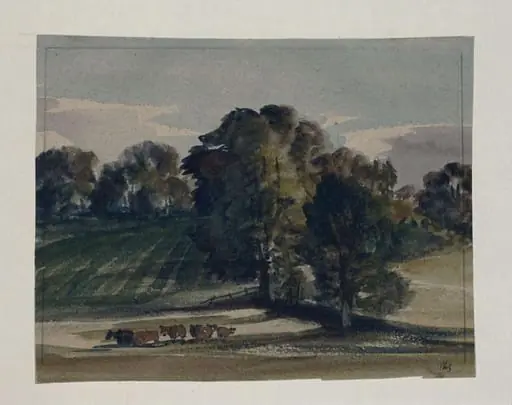
After the rain. Landscape with trees and a pond
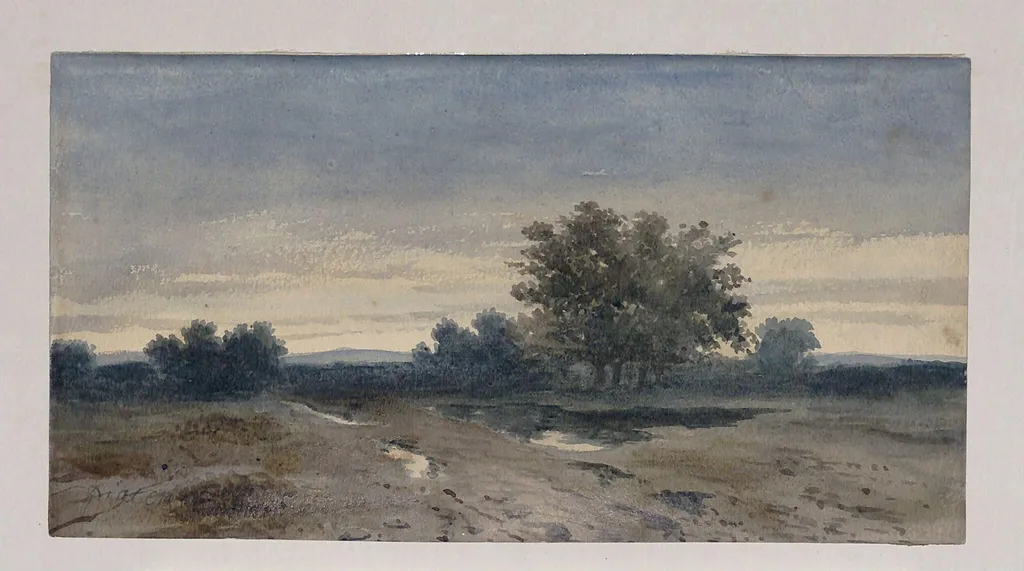
After the rain. Landscape with trees and a pond is a watercolor work on paper by the Impressionist artist Carlo Piacenza. It dates from 1870 and is held in the collection of the Victoria and Albert Museum.
About this work
Overview
The composition centers on a still pond surrounded by trees, with damp earth and scattered puddles reflecting the overcast sky.
Created in 1870 by Carlo Piacenza, this watercolour landscape captures a quiet moment after rainfall. The composition centers on a still pond surrounded by trees, with damp earth and scattered puddles reflecting the overcast sky. The artist signed and dated the work, adding an Italian inscription that anchors it in its time and place. The muted palette and delicate handling suggest a contemplative mood, typical of 19th-century Italian landscape studies.
Subject & Meaning
The scene portrays nature in a state of transition—rain has passed, and the air remains heavy with moisture. Trees, their forms softened by reflection, frame the pond, while the wet ground absorbs the light diffused through cloud cover. There is no human presence, emphasizing solitude and the quiet renewal of the natural world. The inscription may hint at personal reflection, reinforcing the work’s introspective tone.
Technique & Style
Piacenza employed transparent watercolour washes to build subtle gradations of gray, brown, and green. Brushwork is restrained, with soft edges and minimal detail, allowing the paper’s texture to contribute to the sense of dampness. Reflections in the pond are rendered with gentle horizontal strokes, avoiding sharp definition. The technique prioritizes atmosphere over precision, creating a hushed, lyrical effect.
History & Provenance
The work is dated and signed by the artist, suggesting it was intended as a finished piece rather than a sketch. Its Italian inscription indicates a local context, likely created during Piacenza’s active years in northern Italy. While specific ownership history is not documented, its preservation implies it was valued within private or regional collections, possibly among contemporaries interested in landscape studies.
Context
In the late 19th century, Italian artists increasingly turned to intimate natural scenes, moving away from grand historical narratives. Piacenza’s focus on transient weather and quiet rural settings aligns with broader trends in regional landscape painting. Though not part of the Impressionist movement, his sensitivity to light and atmosphere shares affinities with contemporary European approaches to plein air observation.
Legacy
This watercolour remains a modest but evocative example of Piacenza’s engagement with the natural world. It reflects a quiet tradition of Italian landscape art that valued mood and observation over dramatic effect. While not widely exhibited, it contributes to understanding how artists of the period used watercolour to capture fleeting moments of stillness in the countryside.
Artist & collection
Artist
Carlo Piacenza painted quiet Italian landscapes in watercolor during the 1800s, often showing ponds ringed by trees just after rain.

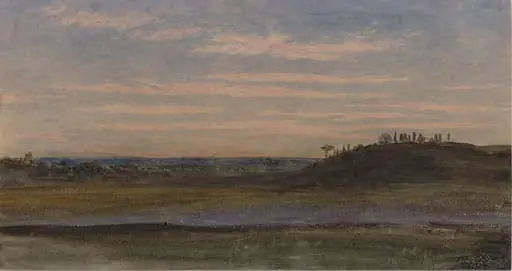 The Campagna, Rome, after sunset
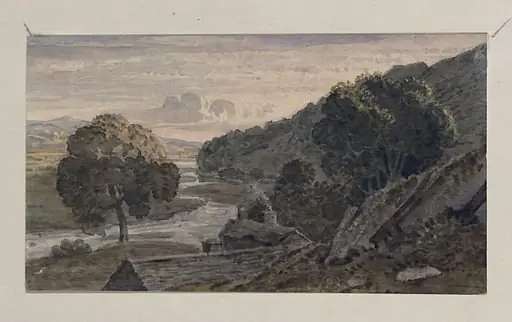 Landscape, with a wiinding river - evening
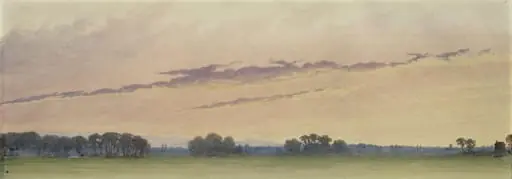 Study of Sky: Afternoon
 Mountains and Cattle
 Landscape
 Landscape with buildings and trees
 Trees at Perry Bar, near Birmingham
 A Yorkshire Road
 Landscape study
 Study of a landscape at sunset
 Landscape with trees and water
 Coneycroft Farm, Compton