Artwork
Comedy
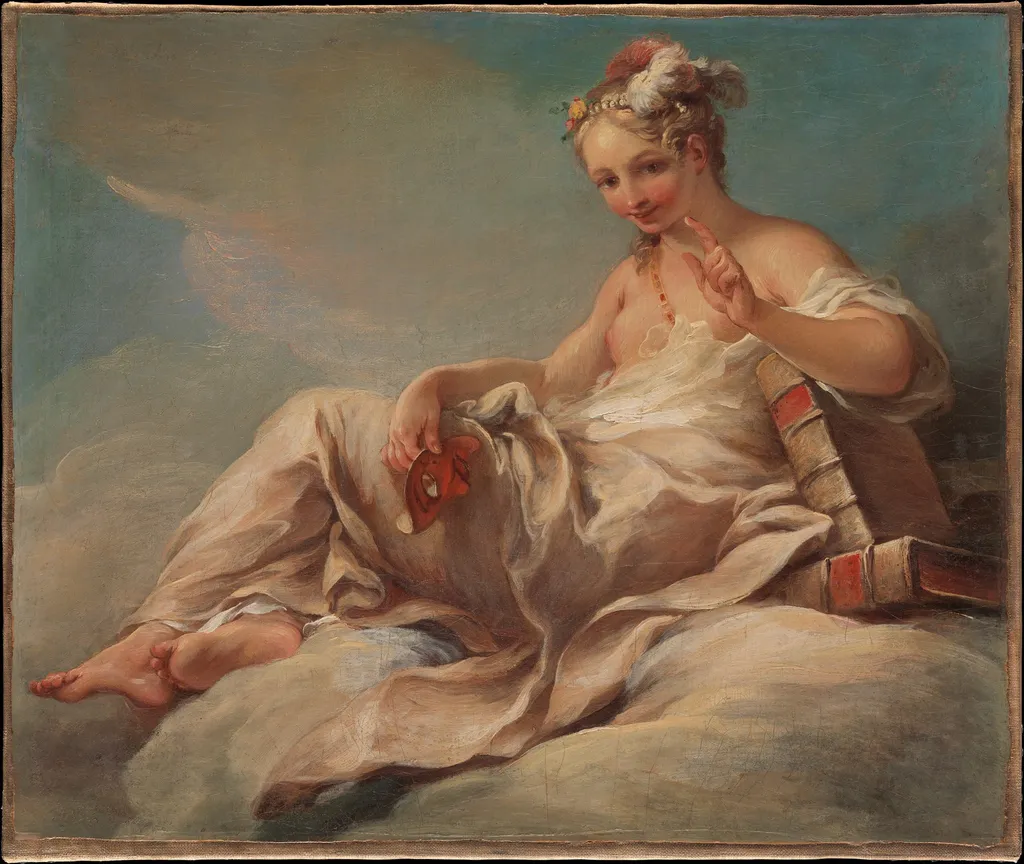
Comedy is an oil painting by the Rococo painting artist Pierre Charles Trémolières. It dates from 1736 and is held in the collection of the Metropolitan Museum of Art.
About this work
Overview
This piece exemplifies the artist's approach to mythological or personified subjects, rendered with a focus on form and light.
Pierre Charles Trémolières's oil painting, Comedy, created in 1736, presents an allegorical figure. The artwork depicts a woman, partially draped, reclining on a cloud while holding a distinctive red mask. This piece exemplifies the artist's approach to mythological or personified subjects, rendered with a focus on form and light. It is currently part of the collection at The Metropolitan Museum of Art.
Subject & Meaning
The painting personifies Comedy through a serene female figure. Lounging amidst soft clouds, she is depicted with a faint smile, her gaze directed outward. In one hand, she delicately holds a vibrant red mask, its simple, stylized form suggesting its theatrical purpose. This attribute clearly identifies her as the embodiment of comedic performance and lightheartedness, a common allegorical motif in 18th-century art.
Technique & Style
Trémolières utilized oil paint to create Comedy, employing chiaroscuro to enhance the dramatic interplay of light and shadow across the canvas. The figure's form emerges from the background through this contrast, with her partially exposed limbs and drapery rendered with a soft luminescence. The surrounding clouds, painted in muted blues and grays, provide an ethereal setting that complements the figure's graceful posture and the vivid color of the mask.
History & Provenance
Completed in 1736, Comedy by Pierre Charles Trémolières has since become part of a prominent public collection. The painting is presently housed at The Metropolitan Museum of Art, where it contributes to the institution's extensive holdings of European art. Its presence there allows for the study and appreciation of 18th-century French painting traditions.
Artist & collection
Artist
Pierre Charles Trémolières (1703–1739) was a French artist, born in Cholet.