Artwork
Vanitas
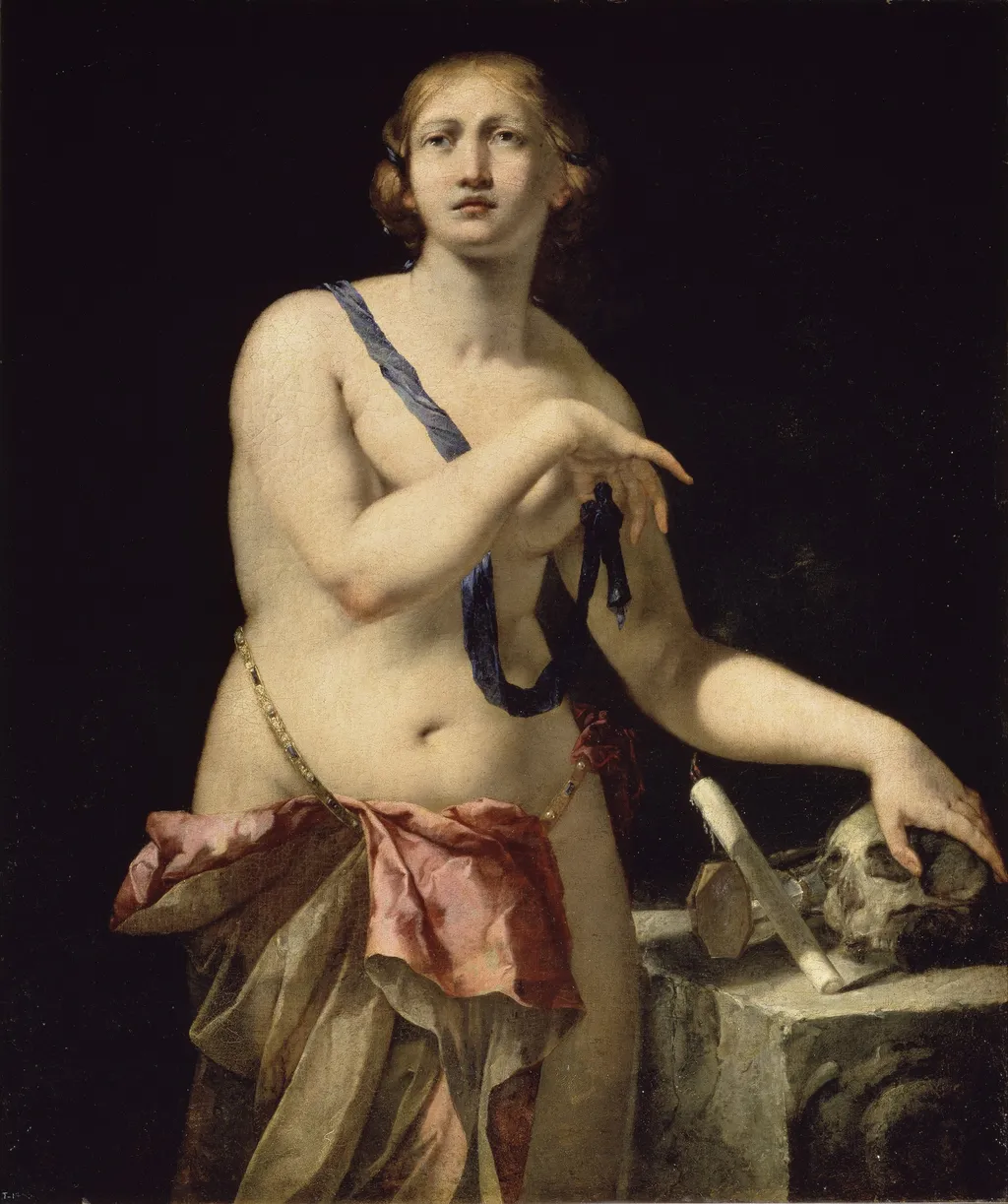
Vanitas is an oil painting by the Early Baroque Italian artist Pietro Negri. It dates from 1662 and is held in the collection of the Museo del Prado.
About this work
Overview
Pietro Negri, a Venetian artist linked to the Baroque tenebrosi tendency, completed the oil painting *Vanitas* in 1662. Executed on canvas, the work belongs to the museum collection of the Prado. It presents a stark still‑life arrangement that incorporates traditional memento mori motifs, inviting contemplation of mortality.
Subject & Meaning
At the centre of the composition stands a solitary woman, her form illuminated against a deep, shadowy backdrop. She is draped in a light fabric over one shoulder, clutching a dark ribbon, while a red blossom is tied to her waist. Adjacent to her, a skull rests on a stone slab, accompanied by a candle stub and an hourglass, all conventional symbols reminding viewers of life's transience.
Technique & Style
Negri employs a pronounced chiaroscuro effect, allowing a focused beam of light to reveal the woman's face and arms while the surrounding space recedes into darkness. This dramatic contrast, characteristic of the tenebrosi, heightens the tactile quality of the textures—fabric, stone, and bone—and reinforces the painting's somber tone.
History & Provenance
Created in the mid‑seventeenth century, *Vanitas* entered the holdings of the Museo del Prado, where it remains part of the permanent collection. Its acquisition reflects the museum’s broader interest in Baroque works that illustrate the period’s preoccupation with moralizing imagery.
Context
The painting aligns with a broader European tradition of vanitas still lifes, which employed objects such as candles, hourglasses, and skulls to symbolize the fleeting nature of earthly existence. Negri’s inclusion of a human figure adds a narrative layer, merging portraiture with the allegorical language common to Baroque moralizing art.
Own this work as a print
Artist & collection
Artist
Pietro Negri (1628, Venice - 31 May 1679, Venice) was an Italian painter in the Baroque style who belonged to the so-called "tenebrosi" (dark or gloomy ones).
