Artwork
Piazza San Marco
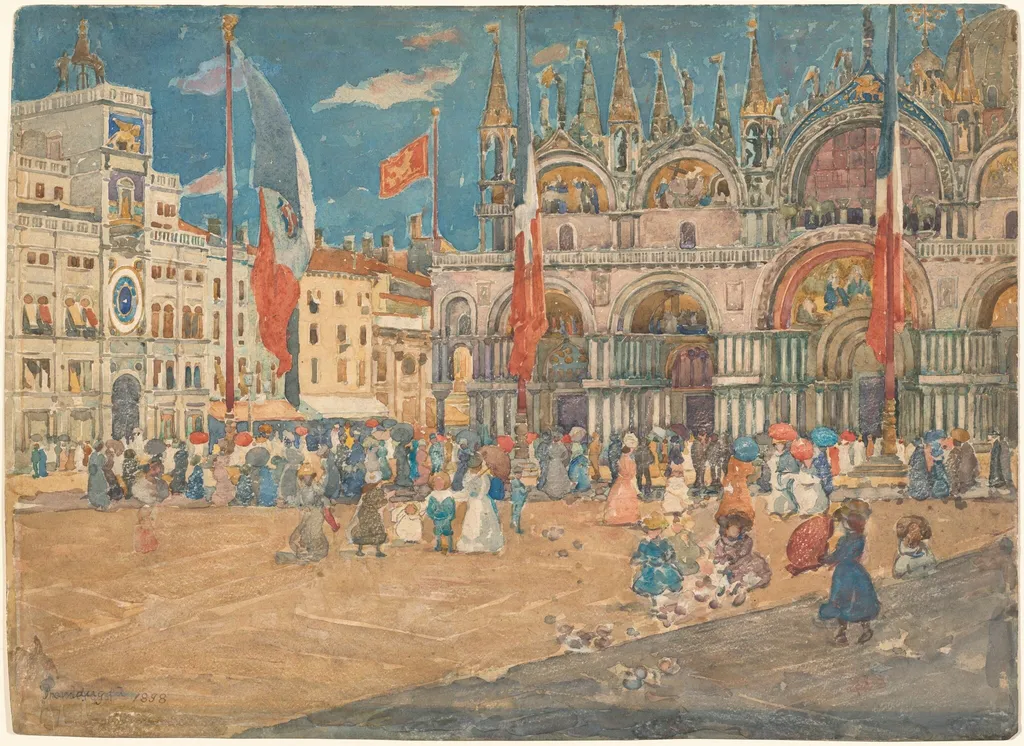
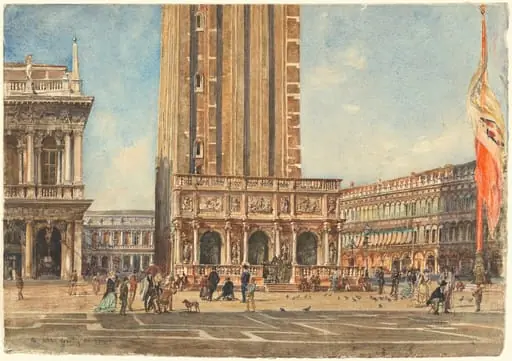
Piazza San Marco is a graphite drawing by the Impressionist artist Maurice Prendergast. It dates from 1898 and is held in the collection of the National Gallery of Art.
About this work
Overview
Created in 1898, *Piazza San Marco* is a watercolor drawing on wove paper, executed by Maurice Prendergast with graphite underdrawing and selective scratching.
Created in 1898, *Piazza San Marco* is a watercolor drawing on wove paper, executed by Maurice Prendergast with graphite underdrawing and selective scratching. The work captures a bustling public space in Venice, rendered through a technique that blends controlled line with fluid washes. Prendergast’s approach emphasizes atmospheric light and rhythmic movement, distinguishing his work within American watercolor traditions of the period.
Subject & Meaning
The scene depicts Venice’s central square, alive with pedestrians in late 19th-century attire—coats, hats, and umbrellas—moving among open-air stalls and seated figures. Flags with red-and-white stripes stretch across the center, anchoring the composition. The architecture of the basilica and campanile frames the activity, suggesting a moment of everyday urban life rather than a grand historical tableau.
Technique & Style
Prendergast applied thin layers of watercolor over a graphite sketch, using scratching to reveal highlights and define edges. His brushwork is rapid and varied, creating texture in fabric, flags, and pavement. Colors are muted yet vibrant—warm ochres and terracottas for buildings contrast with cool blues in the sky and shadows—producing a mosaic-like effect that echoes Post-Impressionist color theory without overt brushstroke emphasis.
History & Provenance
Painted during Prendergast’s second trip to Europe, the work reflects his immersion in Italian urban scenes after earlier studies in Paris. Though not exhibited publicly until later, it remained in private hands, part of a broader body of Venetian watercolors he produced between 1898 and 1902. Its survival in relatively intact condition offers insight into his working process and evolving style.
Context
Prendergast was associated with American artists seeking alternatives to academic realism, aligning loosely with Post-Impressionism and later with *The Eight*. While his peers focused on gritty urban life in New York, Prendergast turned to European public spaces, translating their rhythm into lyrical compositions. *Piazza San Marco* exemplifies this transatlantic sensibility, blending European subject matter with American watercolor innovation.
Legacy
The work contributes to Prendergast’s reputation as a pivotal figure in American watercolor, bridging European modernism and domestic practice. Its emphasis on color harmony and kinetic composition influenced later generations of American painters interested in light and movement. Though not widely known outside specialized circles, it remains a quiet testament to his refined, observational approach.
Artist & collection
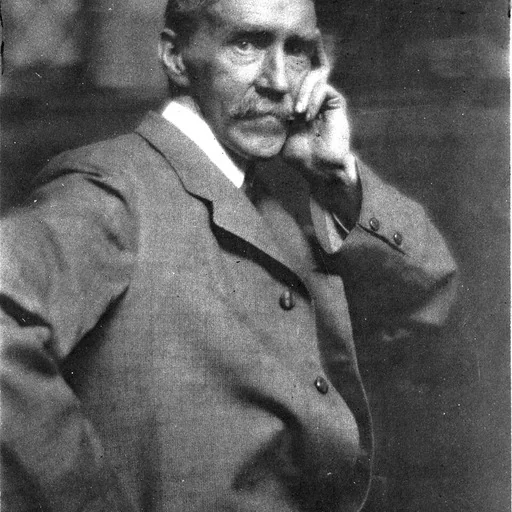
Artist
Maurice Brazil Prendergast (October 10, 1858 – February 1, 1924) was a Newfoundlander-American artist who painted in oil and watercolor, and created monotypes.