Artwork
House and Shop, Leintwardine
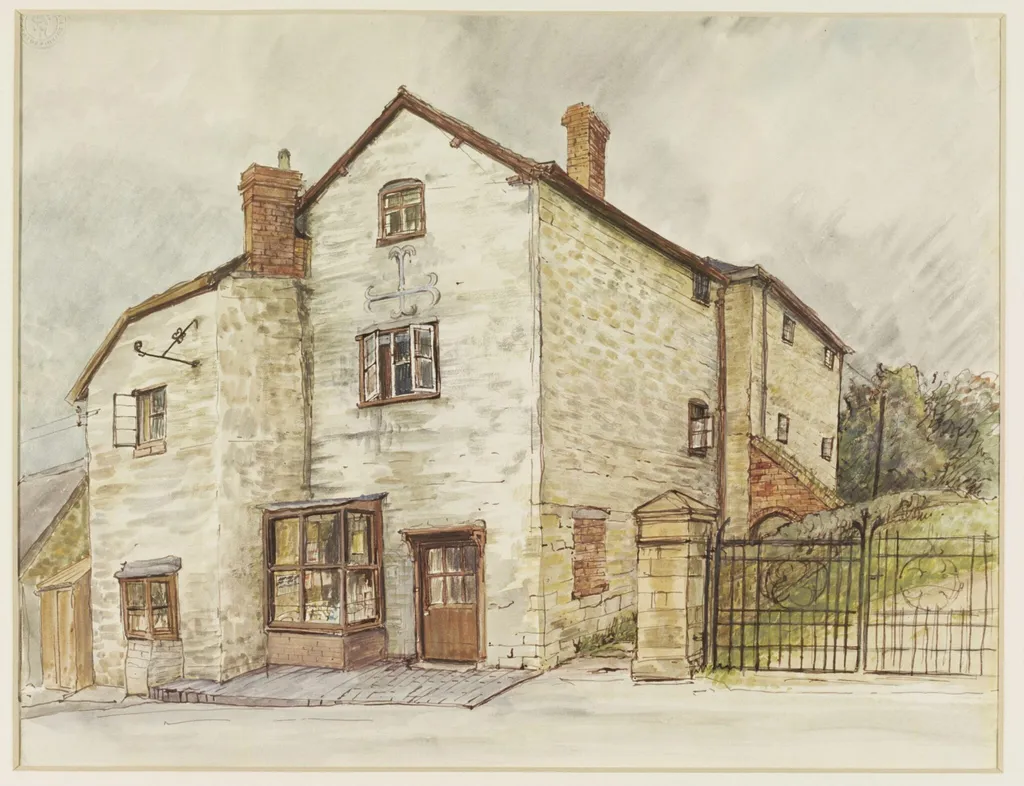
House and Shop, Leintwardine is a watercolor work on paper by the Social Realist artist Puller. It is held in the collection of the Victoria and Albert Museum.
About this work
Overview
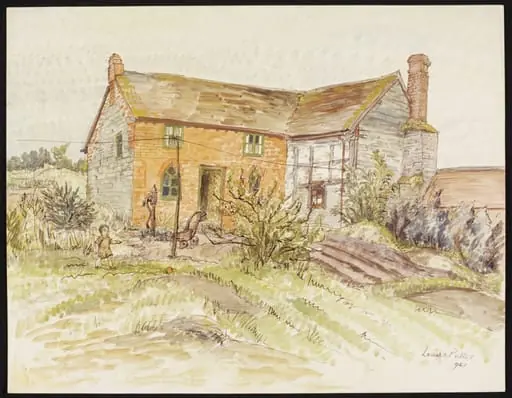
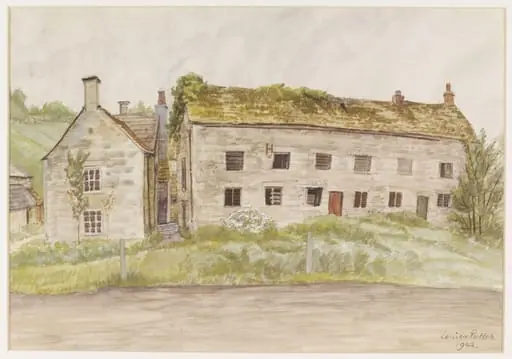
The work captures a modest stone house and shop in Leintwardine, Herefordshire, rendered with pen and ink alongside delicate washes.
Created in 1941, this watercolour by Puller is part of the *Recording Britain* initiative, a wartime effort to document rural and vernacular architecture at risk from conflict or change. The work captures a modest stone house and shop in Leintwardine, Herefordshire, rendered with pen and ink alongside delicate washes. It reflects a broader project led by Sir Kenneth Clark and funded by the Pilgrim Trust, aiming to preserve visual records of England’s disappearing landscapes during a time of national uncertainty.
Subject & Meaning
The composition centers on a two-story dwelling with a ground-floor shop, its rough-hewn stone walls and brick buttress suggesting age and local craftsmanship. A small porch, wooden door, fenced yard, and corner shed convey everyday domestic life. The inclusion of a commercial space hints at the village’s modest economic activity. Rather than idealizing the scene, the artist presents it with quiet realism, emphasizing the quiet endurance of ordinary structures amid wartime disruption.
Technique & Style
Puller employed soft watercolour washes to evoke the weathered texture of stone and brick, allowing the paper’s natural tone to suggest light and shadow. Pen lines define architectural details—chimneys, window frames, and the gate—with restrained precision. The palette is muted, with warm earth tones enhancing the sense of age and materiality. The absence of strong contrasts and the gentle handling of light create a contemplative, unhurried atmosphere, characteristic of the *Recording Britain* aesthetic.
History & Provenance
The work was produced during the Second World War as part of the *Recording Britain* collection, commissioned by the Pilgrim Trust under the direction of Sir Kenneth Clark. It entered the Victoria and Albert Museum’s holdings as part of this national archive, which now includes over 1,500 works by artists documenting threatened sites. The piece remains in the museum’s permanent collection, preserved as a historical record rather than a decorative object.
Context
During the early 1940s, Britain faced widespread destruction from aerial bombing and accelerating modernization. The *Recording Britain* project sought to capture rural and historic buildings before they vanished. Artists like Puller were sent to villages across England, Wales, and Scotland, focusing on vernacular architecture often overlooked by official records. This work contributes to a collective effort to safeguard visual memory during a period of national upheaval.
Legacy
The *Recording Britain* collection, including this watercolour, endures as a significant archive of mid-20th-century English vernacular life. It offers insight into how artists responded to wartime anxiety through documentation rather than propaganda. Today, the work is studied for its historical value and its quiet testimony to the resilience of everyday places. It remains accessible at the Victoria and Albert Museum, where it continues to inform understanding of Britain’s architectural heritage.
Artist & collection