Artwork
Fisherman's Joy

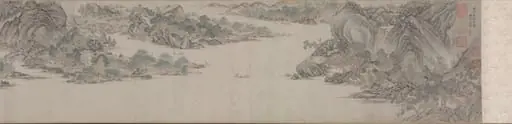
Fisherman's Joy is an unspecified painting by the Ming dynasty painting artist Qian Gu. It dates from 1572 and is held in the collection of the Cleveland Museum of Art.
About this work
Overview
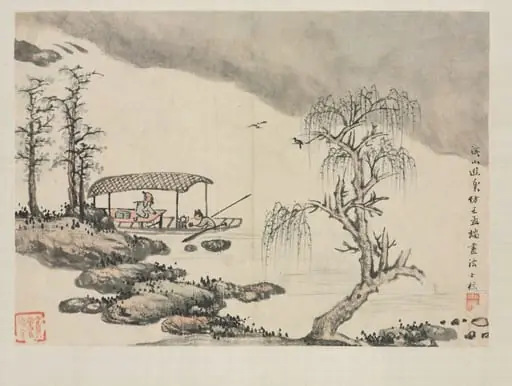
Fisherman's Joy depicts a serene fishing scene with two small boats, each crewed by two fishermen, employing a traditional method of fishing. One boat highlights a unique technique where a fisherman uses a bamboo pole to guide a cormorant bird in the water.
Subject & Meaning
The painting showcases cormorant fishing, a practice historically observed in the lower Yangzi River region. This subject appealed to urban, educated audiences who romanticized the independence of fisherfolk, seeing in them a symbol of self-sufficiency.
Technique & Style
Qian Gu's work blends influences: the narrative figure scenes resemble those found in Zhe school paintings, while the vantage point, expressive brushwork, and soft tonal palette are characteristic of the Wu school style. The use of chiaroscuro adds depth to the composition.
History & Provenance
While specific historical ownership details of 'Fisherman's Joy' are not provided, its style suggests Qian Gu's synthesis of Zhe and Wu school traditions, reflecting the artistic exchanges and inspirations common during the period.
Context
Created in a time when natural, everyday scenes were valued for their simplicity and philosophical undertones, 'Fisherman's Joy' reflects the broader cultural appreciation for landscapes and the humble life, resonating with the intellectual and aesthetic tastes of its time.
Legacy
As a representation of traditional Chinese fishing practices and artistic synthesis, 'Fisherman's Joy' contributes to the historical record of regional painting styles and their evolution, offering insights into the blending of artistic traditions in Chinese art.
Artist & collection