Artwork
You feel like a pig because your tool is not big
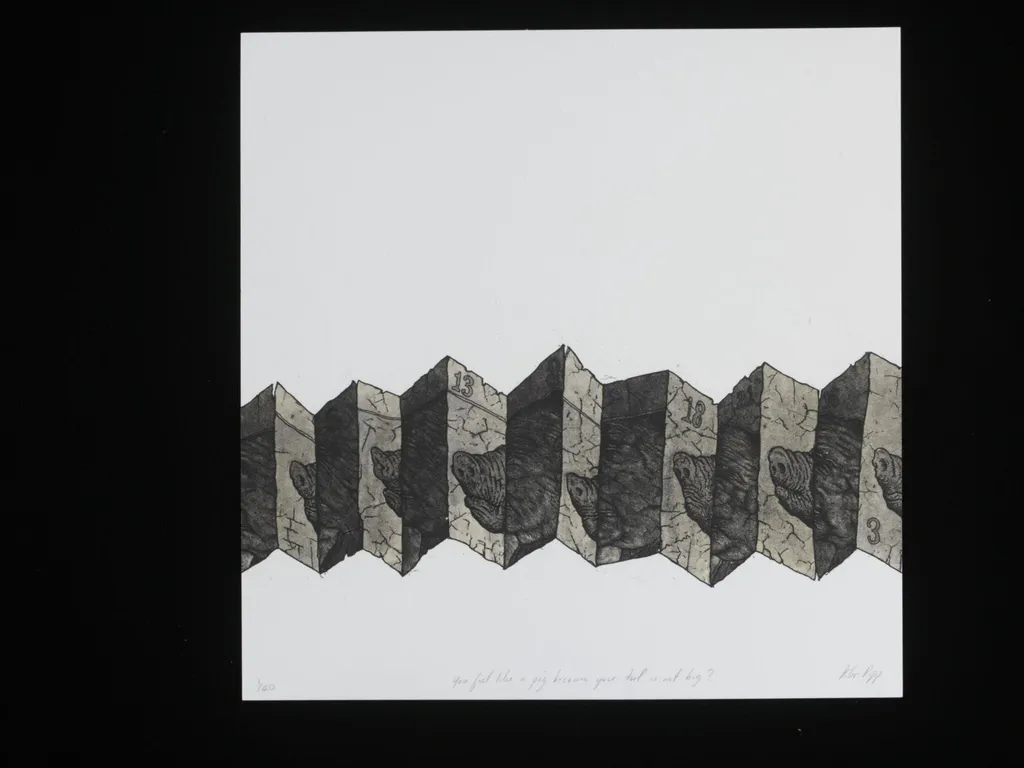
You feel like a pig because your tool is not big is a print by Rapp. It dates from 2010 and is held in the collection of the Victoria and Albert Museum.
About this work
Overview
The composition consists of irregularly shaped blocks, each containing a fragment of a pig’s snout and a numerical label.
This 2010 etching by Rapp is executed on white paper with a folded, textured surface that suggests age and reuse. The composition consists of irregularly shaped blocks, each containing a fragment of a pig’s snout and a numerical label. The artist signs, titles, and numbers the work, affirming its status as a limited print. The arrangement of elements follows a jagged, non-linear path across the surface, disrupting conventional visual order.
Subject & Meaning
The title, *You feel like a pig because your tool is not big?*, introduces a confrontational tone, linking bodily imagery with social or psychological insecurity. The repeated pig snouts, stripped of full context, reduce the animal to a symbolic fragment—perhaps mocking vanity, masculinity, or self-perception. The numbers may imply measurement, ranking, or arbitrary categorization, reinforcing a critique of quantified identity.
Technique & Style
Rapp employs etching to create sharp, dark outlines against a pale ground, enhancing contrast without relying on tonal gradation. The blocks are cut with irregular edges, avoiding symmetry or harmony. The pig heads are simplified, almost cartoonish, yet rendered with precise line work. The folded paper adds physical texture, integrating materiality into the work’s conceptual framework.
History & Provenance
Created in 2010, the print is part of a small edition, each piece individually numbered and signed by the artist. No public exhibition history or prior ownership records are widely documented. Its production aligns with a period of experimental printmaking in early 21st-century contemporary art, where text, irony, and fragmented imagery were common tools for social commentary.
Context
The work emerges from a broader trend in post-2000 art that uses absurdity and wordplay to interrogate identity and societal norms. Its use of animal imagery echoes earlier satirical traditions, while the numerical system recalls bureaucratic or psychological testing. The folded paper may reference discarded documents or personal diaries, suggesting private anxieties made public.
Legacy
Though not widely exhibited, the piece contributes to Rapp’s body of work that challenges viewers through visual ambiguity and linguistic tension. Its influence is subtle, resonating in contemporary prints that combine text, fragmented imagery, and material experimentation. It remains a quiet example of how printmaking can convey psychological unease without overt narrative.
Artist & collection
Artist
Rapp’s prints blend pop-culture wit with printmaking’s sharp edges. Look for “It’s Only Make Believe” and “Love for Sale,” where familiar words become bold, colorful declarations. His 2010–2013 prints mix humor and…