Artwork
St. Francis Beneath a Tree Praying
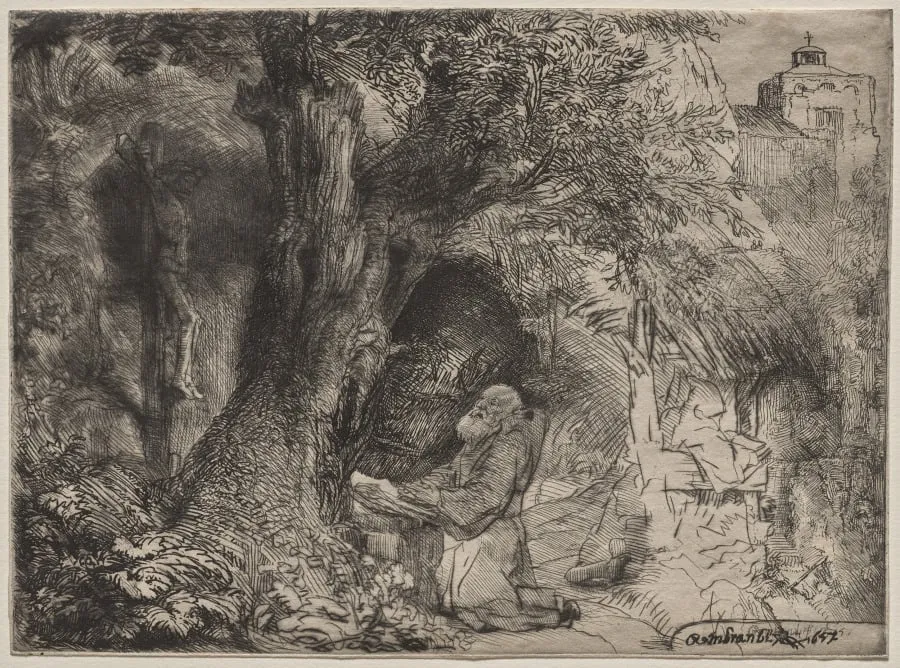
St. Francis Beneath a Tree Praying is a print by the Baroque artist Rembrandt. It dates from 1657 and is held in the collection of the Cleveland Museum of Art.
About this work
Overview
This drypoint and etching by Rembrandt portrays Saint Francis of Assisi in quiet prayer beneath a dense tree, a small crucifix hanging above him.
This drypoint and etching by Rembrandt portrays Saint Francis of Assisi in quiet prayer beneath a dense tree, a small crucifix hanging above him. Executed late in the artist’s life, the work reflects a转向 toward intimate, contemplative subjects. The scene is rendered with minimal detail but profound emotional weight, emphasizing stillness and solitude over narrative action. The faint presence of a second figure, likely Brother Leo, adds subtle context without distracting from the central moment.
Subject & Meaning
The image captures Saint Francis in a moment of personal devotion, isolated in nature and focused on the crucifix. His bowed posture and clasped hands convey humility and inner reflection. The inclusion of Brother Leo, rendered as a near-invisible outline, acknowledges the saint’s monastic life without disrupting the solitude of the moment. The emphasis on quiet prayer, rather than miracle or spectacle, suggests a deeply humanized spirituality, aligned with Rembrandt’s later interest in inner life.
Technique & Style
Rembrandt employed drypoint and etching to achieve rich tonal contrasts, using deep shadows and delicate, flickering light to model form and atmosphere. The tree’s foliage is suggested through layered lines, allowing light to filter ambiguously through the canopy. The background is simplified—a distant hill and structure imply depth without detail. The monk’s faint outline is achieved with barely-there strokes, demonstrating mastery in restraint and the expressive potential of minimal mark-making.
History & Provenance
Created around 1655–1660, this print belongs to Rembrandt’s late period, when he increasingly turned to personal and spiritual themes. It was likely made for private circulation among collectors and fellow artists, rather than public display. The work’s survival in multiple impressions suggests it was valued in his lifetime, though its quiet nature meant it did not achieve widespread fame until later centuries, when its emotional depth was more fully appreciated.
Context
Rembrandt was familiar with Italian Renaissance landscapes through prints by Titian and others, and their influence is evident in the atmospheric depth and compositional balance here. Yet he adapted these elements to serve his own vision: the landscape is not idealized but emotionally charged, serving as a mirror to the saint’s inner state. This synthesis of external observation and internal feeling reflects a broader shift in 17th-century Dutch art toward psychological realism.
Legacy
This print exemplifies Rembrandt’s late style—reduced in detail, heightened in emotional resonance. It influenced later artists drawn to introspective subjects and the expressive use of light and shadow. Its quiet power lies not in grandeur but in restraint, offering a model for conveying spiritual depth through understatement. Today, it remains a touchstone for discussions of how printmaking can capture the ineffable.
Artist & collection
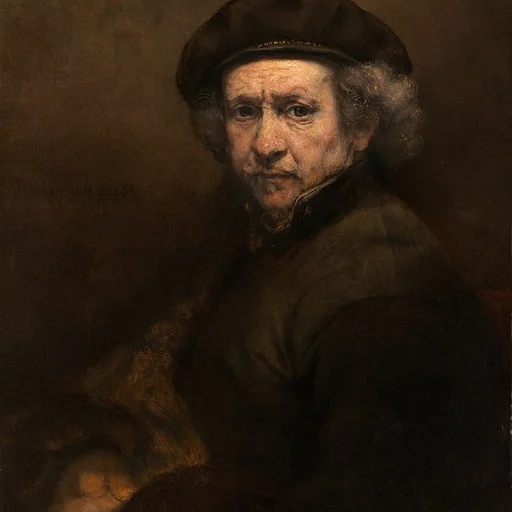
Artist
Rembrandt Harmenszoon van Rijn (15 July 1606 – 4 October 1669), known mononymously as Rembrandt, was a Dutch Golden Age painter, printmaker, and draughtsman.

 Old Village (Ville vieille)
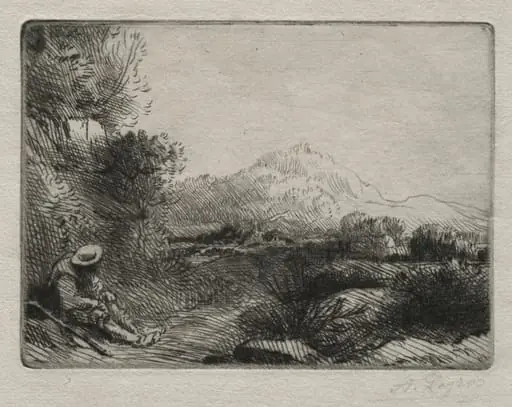 Rest of the Traveler
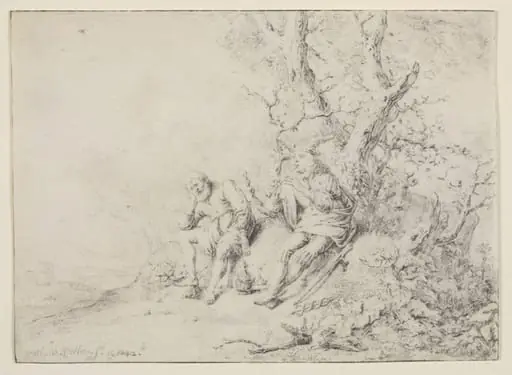 Mercury and Argus (Ovid, Metamorphoses i.668–721)
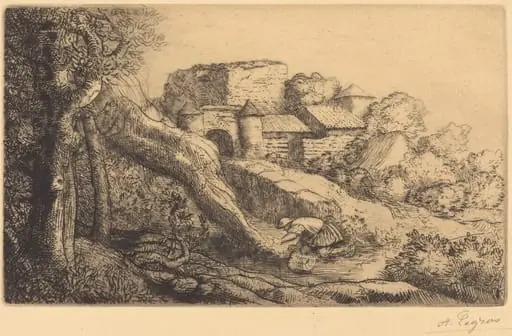 Little Burner of Grass (Le petit bruleur d'herbe)
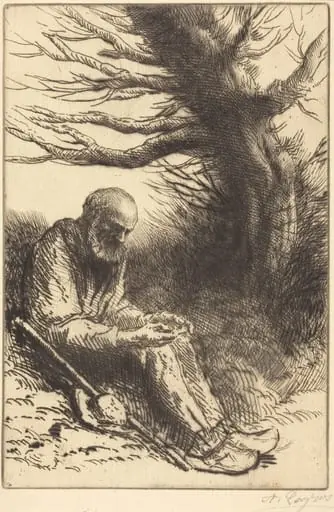 Old man, Old Tree (Vieil homme, vieil arbre)
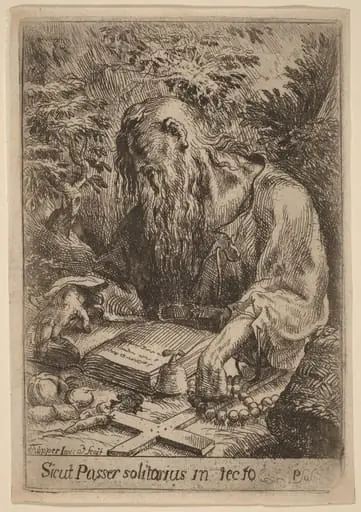 A Hermit Saint
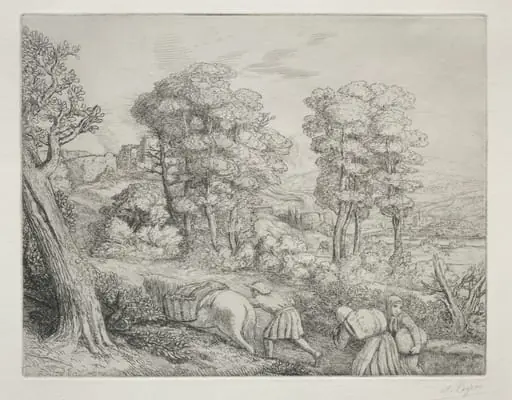 The Return to the Farm (Le Retour à la Ferme)
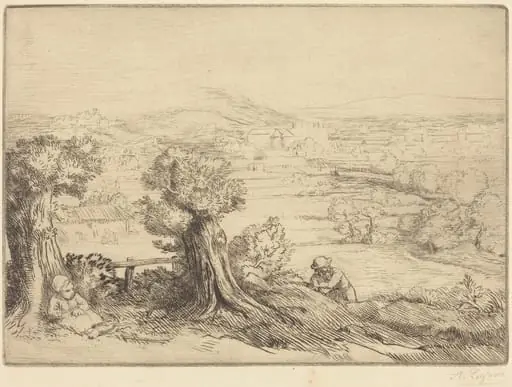 Remembrance of a Valley in Bourgogne (Souvenir d'une vallee en Bourgogne)
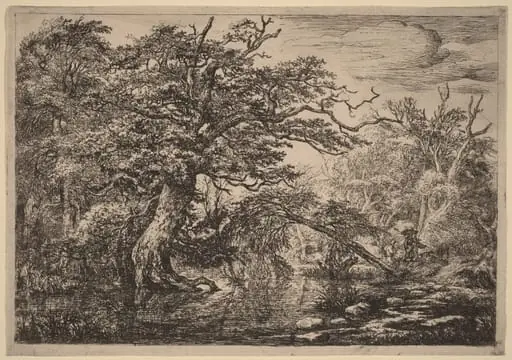 A Forest Marsh with Travelers on a Bank (The Travelers)
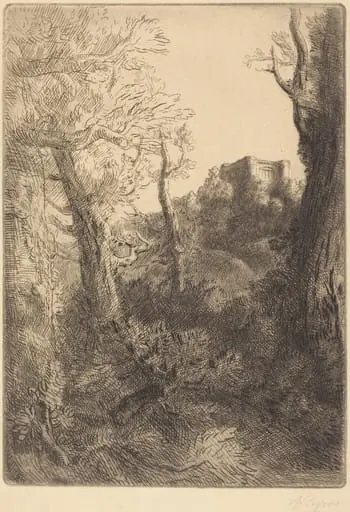 Landscape (Paysage)