Artwork
Hagar and Ishmael
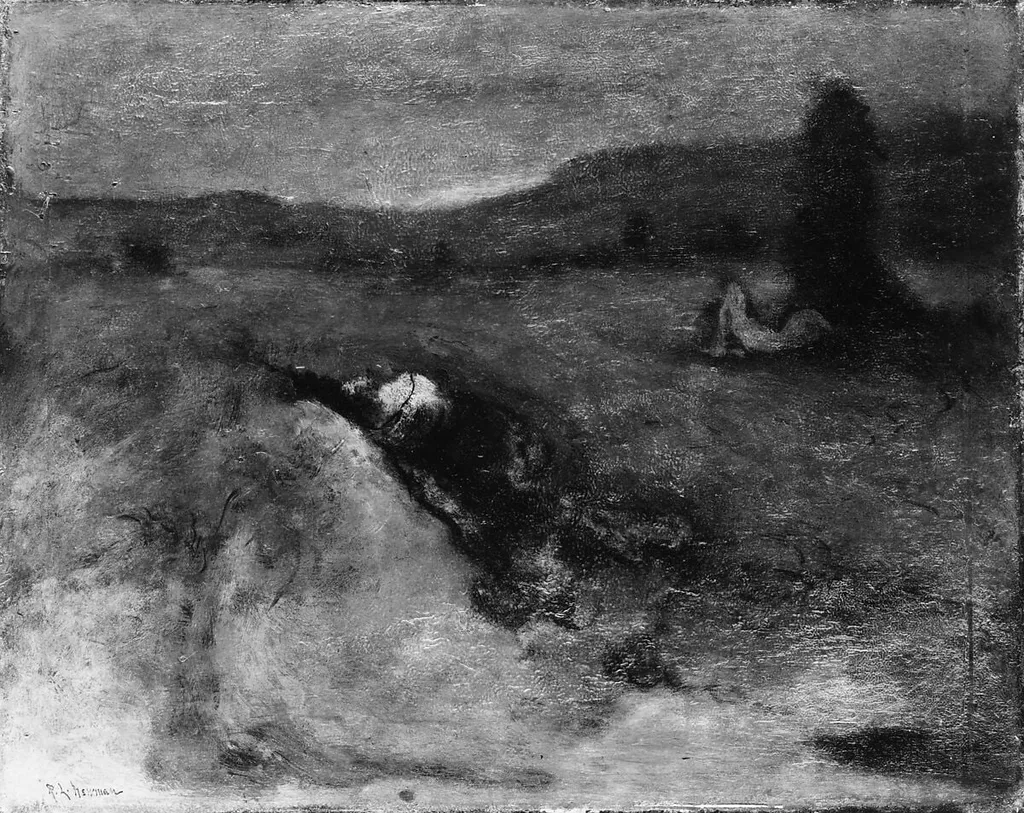
Hagar and Ishmael is an oil painting by the American Impressionist artist Robert Loftin Newman. It dates from 1894 and is held in the collection of the Metropolitan Museum of Art.
About this work
Overview
Robert Loftin Newman’s 1894 oil on canvas, *Hagar and Ishmael*, belongs to the American Wing collection. The work portrays the biblical figures Hagar and her son Ishmael in a barren desert setting, rendered with muted tones and gentle brushwork that convey both desolation and quiet introspection.
Subject & Meaning
The composition captures a moment of hardship: the mother, cloaked in a long robe, sits with her head cradled in her hands, while the child stands nearby, eyes lifted toward the sky. This juxtaposition of despair in the mother and a tentative hope in the child reflects the scriptural narrative of exile and survival.
Technique & Style
Newman employs a restrained palette of earth‑tones, applying soft, blended strokes that soften the harshness of the sand dunes behind the figures. Though linked to American Impressionism, the emphasis on realistic human emotion and the subdued coloration echo the concerns of 19th‑century Realism.
History & Provenance
Created in 1894, the painting entered the museum’s American Wing through acquisition in the early 20th century, joining a group of Newman’s religious and narrative works that illustrate his career as both painter and stained‑glass designer.
Context
During the late 1800s, American artists often turned to biblical subjects to explore universal themes of suffering and redemption. Newman’s choice of Hagar and Ishmael aligns with this trend, while his focus on mood and personal feeling distinguishes his approach from more overtly didactic religious art.
Artist & collection

Artist
Robert Loftin Newman (November 10, 1827 – March 31, 1912) was an American painter and stained-glass designer.