Artwork
Brick Lane
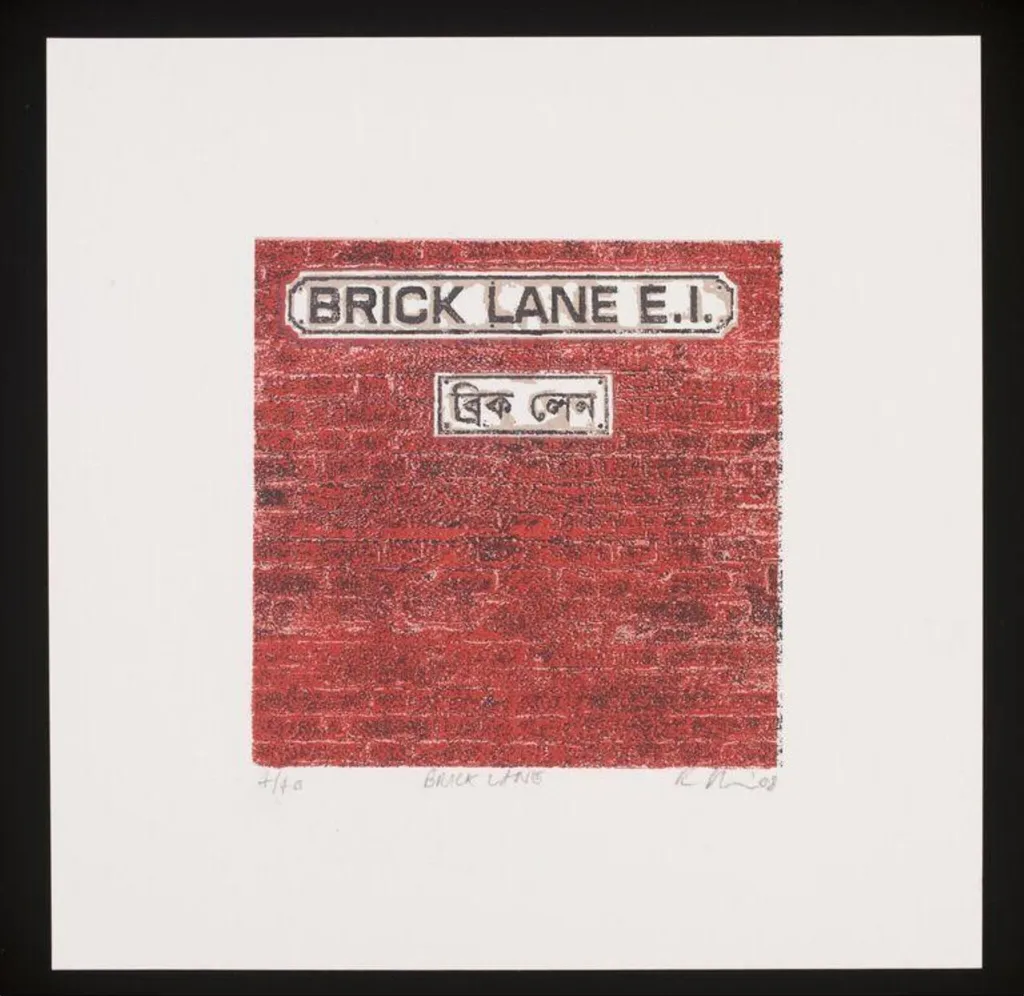
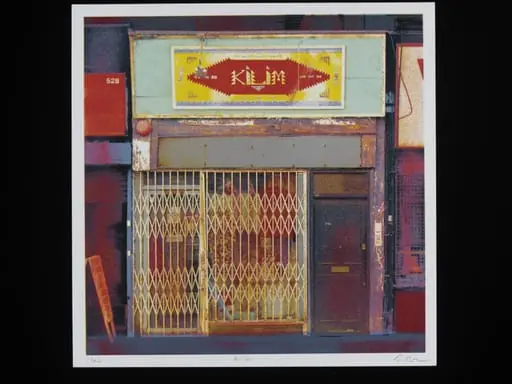
Brick Lane is a print by Richard Roberts. It dates from 2008 and is held in the collection of the Victoria and Albert Museum.
About this work
Overview
The artist uses flat, unmodulated colors and sharp edges to emphasize texture over detail, grounding the image in the physicality of urban surfaces.
Created in 2008, this screenprint by Richard Roberts captures a section of a weathered brick wall in London’s East End. The composition is minimal, centered on two street signs: a large white one reading 'BRICK LANE E.I.' and a smaller one below with Bengali script. The artist uses flat, unmodulated colors and sharp edges to emphasize texture over detail, grounding the image in the physicality of urban surfaces.
Subject & Meaning
The print presents a literal slice of Brick Lane, a street historically shaped by waves of migration. The coexistence of English and Bengali signage reflects the area’s layered cultural identity. The worn bricks and uneven surface suggest time and use, while the absence of people or activity invites contemplation of place rather than narrative. The work quietly acknowledges the neighborhood’s transformation through language and material decay.
Technique & Style
Roberts employed screen printing to achieve crisp, layered color fields. The red brick is rendered in subtle gradients, with dark streaks suggesting moisture or soot. The white lettering is bold and uniform, contrasting with the irregular texture beneath. The smaller Bengali sign, rendered in a different typeface, adds visual complexity without clutter. The black border frames the image like a window, isolating the wall from its surroundings.
History & Provenance
The print is signed by the artist and dates from 2008, a period when London’s East End was undergoing rapid change. It was likely produced as part of a series documenting local architecture and identity. The work entered public collections shortly after its creation, with examples held at the Victoria and Albert Museum, where it is grouped with other contemporary prints exploring urban space and cultural memory.
Context
Brick Lane has long been a site of cultural convergence, from Huguenot weavers to Jewish immigrants and later Bangladeshi communities. Roberts’ print emerges from a broader artistic interest in documenting the visible traces of these transitions. The work aligns with post-2000 British printmaking that prioritizes quiet observation over overt commentary, using everyday surfaces to reflect social history.
Legacy
The print contributes to a growing body of work that treats urban architecture as a record of collective experience. Its restrained aesthetic and focus on linguistic duality have influenced later artists examining multicultural neighborhoods through similar visual strategies. While not widely exhibited, it remains a referenced example in discussions of contemporary British printmaking and the representation of place.
Artist & collection
Artist
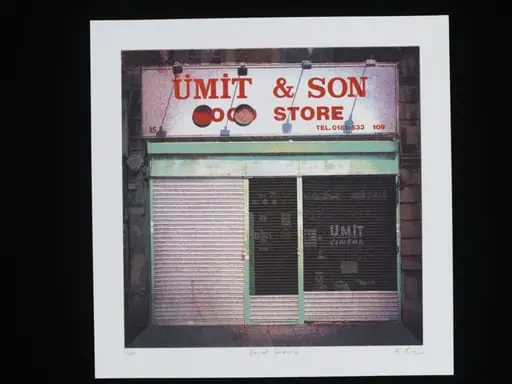
Richard Roberts makes small, repeatable images: screen prints of London corners like Brick Lane and Umit Cinema, and everyday things like Extra Chilli Sauce.