Artwork
The Farm at the Entrance of the Wood
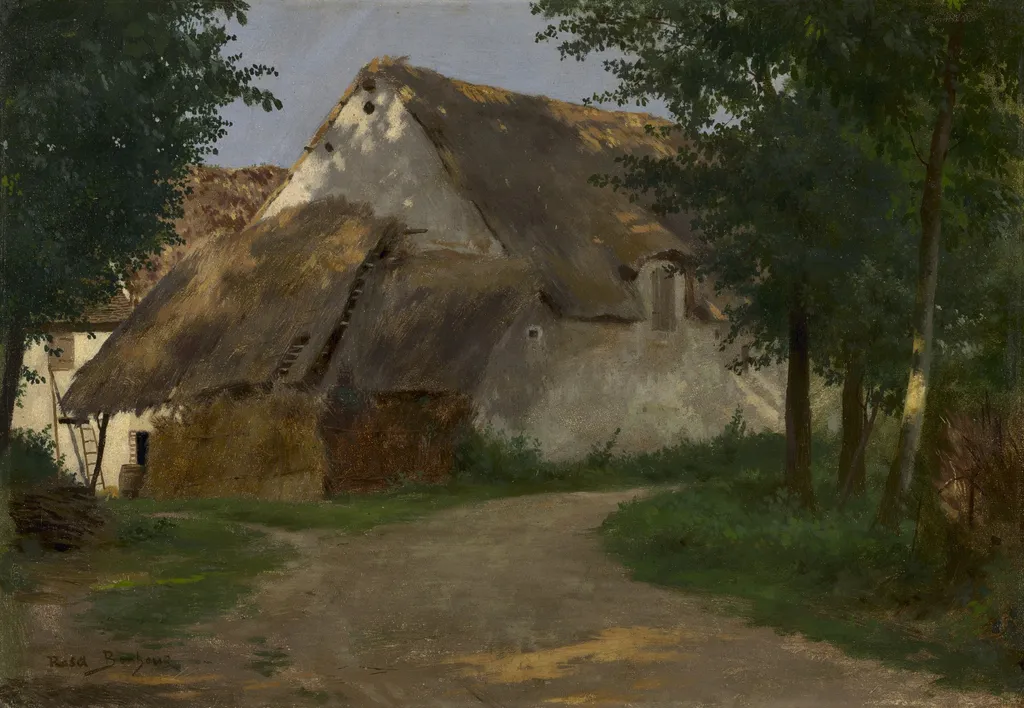
The Farm at the Entrance of the Wood is an oil painting by the Realist artist Rosa Bonheur. It dates from 1850 and is held in the collection of the Cleveland Museum of Art.
About this work
Overview
One structure features a ladder leaning against its wall, while the other displays a small arched doorway, grounding the scene in everyday agricultural life.
Painted in 1850, The Farm at the Entrance of the Wood depicts a tranquil rural landscape characteristic of Rosa Bonheur's early career. The composition centers on two thatched-roof farmhouses situated at the edge of a wooded area, framed by trees on the right and a pale sky above. One structure features a ladder leaning against its wall, while the other displays a small arched doorway, grounding the scene in everyday agricultural life. The foreground consists of a textured mix of dirt and grass, rendered with thick, visible brushstrokes that emphasize the tactile quality of the earth and architecture. This work exemplifies Bonheur's commitment to realistic observation and her focus on the French countryside, themes she would explore throughout her life. Created during a period when she was establishing her reputation for detailed animal and landscape studies, the painting reflects her dedication to painting directly from nature rather than relying on studio imagination. The scene captures a moment of quiet stillness, avoiding romanticized drama in favor of a straightforward, dignified representation of rural existence. This approach aligns with the broader Realist movement of the mid-19th century, which sought to portray contemporary life with honesty and precision.
Subject & Meaning
The composition presents an everyday agrarian scene, emphasizing the simplicity of country life. The juxtaposition of the two houses, one seemingly in use (ladder) and the other more passive (arched doorway), suggests a narrative of work and shelter within a quiet landscape, inviting contemplation of rural routines.
Technique & Style
Bonheur employs a pronounced impasto technique, especially on the thatched roofs, where thick, tactile brushstrokes create a palpable texture. This handling of paint renders the surfaces tangible, enhancing the realism of the structures and ground while maintaining a slightly rough, painterly quality characteristic of mid‑nineteenth‑century French realism.
History & Provenance
Created circa 1850, the painting entered the collection of the Cleveland Museum of Art, where it remains on view. Its acquisition reflects the museum’s interest in 19th‑century European genre scenes and contributes to the representation of Bonheur’s oeuvre beyond her more widely known animal subjects.
Own this work as a print
Artist & collection

Artist
Rosa Bonheur was a French artist known best as a painter of animals (animalière).