Artwork
Civita Castellana and Mount Soracte, 1852
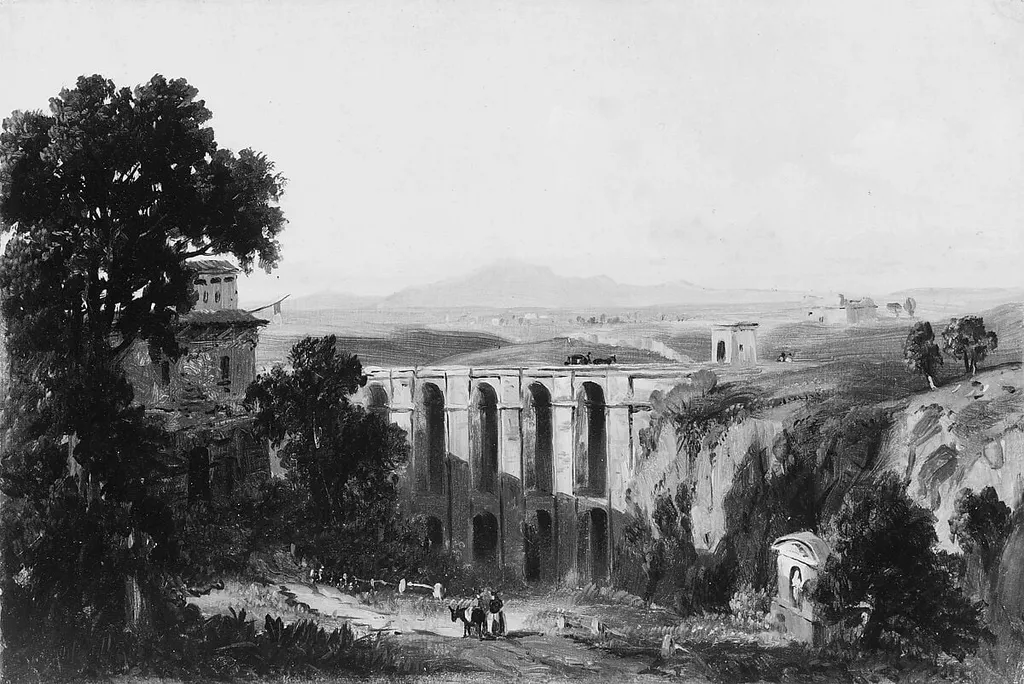
Civita Castellana and Mount Soracte, 1852 is an oil drawing by the Impressionist artist Russell Smith. It dates from 1852 and is held in the collection of the Metropolitan Museum of Art.
About this work
Overview
The composition presents a modest Italian hillside settlement, its clustered structures and a solitary leaning tree rendered in muted browns and greens.
Civita Castellana and Mount Soracte, painted in 1852, is an oil work on wove paper by William Thompson Russell Smith. The composition presents a modest Italian hillside settlement, its clustered structures and a solitary leaning tree rendered in muted browns and greens. The distant silhouette of Mount Soracte rises behind the town, creating a layered landscape that balances foreground detail with atmospheric background.
Subject & Meaning
The scene captures a tranquil moment in a rural Italian locale, emphasizing the relationship between human habitation and the surrounding terrain. The modest architecture clings to the slope, while the lone tree, angled toward the light, suggests a quiet resilience. The overall mood conveys a reflective, almost nostalgic view of a place that is both specific and emblematic of pastoral life.
Technique & Style
Smith employs the soft, blended brushwork characteristic of the Hudson River School, using subtle gradations of tone to render atmospheric depth. The oil on paper allows for delicate layering, producing a hazy transition between the immediate trees and the distant mountain. This approach creates a sense of memory‑like reverie, with the landscape appearing both observed and imagined.
History & Provenance
Born in Glasgow in 1812, Smith settled in Pennsylvania and built a reputation for depictions of American scenery. During a European tour he produced this work, marking a rare departure from his usual domestic subjects. The painting entered the American Wing of the museum’s collection, where it stands as evidence of his transatlantic artistic encounters.
Context
Although Smith is chiefly associated with Pennsylvania’s vistas, his exposure to European topography broadened his visual vocabulary. The influence of the Hudson River School—its emphasis on natural grandeur and meticulous detail—remains evident, even as the subject shifts to an Italian hillside. This work illustrates the fluid exchange between American and European landscape traditions in the mid‑nineteenth century.
Artist & collection
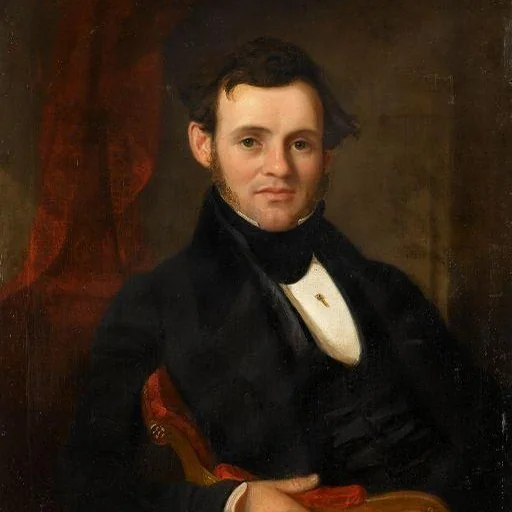
Artist
William Thompson Russell Smith (Glasgow, Scotland 1812 – Glenside, PA, 1896) was a Scottish-American painter who produced iconic images of Pennsylvania's landscape inspired by the aesthetic of the Hudson River School.
