Artwork
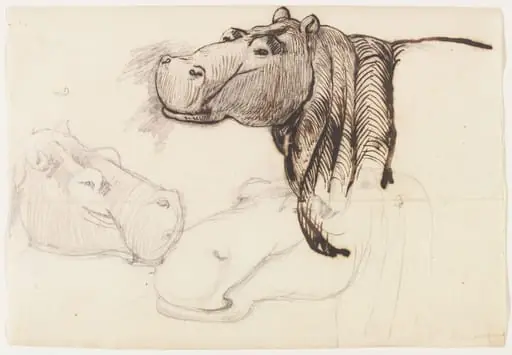
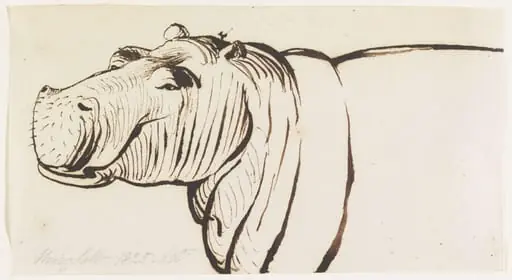
Study of a Hippopotamus, full length
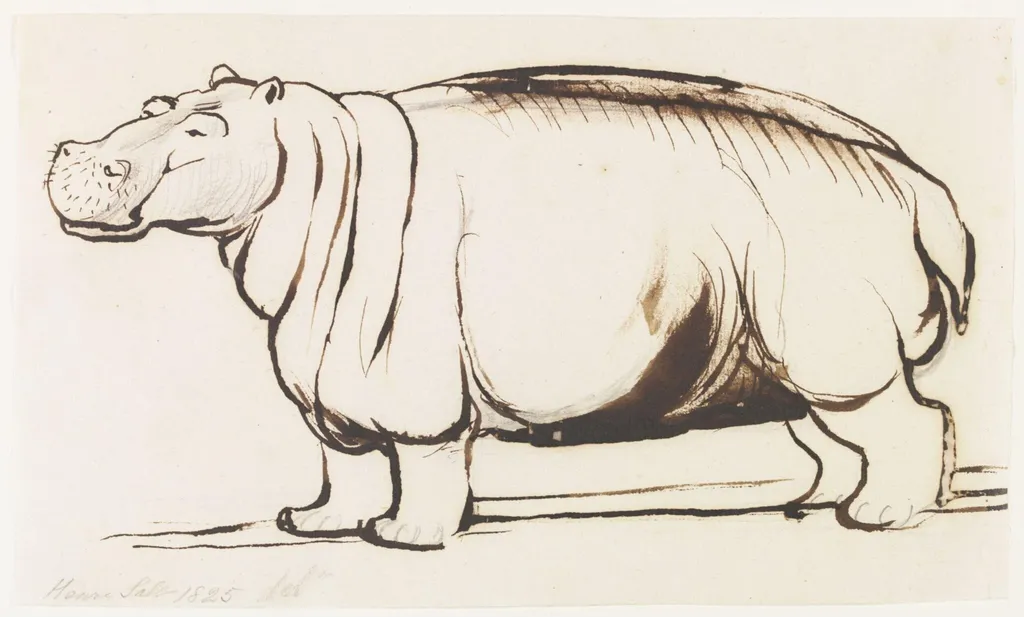
Study of a Hippopotamus, full length is a drawing by the Romanticist artist Henry Salt. It dates from 1825 and is held in the collection of the Victoria and Albert Museum.
About this work
Henry Salt’s 1825 drawing shows a hippopotamus in full. Made during the Romantic period, it captures the animal’s size and texture with careful lines.
Salt hunted one near Damietta in 1818 and wrote he’d gotten a “pretty correct drawing” of its skin. The work mixes science with wonder, feeding curiosity about big, rare beasts.
Look up the Romanticism movement next.
Overview
Study of a Hippopotamus, full length is a drawing by Henry Salt, created in 1825, depicting the animal in its entirety. The work reflects both scientific observation and the sense of wonder characteristic of the Romantic period.
Subject & Meaning
The hippopotamus, a mysterious and massive Nile inhabitant, was a subject of fascination in early natural history. Salt's drawing captures this intrigue, blending scientific accuracy with the awe inspired by rare and formidable creatures.
Technique & Style
Salt employed careful, detailed lines to convey the hippopotamus's size and texture. His artistic training in drawing and portrait-painting under J. Glover, J. Farington, and J. Hoppner is evident in the drawing's precision and realism.
History & Provenance
Created after Salt's 1818 encounter with a hippopotamus near Damietta, the drawing was part of his broader activities as a diplomat, artist, and collector in Egypt (1815-1827). Salt's collections largely ended up in the British Museum and the Louvre.
Context
Produced during Salt's tenure as British Consul-General in Egypt, the drawing intersects with his support for excavations, including those by G.B. Belzoni, reflecting the era's convergence of artistic, scientific, and antiquarian pursuits.
Artist & collection
Artist
Henry Salt filled a sketchbook with careful pencil drawings of a hippopotamus in 1825.