Artwork
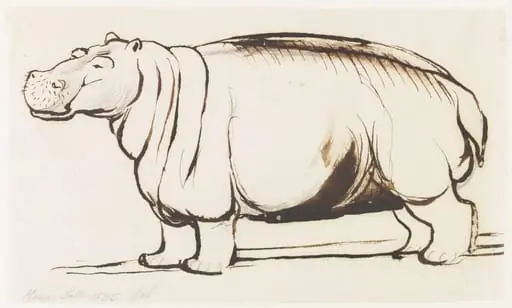
Study of a Hippopotamus, head and shoulders
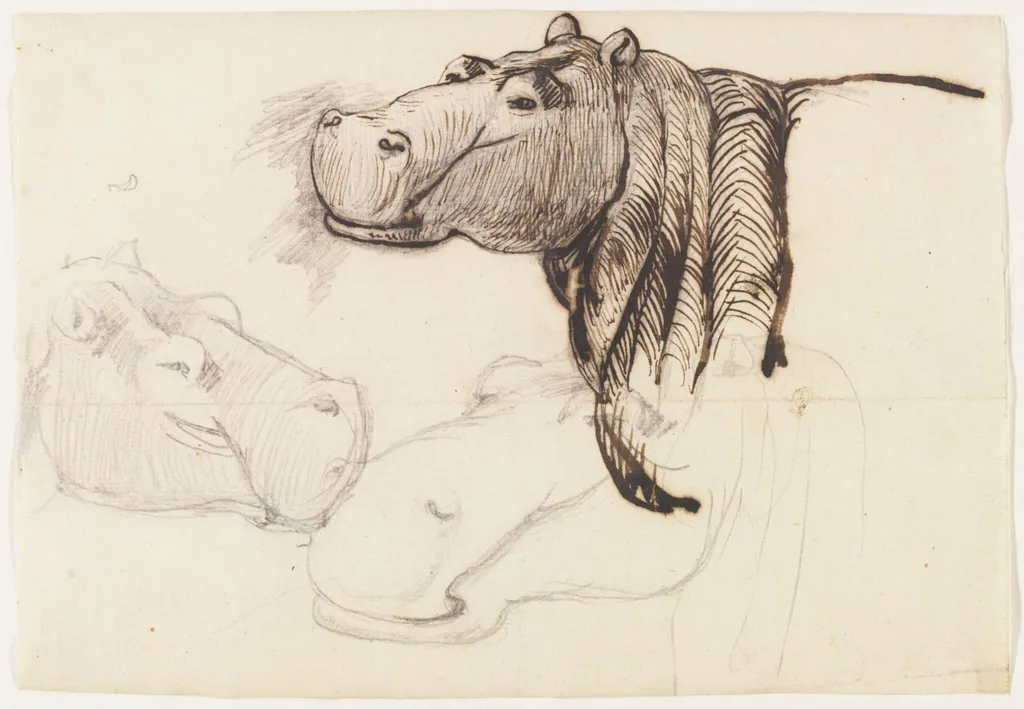
Study of a Hippopotamus, head and shoulders is a drawing by the Romanticist artist Henry Salt. It dates from 1825 and is held in the collection of the Victoria and Albert Museum.
About this work
The drawing reflects early naturalists’ fascination with huge African animals.
This is a careful drawing from 1825 by Henry Salt. He was a diplomat and collector who trained in drawing. The image shows the head and shoulders of a hippopotamus.
Salt saw real hippos in Egypt’s Nile Delta. He hunted one near Damietta in 1818 and later made this study from its skin. The drawing reflects early naturalists’ fascination with huge African animals.
Check out more of Salt’s work at the Victoria and Albert Museum.
Overview
This 1825 drawing by Henry Salt depicts the head and shoulders of a hippopotamus. Created by a trained artist and collector, it showcases Salt's attention to detail.
Subject & Meaning
The hippopotamus was a subject of fascination for natural historians and the public, with some identifying it as the biblical 'Behemoth'. Salt's drawing reflects this interest, informed by his firsthand experience with the animal in Egypt's Nile Delta.
Technique & Style
Salt's training in drawing and portrait-painting is evident in the careful rendering of the hippopotamus's head and shoulders. The study was likely made from the skin of a hippopotamus Salt hunted near Damietta in 1818.
History & Provenance
Henry Salt, a diplomat and collector, served as British Consul-General in Egypt from 1816 to 1827. During this time, he financed excavations and formed large collections of antiquities, mostly acquired by the British Museum and the Louvre.
Artist & collection
Artist
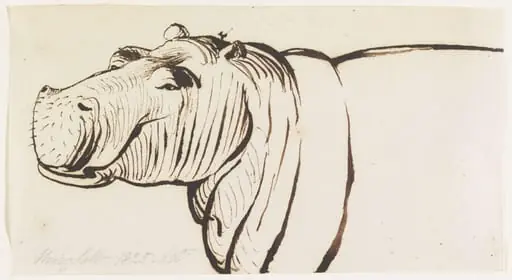
Henry Salt filled a sketchbook with careful pencil drawings of a hippopotamus in 1825.

![The Horse of Selene from the Elgin Marbles [recto], by William Etty](https://artifactworldgallery.com/img/william-etty--the-horse-of-selene-from-the-elgin-marbles-recto--9ba6b2e51464c157-w320.webp)