Artwork
The Story of Nastagio Degli Onesti, part three
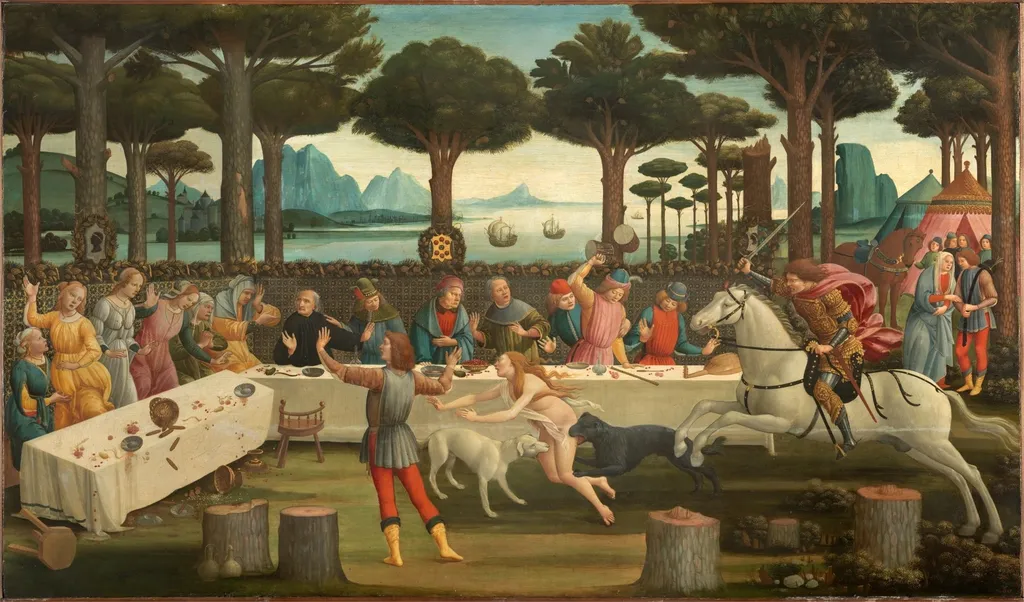
The Story of Nastagio Degli Onesti, part three is a tempera painting by the Early Renaissance artist Sandro Botticelli. It dates from 1492 and is held in the collection of the Museo del Prado.
About this work
Overview
Created in 1492, this tempera panel by Sandro Botticelli forms the third episode of the narrative series "The Story of Nastagio Degli Onesti." The work is part of the Early Renaissance canon and is currently displayed in the Museo del Prado. It presents a complex outdoor banquet scene, rendered in the luminous yet restrained palette characteristic of Botticelli’s late 15th‑century practice.
Subject & Meaning
The composition depicts a festive gathering that has taken a disquieting turn: a long table laden with food and wine is juxtaposed with a nude woman lying on the ground and a mounted rider brandishing a sword. Attendants in elegant dress mingle with servants, while dogs sniff the spread and several figures appear startled, suggesting a narrative moment of tension within the larger story of Nastagio.
Technique & Style
Executed in egg tempera, the painting showcases Botticelli’s precise brushwork and layered glazing that allow colors to remain vivid yet softened by age. The figures are outlined with fine contours, and the landscape background—tall trees, distant mountains, and a lake dotted with ships—provides a shallow spatial depth typical of early Renaissance settings.
History & Provenance
The panel was likely commissioned as part of a decorative program for a Florentine patron interested in the chivalric legend of Nastagio. After remaining in private collections for several centuries, it entered the Spanish royal collection in the 18th century and was subsequently transferred to the Museo del Prado, where it has been on public view since the museum’s establishment.
Context
Botticelli’s narrative cycles often blended classical motifs with contemporary courtly life. This episode reflects the period’s fascination with moralizing tales and the visual language of courtly festivities, while the inclusion of heraldic devices and a waterborne vessel anchors the scene in a specific social milieu of late‑medieval Florence.
Artist & collection

Artist
Sandro Botticelli was a Florentine painter who loved the drama of stories—myths, saints, and ancient tales.