Artwork
The Roman Theater at Taormina
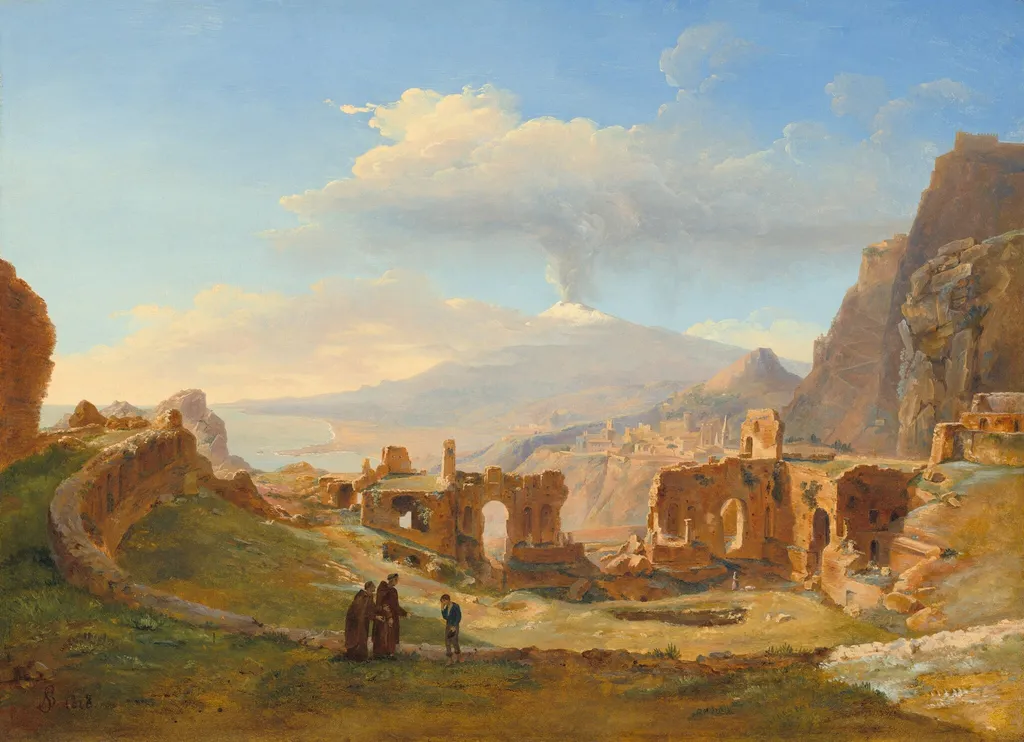
The Roman Theater at Taormina is an oil painting by the Romanticist artist Louise-Joséphine Sarazin de Belmont. It dates from 1828 and is held in the collection of the National Gallery of Art.
About this work
Overview
Louise‑Joséphine Sarazin de Belmont’s 1828 work, titled The Roman Theater at Taormina, is an oil composition executed on paper that has been adhered to canvas. The painting presents a Roman amphitheater nestled within a mountainous setting, capturing both the architectural ruin and the surrounding natural scenery in a single, balanced view.
Subject & Meaning
The central element of the canvas is the ancient Roman theater, rendered with careful attention to its stone arches and tiered seating. It is framed by a sweeping landscape of rugged peaks, suggesting a dialogue between human history and the enduring environment, and evoking a tranquil, contemplative atmosphere.
Technique & Style
Sarazin de Belmont employed oil glazing on a paper support, a method that allows successive translucent layers to build depth and luminosity. The delicate handling of light across the stone and sky creates atmospheric perspective, while the fine brushwork in the foliage and distant mountains demonstrates a refined, early‑19th‑century academic approach.
History & Provenance
Created in 1828, the painting reflects the period’s fascination with classical antiquity and the picturesque. While specific ownership records are limited, the work has been catalogued among the artist’s known landscape productions, illustrating her interest in Italian sites that were popular among travelers of the Grand Tour.
Context
During the early 1800s, European artists frequently depicted Italian ruins as symbols of cultural heritage and romantic ruin. Taormina’s Roman theater, perched on Sicily’s eastern coast, offered a compelling subject that combined archaeological significance with dramatic topography, aligning with contemporary tastes for historic yet serene vistas.
Own this work as a print
Artist & collection

Artist
Louise-Joséphine Sarazin de Belmont
Louise-Joséphine Sarazin de Belmont (1828–1828) was an artist.