Artwork
Army Train and Death
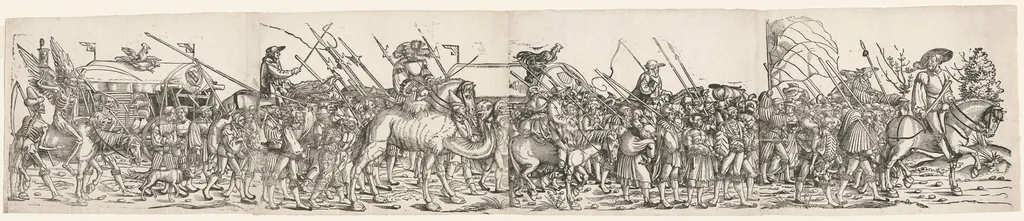
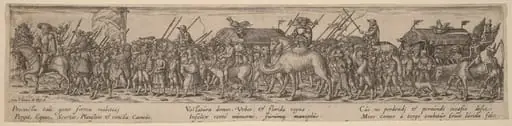
Army Train and Death is an ink print by the Renaissance artist Erhard Schön. It dates from 1532 and is held in the collection of the National Gallery of Art.
About this work
Overview
Created circa 1532, *Army Train and Death* is a multi‑sheet woodcut composed of four separate blocks that together form a single, densely populated tableau. The German artist Erhard Schön, active in Nuremberg in the early sixteenth century, assembled the image using the traditional relief technique, resulting in a large, continuous scene printed on four sheets of paper.
Subject & Meaning
The composition depicts a tumultuous military encampment where soldiers, cavalry, and artillery intermingle amid a stormy sky and a fortified backdrop. Figures scramble, clash, and tumble, while equipment such as cannons and ladders is hauled across the ground. The title introduces an allegorical layer, suggesting that the chaos of war is inseparable from the presence of death.
Technique & Style
Schön employed four carved wooden blocks, each inked and pressed onto a separate sheet, then aligned to produce the expansive view. His handling of line and hatching reflects the influence of Albrecht Dürer, especially in the precise modeling of human anatomy and the intricate rendering of armor and textiles. The dense arrangement of forms creates a sense of movement within the static medium.
History & Provenance
Born around 1491, Schön trained in his father’s workshop before establishing his own practice in Nuremberg. The print was likely produced for a market interested in contemporary military subjects and the moralizing themes common in Reformation-era art. Surviving copies have appeared in several European collections, indicating a broad circulation during the sixteenth century.
Context
The work belongs to a period when German printmakers used woodcut to disseminate complex narratives to a growing literate public. By integrating Dürer’s compositional rigor with his own vigorous storytelling, Schön contributed to the development of narrative printmaking that influenced later artists who explored the interplay of war, mortality, and visual spectacle.
Artist & collection

Artist
Erhard Schön (c. 1491–1542) was a German woodcut designer and painter. Schön was born in Nuremberg as the son of painter Max Schön III. He probably started to learn his trade as an artist in the workshop of his father.…

 The Baggage Train with the Sergeant-Major
 The Adoration of the Magi
 The Triumphal Chariot of Maximilian I (The Great Triumphal Car)
 Combats and Triumphs No. 10
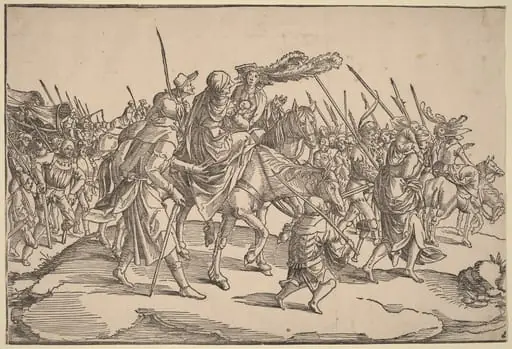 The Stragglers
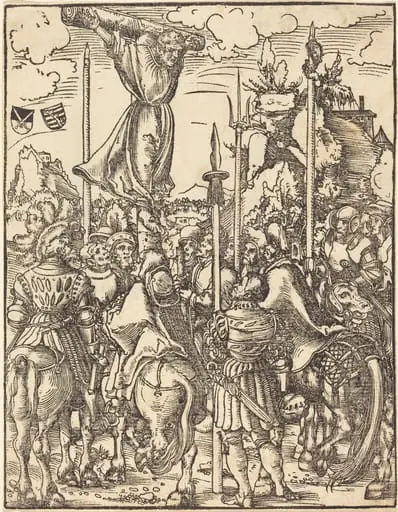 Saint Philip
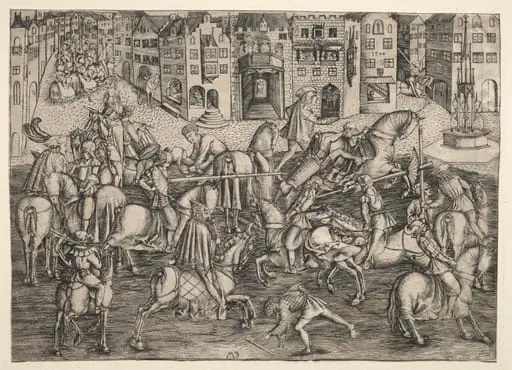 The Great Tournament: Munich
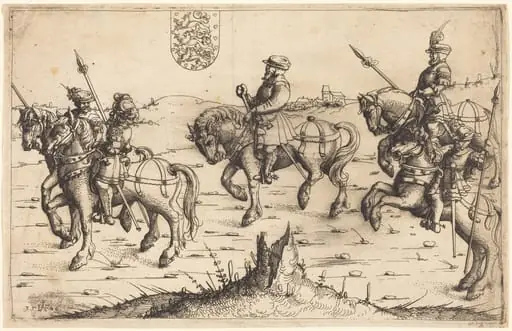 Herberstein's Journey to Denmark
 Landscape with a Milkmaid
 Five Soldiers and a Turk on Horseback
 The Journey to Constantinople
 Army Train and Death