Artwork
清 石濤 (朱若極) 花石圖 軸|Hibiscus, Lotus, and Rock
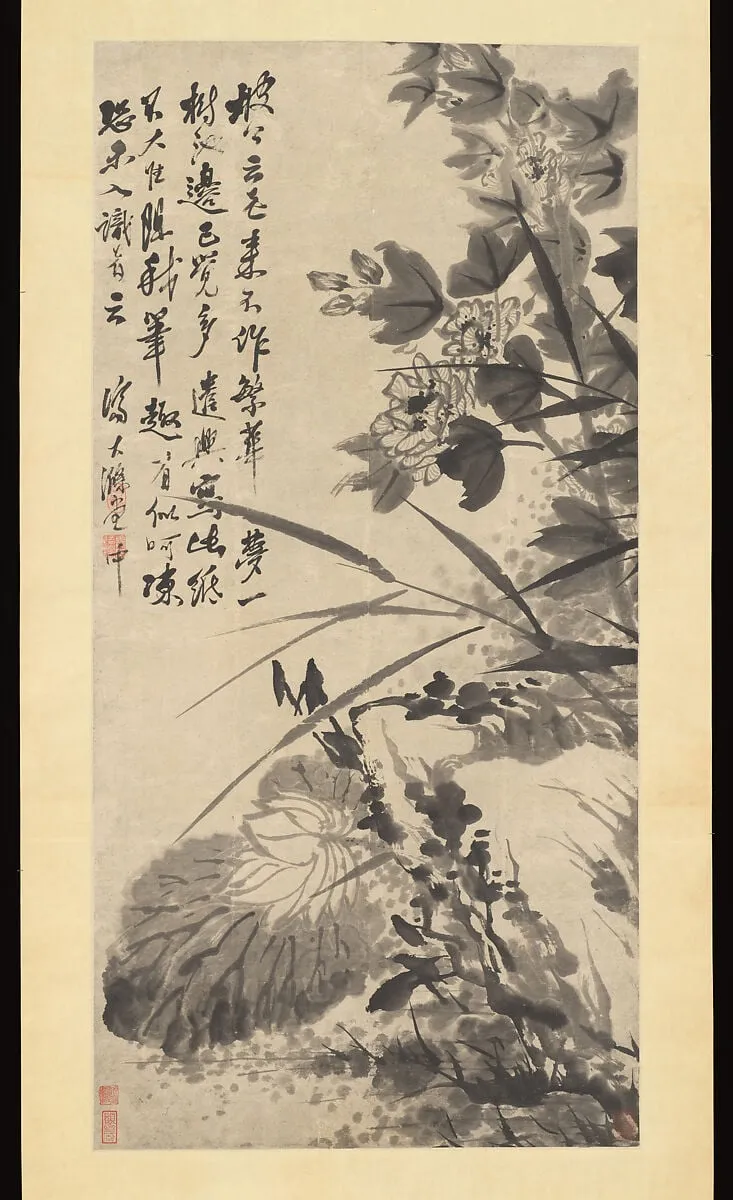
清 石濤 (朱若極) 花石圖 軸|Hibiscus, Lotus, and Rock is an ink painting by the Baroque artist Shitao. It dates from 1706 and is held in the collection of the Metropolitan Museum of Art.
About this work
Overview
The piece stands as a testament to his late-career refinement, merging botanical observation with landscape sensibilities to create a unified, meditative image.
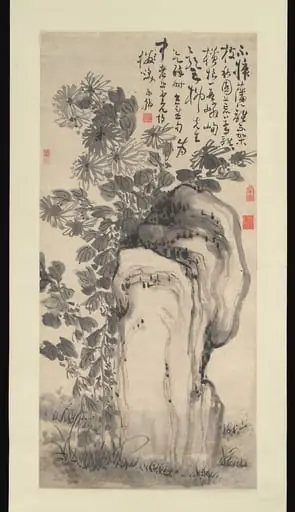
Created in 1706, near the end of his life, 'Hibiscus, Lotus, and Rock' is a hanging scroll executed in ink on paper by the Qing dynasty master Shitao. The composition features a sparse arrangement of a large, textured rock accompanied by a lotus leaf and two hibiscus blooms. Shitao employs a distinctive technique that contrasts wet, fluid ink washes for the delicate flower petals with dry, scratchy brushstrokes to define the rugged surface of the stone. This juxtaposition highlights the artist's mastery of ink tonality and his ability to convey texture through varied brush pressure. The significant use of negative space is integral to the work's aesthetic, functioning not as an empty void but as an active element that balances the physical forms and suggests atmospheric depth. Painted when the artist was in his seventies, this work reflects his mature style, characterized by a departure from strict adherence to traditional models in favor of a more personal, expressive approach. It exemplifies Shitao's theoretical emphasis on the 'one-stroke' method, where a single, continuous spirit guides the brushwork across the entire surface. The piece stands as a testament to his late-career refinement, merging botanical observation with landscape sensibilities to create a unified, meditative image.
Subject & Meaning
The scroll juxtaposes natural elements—a rugged stone, the broad surface of a lotus leaf, and the delicate forms of hibiscus flowers—inviting contemplation of the interplay between solidity and transience. The minimal arrangement suggests a meditation on the essence of nature rather than a literal landscape.
Technique & Style
Shitao employs a restrained palette, using only a few wet brushstrokes to suggest the softness of petals and dry, scratchy lines to convey the texture of the rock. The surrounding void is deliberately left open, functioning as an integral visual element that balances the composition much like silence in music.
History & Provenance
The piece belongs to Shitao’s late oeuvre, produced after decades of itinerant painting across China. While specific ownership records are scarce, the work is recognized as part of the artist’s corpus that reflects his mature philosophical and aesthetic concerns.
Artist & collection