Artwork
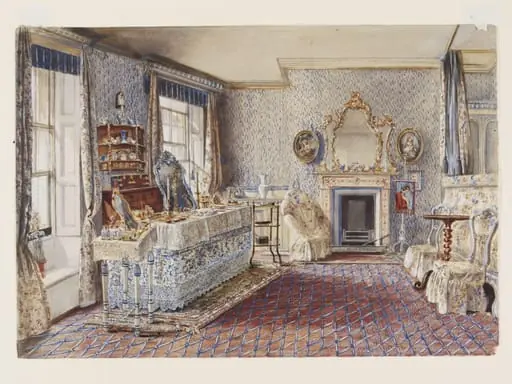
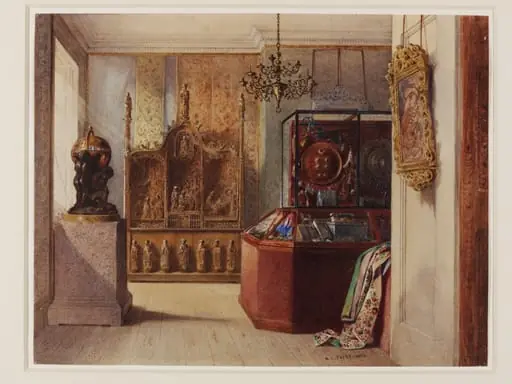
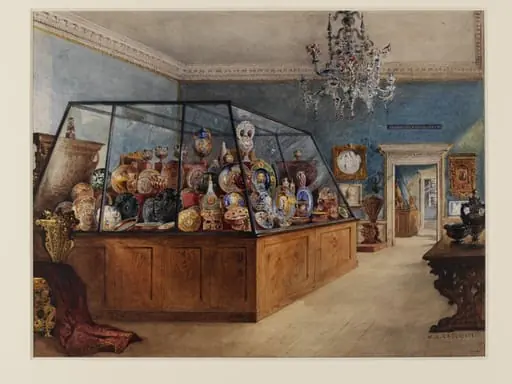
Marlborough House: Fourth Room. 1856
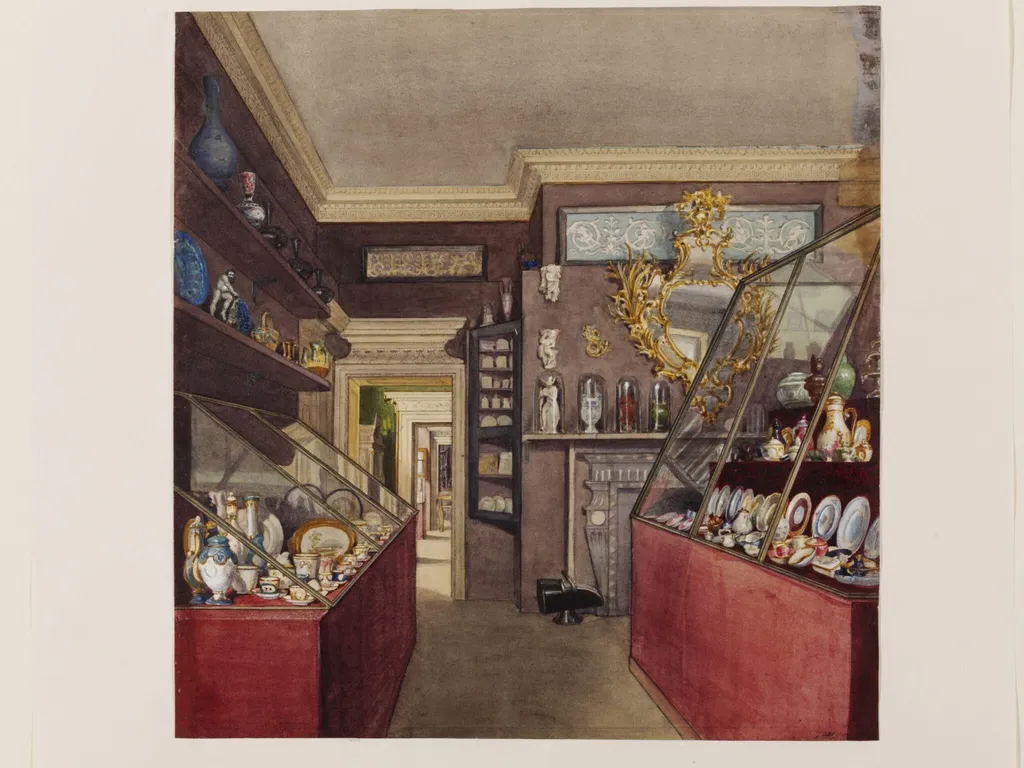
Marlborough House: Fourth Room. 1856 is a watercolor work on paper by the British Romanticist artist John C L Sparkes. It dates from 1856 and is held in the collection of the Victoria and Albert Museum. Painted in 1856 by John C.
About this work
Overview
The scene centers on a series of display cases filled with ceramic objects, glass vessels, and small statuettes.
Painted in 1856 by John C. L. Sparkes, this watercolour captures the interior of the fourth room at Marlborough House in London. The scene centers on a series of display cases filled with ceramic objects, glass vessels, and small statuettes. The composition emphasizes quiet order and meticulous arrangement, with no figures present, suggesting a space dedicated to curated collection rather than daily use.
Subject & Meaning
The room functions as a private cabinet of curiosities, displaying objects likely gathered from global trade and antiquarian sources. Ceramics, particularly blue-and-white porcelain, dominate the shelves, reflecting 19th-century tastes for East Asian and European decorative arts. The absence of people and the dim lighting imply a contemplative, almost museum-like atmosphere, where objects are valued for their material and historical presence.
Technique & Style
Sparkes employed fine watercolour washes to render textures with precision: the glaze on porcelain, the grain of wood in the cases, and the reflective surface of the mirror. Delicate brushwork captures subtle light effects, particularly where illumination strikes glass and ceramic surfaces. The restrained palette and sharp focus on detail align with the observational rigor of Realism, avoiding idealization in favor of recorded fact.
History & Provenance
Marlborough House, built in the early 18th century, served as a royal residence and later housed the British royal family’s art collections. This painting likely documents the room’s contents during the mid-19th century, possibly commissioned by or for a member of the household. Its survival suggests it was valued as a record of the collection’s state before later reorganization or dispersal.
Context
In mid-19th century Britain, collecting decorative arts became a marker of cultural refinement. Private interiors like this one mirrored public exhibitions emerging in institutions such as the South Kensington Museum. Sparkes’s work reflects a broader trend: the documentation of domestic spaces as repositories of historical objects, bridging private taste and public scholarship.
Legacy
The painting stands as a quiet testament to the era’s fascination with material culture. It offers insight into how collections were displayed and perceived before modern museum practices. Though not widely exhibited today, it remains a valuable visual archive of 19th-century collecting habits and interior design in elite British households.
Artist & collection
Artist
John Sparkes spent his days wandering London’s grand houses with a watercolour box dangling from his wrist, stopping wherever the light hit just right.