Artwork
Sts. Catherine, Hubert and Quirinus (Last-Judgement-Altar)
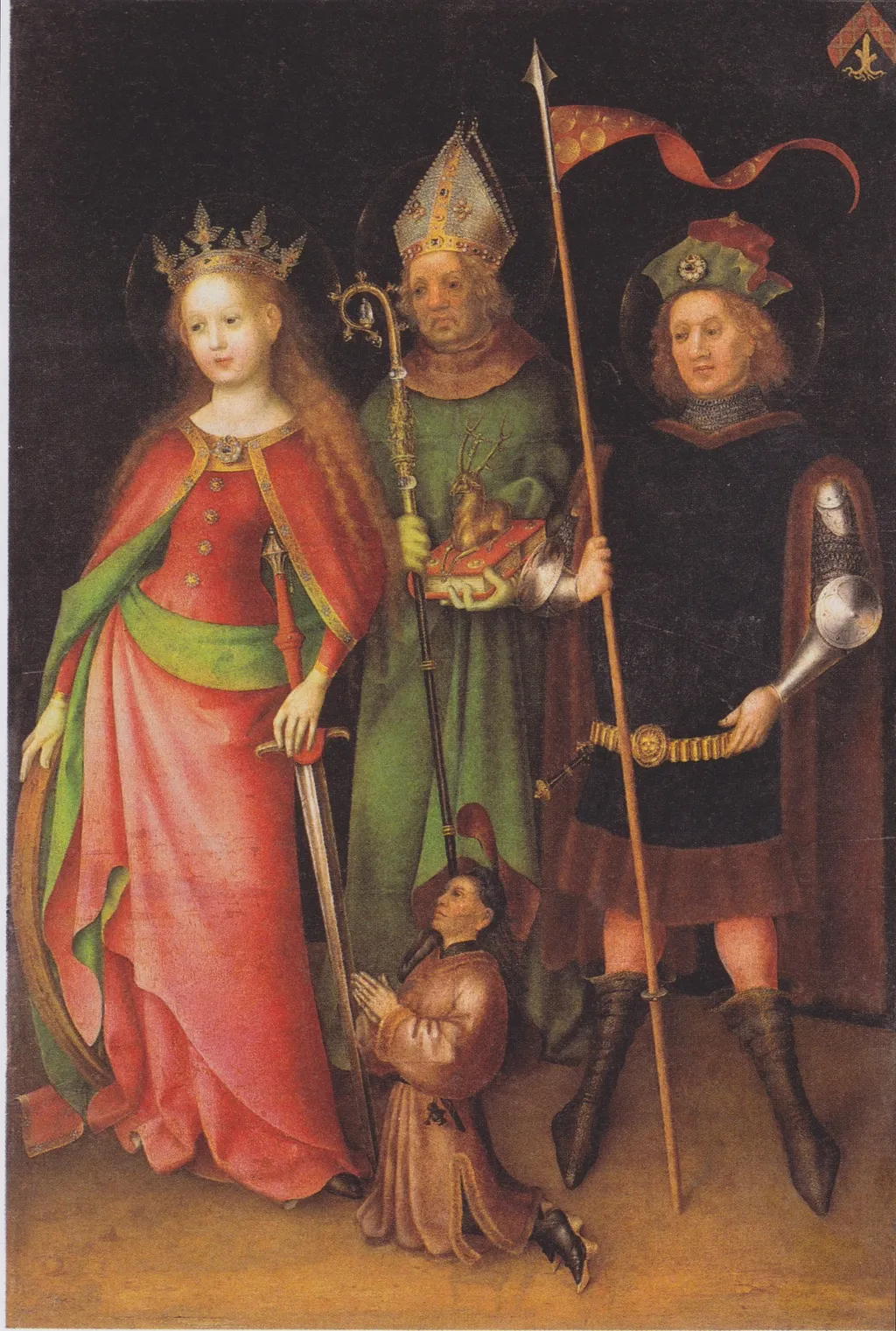
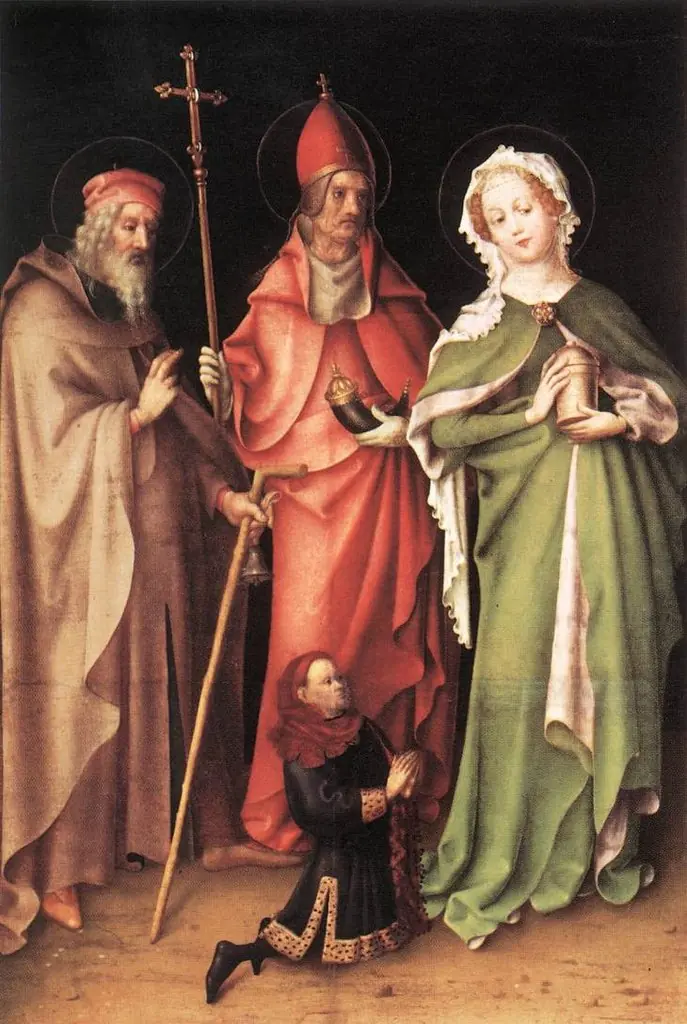
Sts. Catherine, Hubert and Quirinus (Last-Judgement-Altar) is an oil painting by the Northern Renaissance artist Stefan Lochner. It dates from 1445 and is held in the collection of the Bavarian State Painting Collections.
About this work
Overview
Created in 1445 by Cologne‑based painter Stefan Lochner, this wooden panel forms part of a larger polyptych altar. It brings together three saints—Catherine of Alexandria, Hubertus, and Quirinus of Neuss—alongside a kneeling donor, set against a dark, unadorned backdrop. The work is presently conserved in the Alte Pinakothek, Munich.
Subject & Meaning
The central female figure, crowned and armed with a sword, represents Saint Catherine, a learned martyr often linked with royal symbolism.
The central female figure, crowned and armed with a sword, represents Saint Catherine, a learned martyr often linked with royal symbolism. To her left, a bishop‑like figure in green robes holds a croziers topped with a cross, identifying him as Saint Hubert, patron of hunters. On the right, a knight in armor with spear and shield depicts Saint Quirinus of Neuss, a military saint. The donor, shown in humble brown attire, kneels in devotion before the trio.
Technique & Style
Lochner combines the elegant, flowing lines and bright palette of the International Gothic with the meticulous surface detail that anticipates the Northern Renaissance. The figures are rendered with fine brushwork that emphasizes texture—silks, armor, and foliage—while maintaining a clear, linear composition characteristic of his Cologne workshop.
History & Provenance
The panel was originally part of a larger Last Judgment altar, likely commissioned for a Cologne church in the mid‑15th century. After changing hands over the centuries, it entered the collection of the Bavarian State Painting Gallery, now the Alte Pinakothek, where it has been on display since the early 19th century.
Context
Lochner’s work reflects Cologne’s position as a cultural crossroads between the Gothic traditions of the Low Countries and the emerging naturalism of the Northern Renaissance. By integrating vivid coloration with precise iconography, the painting illustrates the transitional aesthetic that defined German art in the decades preceding the Reformation.
Own this work as a print
Artist & collection
Artist
Stefan Lochner (the Dombild Master or Master Stefan; c. 1410 – late 1451) was a German painter working in the late International Gothic period. His paintings combine that era's tendency toward long flowing lines and…