Artwork
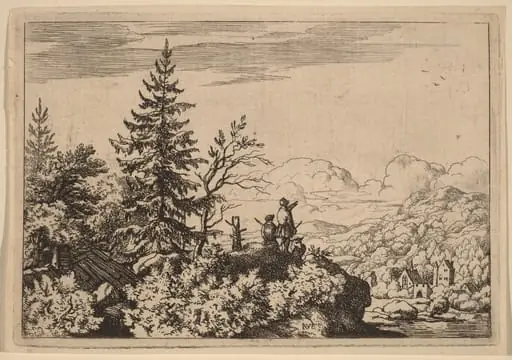
Two Men on a Bare Hill
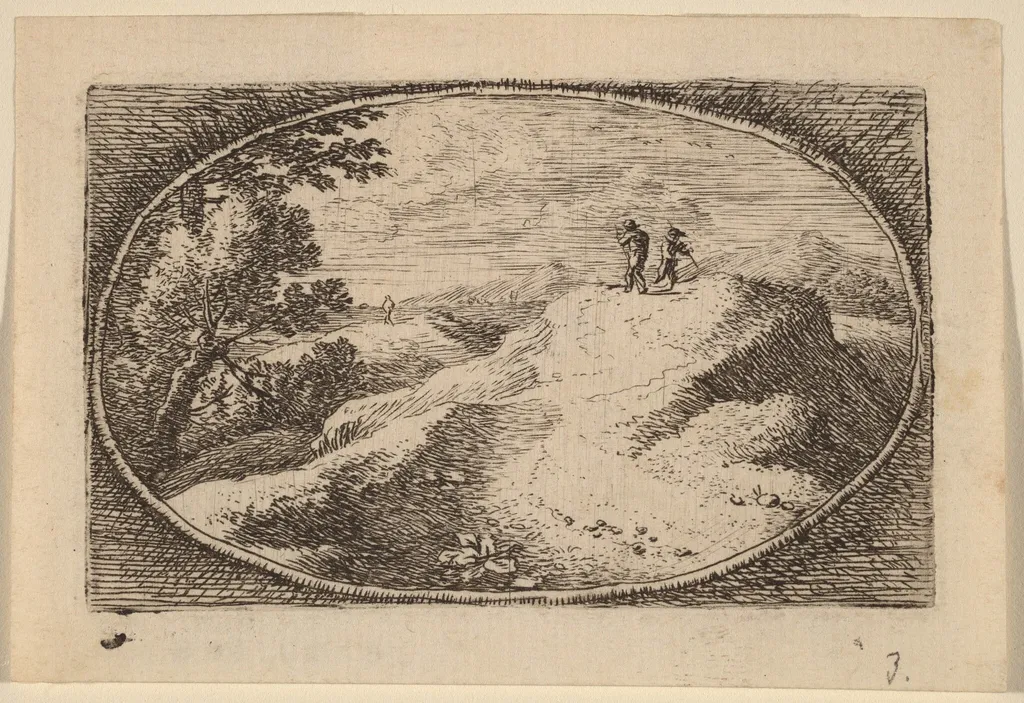
Two Men on a Bare Hill is an ink print by the Baroque artist Herman van Swanevelt. It dates from 1628 and is held in the collection of the National Gallery of Art.
About this work
Overview
Two Men on a Bare Hill is an etching produced in 1628 by the Dutch landscape artist Herman van Swanevelt. Executed on a metal plate and printed in black and white, the work measures a modest size typical of early seventeenth‑century prints. It depicts a quiet scene of two diminutive figures traversing a winding path across a sparsely vegetated hill.
Subject & Meaning
The composition centers on two small travelers moving along a serpentine track that cuts through a rough, scrub‑covered slope. Sparse vegetation, a few isolated trees to the left and scattered stones on the right, emphasize the openness of the landscape and suggest a contemplative journey through an uninhabited terrain.
Technique & Style
Van Swanevelt employed the etching process, incising fine lines into a copper plate with acid to render texture and tonal variation. The delicate hatching conveys the uneven ground, while broader, lighter strokes suggest the expansive sky. The precise linework and subtle gradations are characteristic of the Dutch etching tradition of the period.
History & Provenance
Created in 1628, the print belongs to a productive phase in van Swanevelt’s career when he focused on idealized landscapes. Though specific ownership records are scarce, the work appears in several early modern print collections, indicating it circulated among connoisseurs of Dutch topographical art during the seventeenth century.
Artist & collection