Artwork
The Copley Family
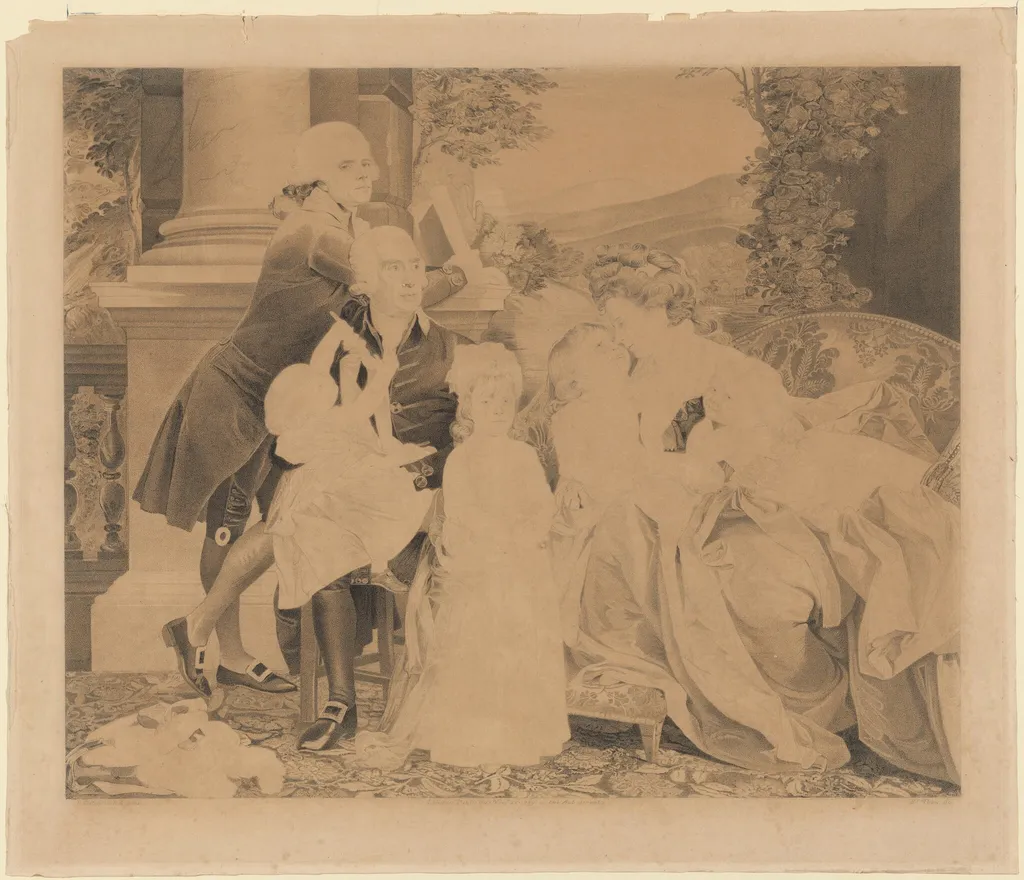
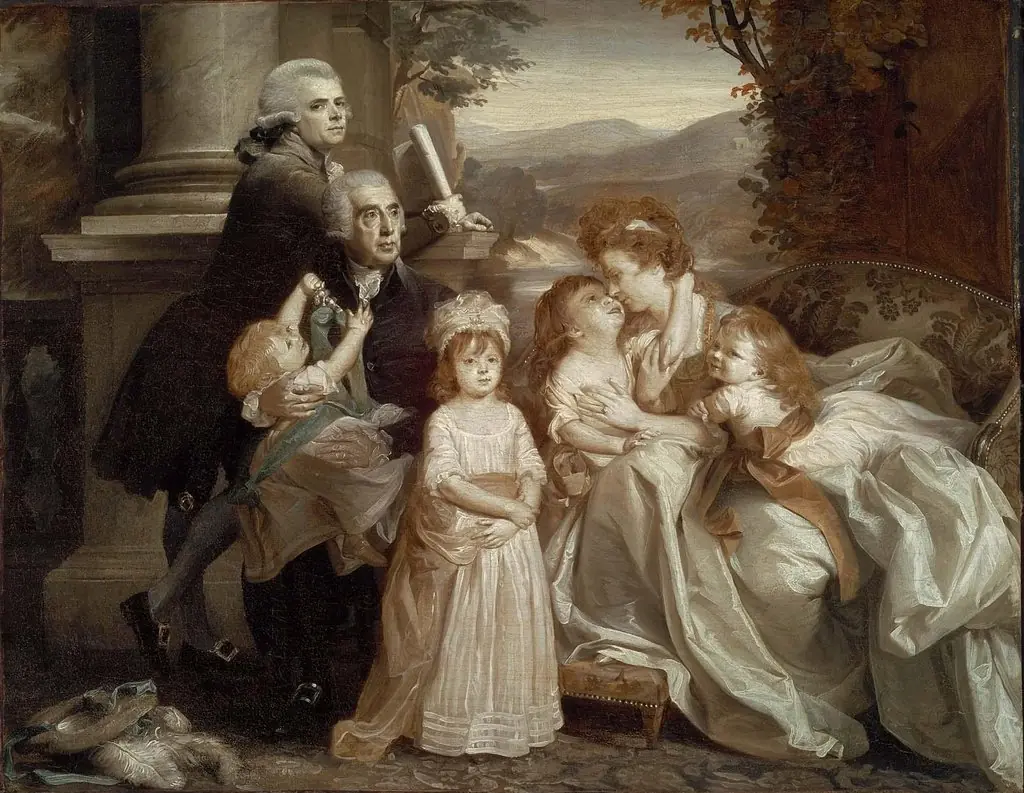
The Copley Family is an ink print by the Romanticist artist Robert Thew. It dates from 1789 and is held in the collection of the National Gallery of Art.
About this work
Everyone wears simple, dark clothes except for the girls’ light dresses.
This engraving shows John Singleton Copley’s family in a cozy room. A father sits with his wife and two young daughters. A dog rests beside them. Everyone wears simple, dark clothes except for the girls’ light dresses.
The image copies Copley’s 1776 painting almost exactly. Engraving means tiny dots were cut into metal to print the picture. Cross-hatching—thin crisscross lines—gives depth and shading.
See how the dog’s fur looks soft? That’s why people trusted Copley’s work. Want to see more? Look up Thew, Robert.
Overview
Robert Thew created this stipple engraving around 1789 as a reproductive print of John Singleton Copley’s 1776 family portrait. The work translates the original oil painting into a printed format using fine dots and cross-hatching to mimic tonal variation. It was produced for wider distribution, allowing audiences beyond elite collectors to access Copley’s composition. The engraving preserves the intimate domestic setting and restrained palette of the source.
Subject & Meaning
The scene depicts John Singleton Copley with his wife, Lydia, and their two young daughters in a modest interior. The family is arranged in a quiet, unified group, with a dog resting at their feet. Their clothing is plain and dark, save for the girls’ pale dresses, which draw subtle attention to youth and innocence. The composition conveys domestic harmony without overt symbolism, reflecting 18th-century ideals of familial affection and quiet virtue.
Technique & Style
Thew employed stipple engraving, a method using tiny punched dots to build gradations of tone, supplemented by fine cross-hatching for texture and depth. The soft rendering of the dog’s fur and the delicate modeling of skin and fabric demonstrate the technique’s capacity for subtlety. Unlike bold line engravings, this approach achieves a gentler, more atmospheric effect, aligning with the tender mood of the original painting.
History & Provenance
The engraving was made shortly after Copley’s departure from America to England, during a period when his portraits were in high demand among British audiences. Thew, a London-based engraver, specialized in reproducing popular paintings for the print market. This version was likely issued to capitalize on Copley’s growing reputation and to satisfy public interest in his personal life, though no record of its original edition size survives.
Context
In the late 18th century, reproductive engravings served as the primary means of disseminating images of famous artworks to a broader public. Copley’s family portrait, originally commissioned as a private keepsake, became a cultural artifact through such prints. Thew’s version reflects the era’s growing middle-class appetite for domestic imagery and the commercialization of fine art through print.
Legacy
Thew’s engraving preserved Copley’s composition for future generations, ensuring its visibility beyond the original painting’s limited circulation. While the oil painting remains in a private collection, the engraving appears in several institutional archives, offering insight into how 18th-century audiences encountered and valued portraiture. It stands as a testament to the role of print in shaping artistic reputation.
Artist & collection

 The Wright Family (The Bradshaw Children)
 L'accord du mariage
 La Reine annonçant à Mme Bellegarde, des Juges, et la liberté de son mari en mai 1777
 The Empty Quiver
 Le duc de Chartres, son epouse et ses enfants
 La lecon interrompue
 Le dejeuner anglais
 Fetes venitiennes
 Le seducteur
 Le concert agreable
 Le jour
 The Copley Family