Artwork
Fishing Boats at Sea
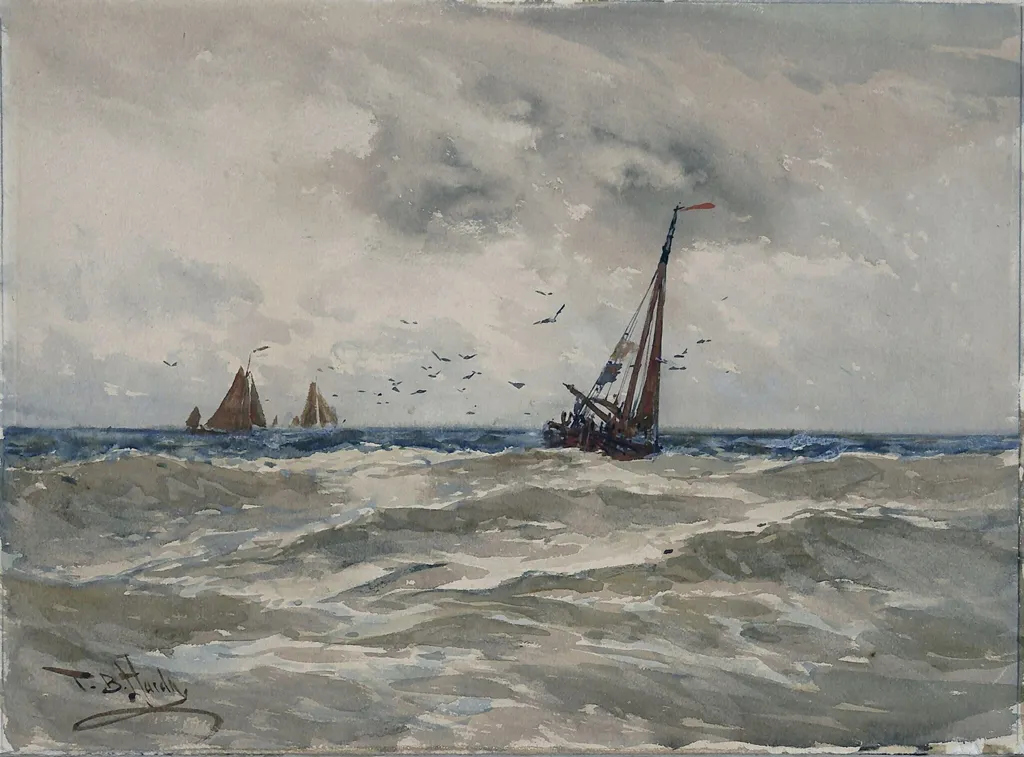
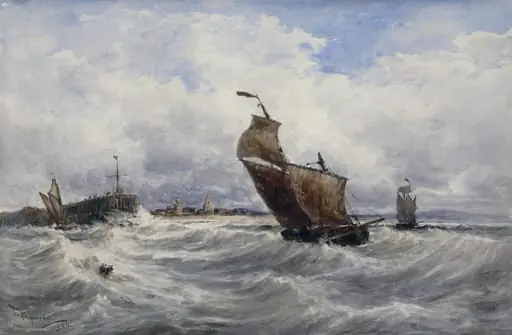
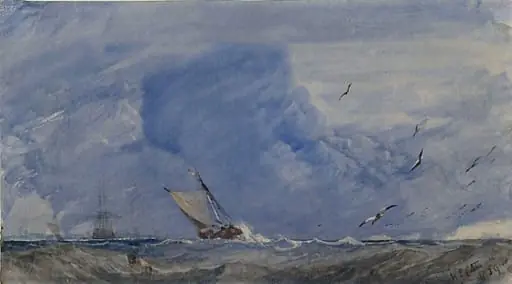
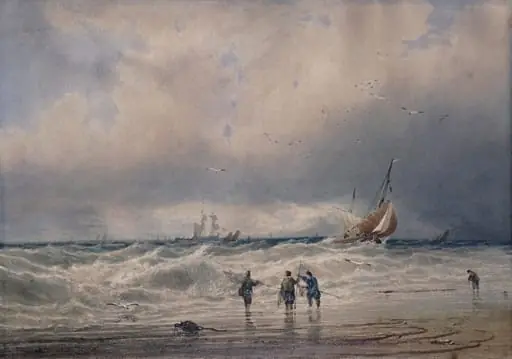
Fishing Boats at Sea is a watercolor work on paper by the British Romanticist artist Thomas Bush Hardy. It dates from 1865 and is held in the collection of the Victoria and Albert Museum.
About this work
Overview
Executed in loose, fluid brushwork, the piece reflects Hardy’s interest in transient atmospheric conditions.
Painted in 1865, this watercolour by Thomas Bush Hardy captures a quiet moment at sea with three fishing vessels navigating rough waters near a rugged coastline. Executed in loose, fluid brushwork, the piece reflects Hardy’s interest in transient atmospheric conditions. His signature is discreetly placed, consistent with his practice of understated authorship. The work belongs to a body of maritime studies emphasizing naturalism over idealization.
Subject & Meaning
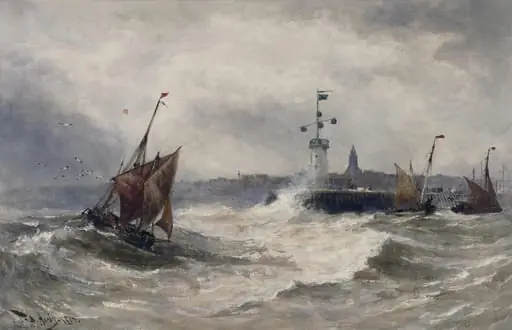
The scene portrays working fishing boats under a pale, overcast sky, their presence suggesting daily labor rather than romanticized seafaring. A single red flag on one mast adds a subtle marker of identity or warning. Birds in flight above the vessels reinforce the sense of open, untamed nature. The composition avoids narrative drama, instead honoring the quiet persistence of coastal life against the sea’s unpredictability.
Technique & Style
Hardy employed rapid, layered watercolour strokes to convey the movement of waves and the diffused quality of light. White pigment suggests foam crashing against rocks, while soft washes blend sky and sea without sharp boundaries. The technique avoids polish, embracing the medium’s inherent transparency to mimic natural luminosity. Brushwork is deliberate yet unrefined, prioritizing observed effect over polished finish.
History & Provenance
Created during Hardy’s active period documenting coastal Britain, this work likely originated from direct observation during sketching trips. Its survival suggests it was retained by the artist or a close associate, as few of his watercolours entered major collections until later. No documented exhibition history exists for this specific piece, but it aligns with his known practice of private, on-site studies.
Context
In mid-19th century Britain, watercolour was increasingly used for topographical and marine studies outside academic traditions. Hardy’s focus on weather and sea conditions reflected a broader interest in realism among artists who rejected studio conventions. His work resonated with contemporary scientific observation and the growing public fascination with coastal environments and maritime livelihoods.
Legacy
Hardy’s watercolours, including this one, contributed to a quiet but enduring tradition of British marine painting that valued direct observation. Though not widely exhibited in his lifetime, his studies influenced later artists interested in atmospheric effects and the unembellished depiction of the sea. His approach remains a reference point for those exploring the expressive potential of watercolour in naturalist contexts.
Own this work as a print
Artist & collection