Artwork
Print Collection
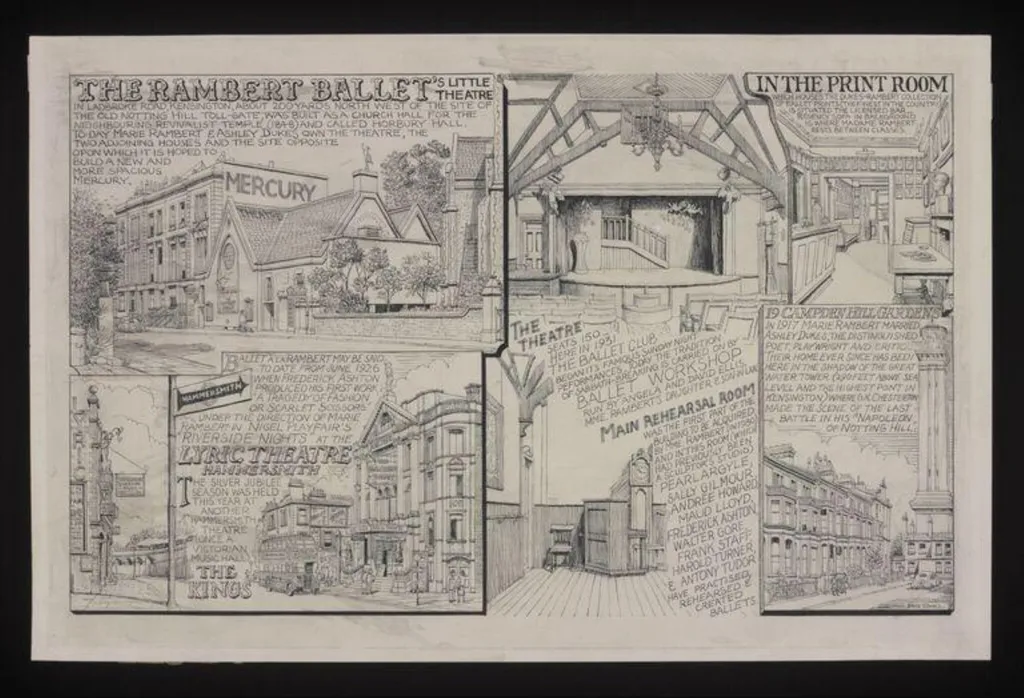
Print Collection is a print by David Thomas. It dates from 1964 and is held in the collection of the Victoria and Albert Museum.
About this work
Overview
Rendered in a comic strip format, the work presents each site as a discrete panel, blending documentary intent with graphic storytelling.
A sequential print composed of six small, interconnected scenes, created in the 1960s by David Thomas, documents locations significant to the Rambert Dance Company. Rendered in a comic strip format, the work presents each site as a discrete panel, blending documentary intent with graphic storytelling. The composition avoids narrative progression, instead offering a spatial inventory of the company’s operational landmarks.
Subject & Meaning
The print identifies six real-world locations tied to the Rambert Dance Company’s history, including the Mercury Theatre, the Lyric Hammersmith, and 19 Camden Hill Gardens. These sites served as rehearsal spaces, performance venues, or administrative bases. The selection reflects the company’s itinerant nature during its formative decades, grounding its artistic identity in physical places rather than abstract ideals.
Technique & Style
Thomas employed a clean-lined, graphic style reminiscent of mid-century comic strips, with bold outlines and minimal shading. Each panel is framed uniformly, creating visual rhythm across the composition. The absence of color and the focus on architectural outlines emphasize structure over atmosphere, aligning the work with documentary illustration rather than expressive art.
History & Provenance
Created in the 1960s, the print likely originated as a commissioned or internally circulated piece for the Rambert Dance Company. Its production coincided with the company’s transition from touring to establishing more permanent bases in London. No record of public exhibition exists, suggesting it was intended for private or institutional use rather than commercial distribution.
Context
During the 1960s, British dance companies were expanding beyond traditional theaters, seeking adaptable spaces in repurposed buildings. Thomas’s print captures this shift, documenting venues that were neither grand opera houses nor established ballet stages. The work reflects a broader cultural movement toward decentralizing performance and embracing urban, non-traditional spaces for dance.
Legacy
The print remains a rare visual record of the Rambert Dance Company’s early spatial history. While not widely reproduced, it is cited in archival studies of British dance infrastructure. Its value lies in its unembellished documentation of places that supported experimental choreography, offering insight into the practical conditions behind artistic innovation.
Artist & collection
Artist
David Thomas made prints around the 1960s. His Print Collection offers a cross-section of mid-century graphic styles, from crisp line-work to bold textures. The works sit somewhere between everyday design and the quiet…