Artwork
The Biglin Brothers Turning the Stake
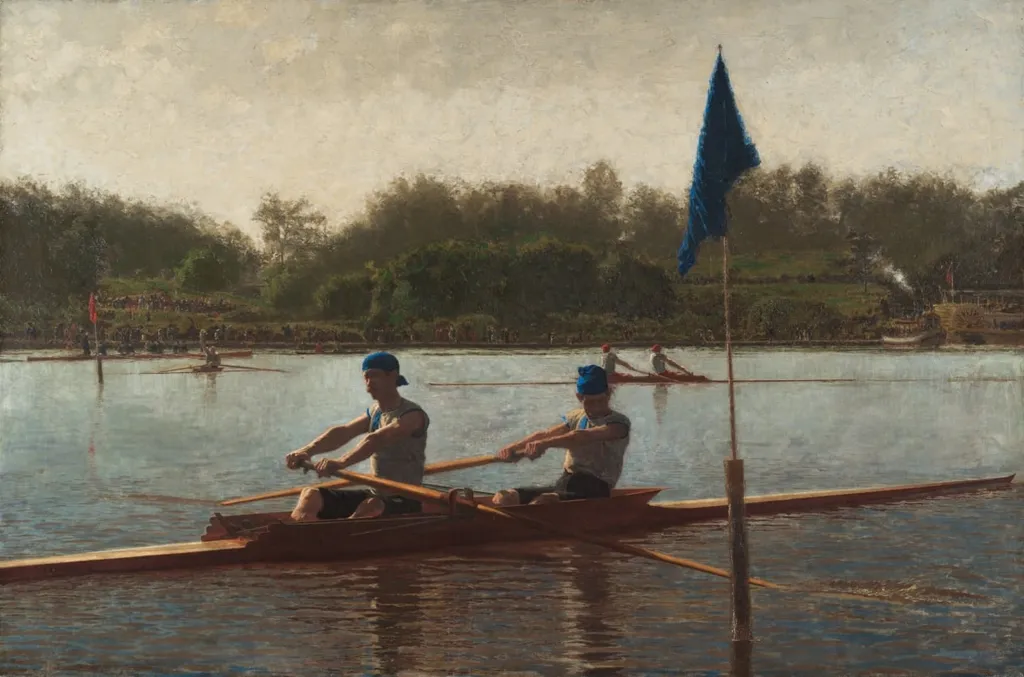
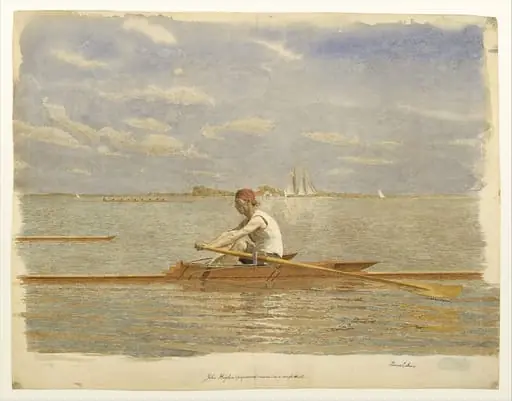
The Biglin Brothers Turning the Stake is an unspecified painting by the Impressionist artist Thomas Eakins. It dates from 1873 and is held in the collection of the Cleveland Museum of Art.
About this work
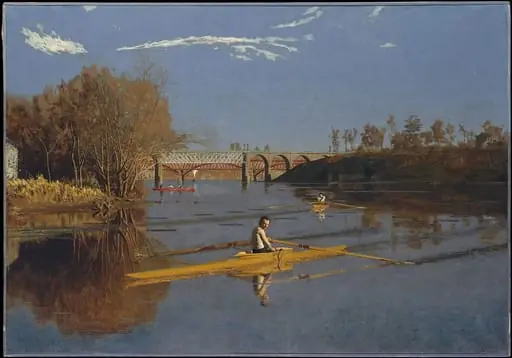
Two men in a narrow rowboat lean hard left near a wooden stake. The river is choppy, their muscles strain. Behind them, other boats drift, spectators jam the shore.
Eakins painted this from life. He watched the 1872 race on the Schuylkill River himself. Details like the brothers’ sweat feel real.
The riverbank crowds show his skill at painting motion. Look up Thomas Eakins (American, 1844–1916).
Overview
The work reflects his commitment to direct observation and his focus on athletic motion as a subject worthy of serious artistic attention.
Thomas Eakins painted The Biglin Brothers Turning the Stake in 1872, capturing a moment from a real rowing race on the Schuylkill River. He observed the event firsthand, translating the physical intensity and spatial dynamics of the race into a carefully composed scene. The work reflects his commitment to direct observation and his focus on athletic motion as a subject worthy of serious artistic attention.
Subject & Meaning
The painting depicts Barney and John Biglin, two of the era’s most prominent rowers, navigating a sharp turn around a wooden stake midway through a race. Their strained postures and the choppy water convey the physical demands of the sport. The distant competitors and crowded riverbank emphasize the stakes of the contest, not as spectacle but as a test of endurance and precision, reflecting Eakins’s interest in human effort under pressure.
Technique & Style
Eakins rendered the scene with precise anatomical accuracy and a rigorous grasp of perspective, informed by his studies in both the U.S. and France. He used direct observation to capture the brothers’ musculature, the ripple of water, and the varied postures of spectators. His brushwork avoids romanticism, favoring clear forms and natural lighting to convey the unvarnished reality of the moment.
History & Provenance
The painting was completed shortly after Eakins witnessed the May 1872 race on the Schuylkill River, where the Biglin brothers emerged victorious. It was among his earliest major works to focus on contemporary American sport. The painting remained in Philadelphia, closely tied to the artist’s personal and professional life, and was later acquired by the Philadelphia Museum of Art, where it continues to reflect his local roots.
Context
In the 1870s, rowing was a popular public sport in Philadelphia, drawing large crowds and media attention. Eakins, deeply embedded in the city’s cultural life, chose to depict this secular, physical endeavor with the same seriousness traditionally reserved for historical or religious subjects. His focus on real people in real motion aligned with broader 19th-century shifts toward realism in American art.
Legacy
The Biglin Brothers Turning the Stake established Eakins as a painter of modern American life grounded in empirical observation. Its influence extended beyond subject matter, shaping how motion, anatomy, and spatial depth were approached in American realism. The work remains a touchstone for its unembellished portrayal of athletic discipline and its rejection of theatricality in favor of quiet, observed truth.
Artist & collection
Artist
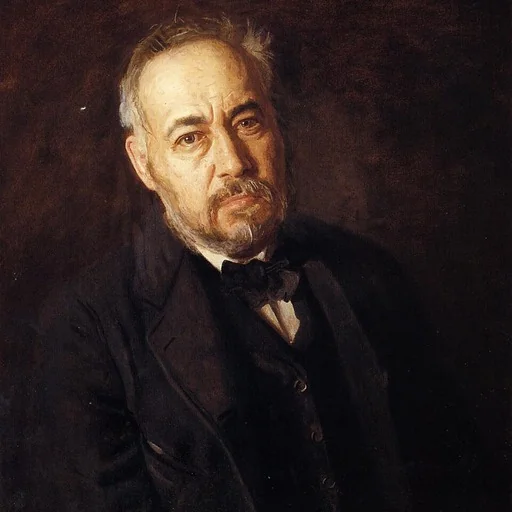
Thomas Cowperthwait Eakins (; July 25, 1844 – June 25, 1916) was an American realist painter, photographer, sculptor, and fine arts educator.