Artwork
Wrestlers
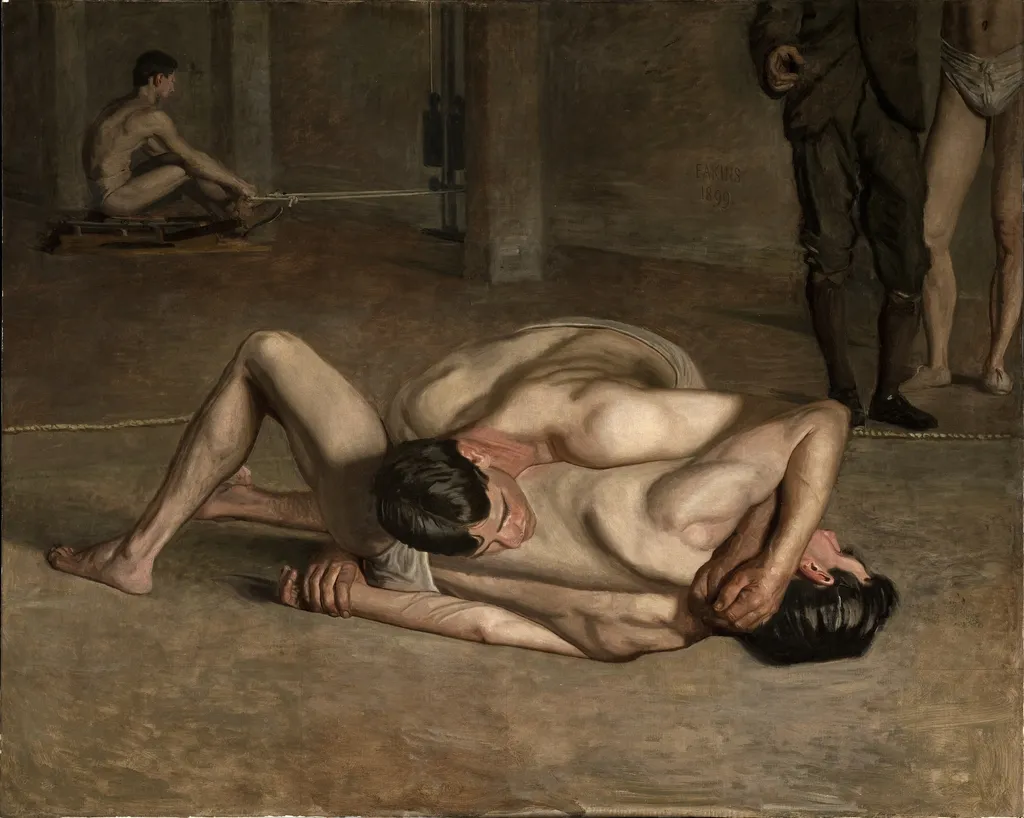
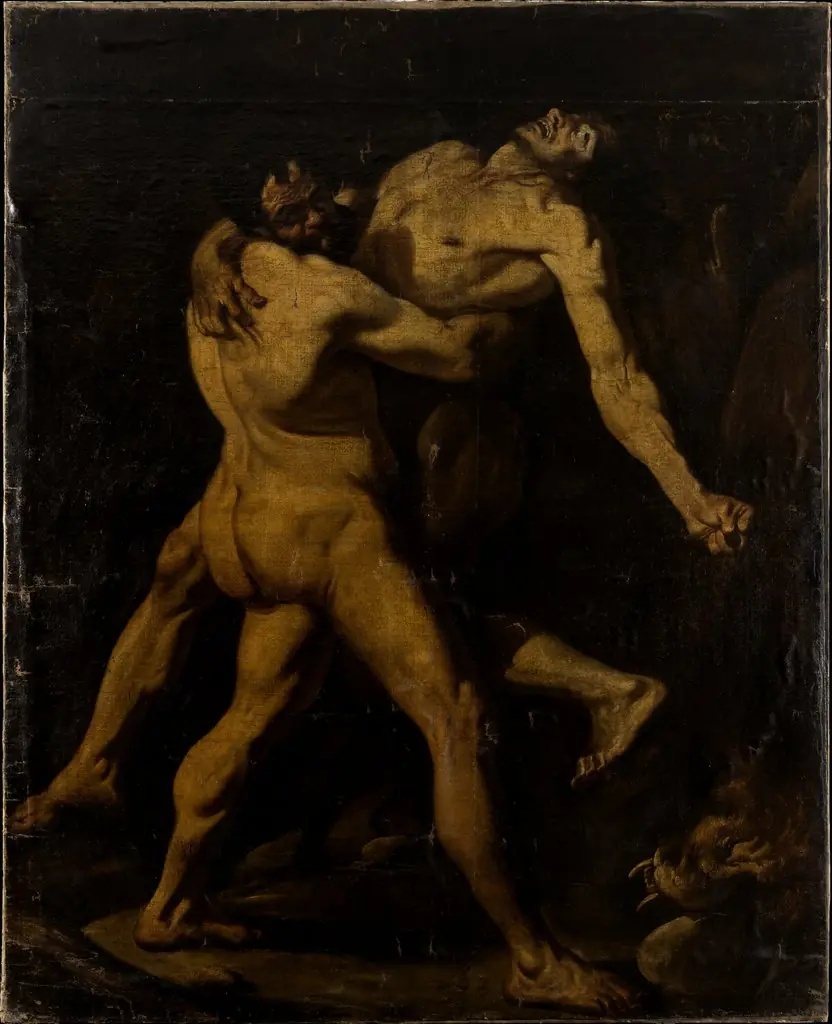
Wrestlers is an oil painting by Thomas Eakins. It dates from 1900 and is held in the collection of the Los Angeles County Museum of Art.
About this work
Wrestlers is a painting by Thomas Eakins. It's an oil paint work from 1899.
The painting is one of three closely related works by the artist. The works depict a wrestling match, but the subjects detected in the image are a clothed male and a naked female, which contrasts with the source description.
To learn more about the artist's style and techniques, look up the artist: Thomas Eakins.
Overview
Each work captures a moment of athletic struggle, rendered with Eakins’ characteristic attention to anatomical precision and spatial realism.
Thomas Eakins created three closely related oil paintings in 1899, all depicting two male wrestlers in intimate physical contact. The finished version resides at the Los Angeles County Museum of Art, accompanied by a preparatory sketch. A smaller, unfinished variant is held by the Philadelphia Museum of Art. Each work captures a moment of athletic struggle, rendered with Eakins’ characteristic attention to anatomical precision and spatial realism.
Subject & Meaning
The paintings portray two nude or nearly nude men locked in a wrestling match, their bodies strained with effort and tension. The scene is not idealized but grounded in observed reality, reflecting Eakins’ interest in human movement and physicality. The setting—a defunct boathouse on Philadelphia’s Schuylkill River—anchors the image in a specific, local context, suggesting a study of working-class recreation rather than mythological or classical themes.
Technique & Style
Eakins employed oil paint with meticulous brushwork to render musculature, shadow, and texture with scientific accuracy. His use of light emphasizes the torsion of the bodies, enhancing the sense of weight and resistance. The compositions are tightly framed, eliminating extraneous detail to focus on the interplay of forms. This approach aligns with his broader commitment to direct observation and anatomical study, influenced by his training in both art and science.
History & Provenance
The three versions of Wrestlers were produced in sequence: an unfinished canvas at the Philadelphia Museum of Art, a smaller oil sketch at LACMA, and the final, larger version also at LACMA. The works remained in Eakins’ possession until his death, after which they entered institutional collections through bequests or purchases. Their survival in multiple states offers rare insight into Eakins’ working process and his iterative approach to composition.
Context
Created during a period when Eakins was increasingly marginalized from mainstream art institutions, Wrestlers reflects his continued dedication to unvarnished realism. The Quaker City Barge Club, where the scene is set, was a site of amateur athletic activity, not elite sport. This choice underscores Eakins’ interest in ordinary American life, contrasting with the romanticized or exotic subjects favored by contemporaries.
Legacy
Wrestlers stands as a testament to Eakins’ uncompromising vision of the human form in motion. Though not widely exhibited during his lifetime, the series has since become a touchstone for studies of American realism and the depiction of the body in art. Its unflinching focus on physical exertion and intimate contact influenced later artists seeking authenticity over idealization.
Own this work as a print
Artist & collection
Artist
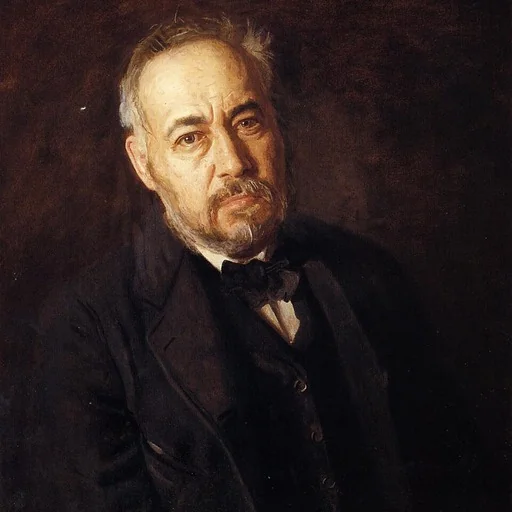
Thomas Cowperthwait Eakins (; July 25, 1844 – June 25, 1916) was an American realist painter, photographer, sculptor, and fine arts educator.