Artwork
Kauterskill Clove (from Sketchbook of Landscape and Animal Subjects)
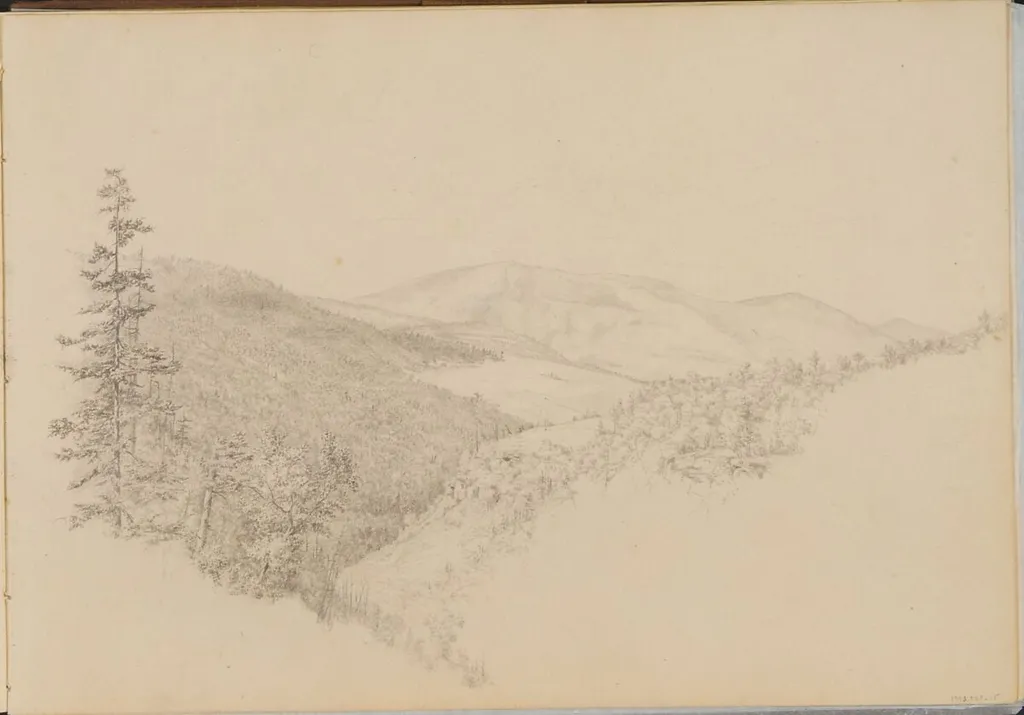
Kauterskill Clove (from Sketchbook of Landscape and Animal Subjects) is a gouache drawing by the Impressionist artist Thomas Hewes Hinckley. It dates from 1862 and is held in the collection of the Metropolitan Museum of Art.
About this work
Overview
Kauterskill Clove, drawn from Thomas Hewes Hinckley’s Sketchbook of Landscape and Animal Subjects, is a modestly sized work on off‑white wove paper. Executed around 1862, the piece combines graphite, ink washes, and gouache, presenting a tranquil mountain valley with a solitary farmhouse, sparse trees, and a distant peak.
Subject & Meaning
The composition captures a quiet, rural scene: a low‑lying valley framed by a rising mountain, a lone farmhouse perched amid thin trees, and a single prominent tree that anchors the view. The drawing functions as a visual note, preserving the atmosphere and light of the landscape rather than delivering a fully finished narrative.
Technique & Style
Hinckley employed a blend of graphite line work, diluted ink washes, and opaque gouache to render atmospheric depth. The pencil outlines suggest rapid observation, while the watery ink adds tonal shading. Gouache, an opaque watercolor, allows the artist to layer lighter tones over darker areas, giving the sky and distant hills a softened, luminous quality.
History & Provenance
Created circa 1862, the work originates from Hinckley’s habit of carrying a sketchbook to record immediate impressions of the natural world. The piece remained within the artist’s personal collection before entering the American Wing, where it is displayed as part of the museum’s holdings of 19th‑century American landscape studies.
Artist & collection